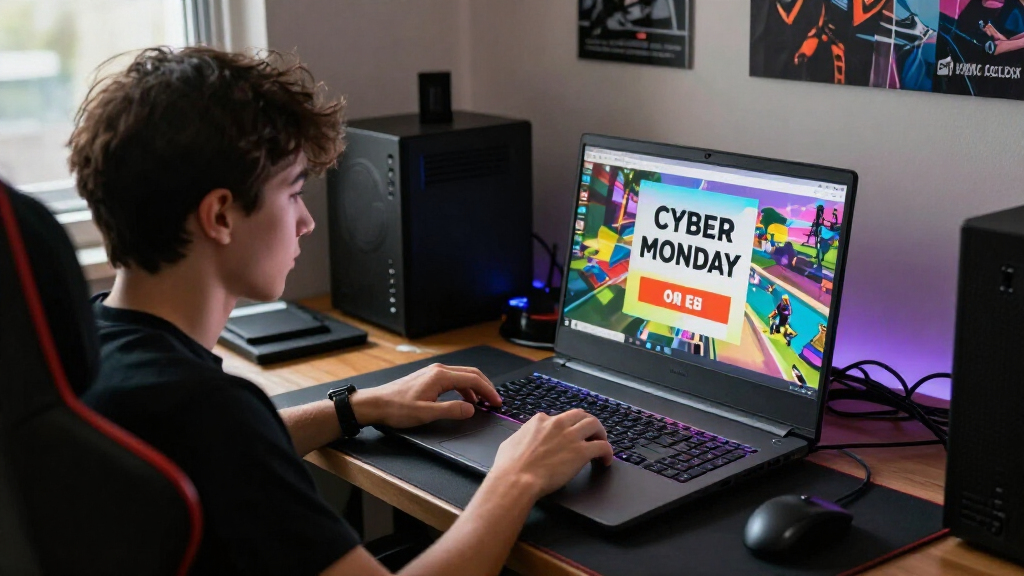

Cyber Monday laptop listings can make two very different purchases look equally compelling: a mainstream gaming laptop with a sharp discount and a premium model with stronger components and a higher starting price. The real decision is whether the premium features will change how you play, or whether a lower-cost machine already meets your needs. A mainstream deal is usually the sensible choice for 1080p gaming, a tighter budget, and everyday use; a premium deal suits players who want higher frame rates, a better screen, or more room for demanding games. Compare the specifications and final price of the exact configurations, because names and discounts alone do not establish which is the better buy.

Get movie nights delivered free with Prime
- Fast, free delivery on millions of items
- Prime Video, Amazon Music and more included
- Member-only deals all year

ASUS ROG Strix G16 (2025) Gaming Laptop
- ✔ Processor: Intel Core i7-14650HX
- ✔ Graphics: NVIDIA GeForce RTX 5060 Laptop GPU, 8GB
- ✔ Display: 16-inch FHD+ (1920 × 1200), 165Hz

Lenovo LOQ 15.6-Inch Gaming Laptop
- ✔ Processor: AMD Ryzen 7 170, 8 cores, 3.2GHz base, up to 4.75GHz
- ✔ Graphics: NVIDIA GeForce RTX 4050
- ✔ Display: 15.6-inch Full HD (1920 × 1080), anti-glare, 144Hz
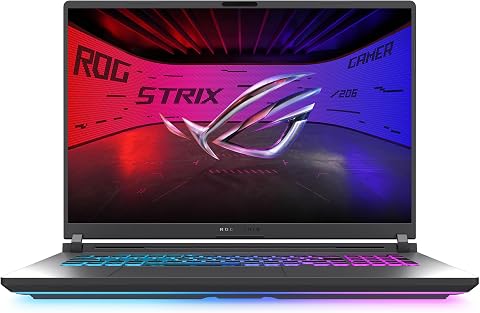
ASUS ROG Strix G18 (2025) 18-Inch Gaming Laptop
- ✔ Processor: Intel Core i9-14900HX
- ✔ Graphics: RTX 5070 in title and description; RTX 5060 in product information
- ✔ Graphics memory: 8GB
At a Glance
| Criteria | Mainstream gaming laptop deal | Premium gaming laptop deal | Winner |
|---|---|---|---|
| Purchase price | Usually lower; value depends on the final price and specific configuration. | Higher; a discount is worthwhile only if its added hardware or features matter to you. | A |
| Gaming performance | Often well suited to 1080p play; check the GPU, its power limit, and independent reviews. | Often offers a faster GPU or higher power limits, but verify the exact configuration. | B |
| Display | Often a 1080p or modest-refresh screen; resolution, brightness, and color vary by model. | More likely to offer higher resolution, brightness, refresh rate, or color quality. | B |
| Cooling and sustained play | Can run games well, though chassis size and cooling affect performance over long sessions. | May have a larger or more capable cooling system; performance still varies by design. | B |
| Portability | May be bulky for its price class; weight and charger size vary. | May be slimmer or more refined, but powerful models can remain heavy and need large chargers. | Depends |
| Build and extras | Usually prioritizes core components over premium materials or extra features. | More likely to include a sturdier chassis, better speakers, or a richer port selection. | B |
| Long-term headroom | Enough for current games at sensible settings, with less room for future demands. | More graphics headroom can help with demanding games and higher settings. | B |
ASUS ROG Strix G16 (2025) Gaming Laptop
The ROG Strix G16 is our first choice for shoppers who want a gaming-focused configuration with fewer major specification questions. Its listing names an RTX 5060, an Intel Core i7-14650HX, and a 16-inch 1920 × 1200 panel running at 165Hz. That combination makes it the most compelling middle ground here: a smaller footprint than the G18, a more clearly specified GPU than the G18 listing, and a higher stated refresh rate than the Lenovo LOQ.The 165Hz display is most relevant to games that can produce high frame rates; it can show motion more smoothly than the Lenovo’s 144Hz panel when the system can feed it enough frames. The G16’s 16GB of DDR5 is the main compromise beside the two 32GB configurations. Buyers can reach the RAM and SSD without tools, which gives this model a practical upgrade path, but that still means additional work if a game library or multitasking habits outgrow the installed memory. Its vapor chamber, three fans, and liquid metal cooling are designed to manage heat during demanding play, while the 1TB SSD provides a useful starting capacity.Compared with the Lenovo, we get a more capable stated graphics tier and a faster screen, but lose the LOQ’s numeric keypad and Ethernet port. Compared with the G18, we give up screen area and half the listed memory, yet avoid the G18’s conflicting GPU and resolution claims. The G16’s listed two-hour battery life also makes it a poor choice for long sessions away from an outlet; its strengths are best realized at a desk.
Pros:
- Listed RTX 5060 graphics and Intel Core i7-14650HX processor
- 16-inch 1920 × 1200 display with a 165Hz refresh rate
- Vapor chamber, three-fan cooling, and liquid metal on the chipset
- Tool-free access to RAM and SSD; 1TB PCIe Gen 4 storage
Cons:
- Ships with 16GB DDR5, less than the 32GB listed for the G18 and Lenovo
- Listed battery life is two hours, limiting away-from-outlet use
- FHD+ resolution is less detailed than higher-resolution panels
Best for: Players who want a clearly specified RTX 5060 configuration, a high-refresh 16-inch screen, and straightforward RAM or SSD upgrades.
Not ideal for: Buyers who need long unplugged sessions, 32GB of memory out of the box, a large 18-inch display, or a numeric keypad.
Bottom line: For a Cyber Monday shortlist, the G16 is our strongest all-round gaming pick when we value a named RTX 5060, a 165Hz screen, and upgrade access over maximum memory or screen size.
“For a Cyber Monday shortlist, the G16 is our strongest all-round gaming pick when we value a named RTX 5060, a 165Hz screen, and upgrade access over maximum memory or screen size.”
Lenovo LOQ 15.6-Inch Gaming Laptop
The Lenovo LOQ 15 takes a different route from the ROG models: rather than leading with a higher-tier listed GPU or an oversized screen, it arrives with 32GB of DDR5, a 1TB SSD, and everyday features that can matter as much as headline gaming specs. Its RTX 4050 sits below the G16’s RTX 5060 in the supplied configurations, so buyers should expect less headroom for demanding graphics settings. In return, the LOQ gives us more memory than the G16 as configured and a familiar 15.6-inch Full HD screen.The 144Hz anti-glare display is a sensible fit for competitive games and bright rooms, but its 1920 × 1080 resolution is less spacious and sharp than the G18’s stated 2560 × 1600 panel. The refresh rate is close to the G16’s 165Hz, yet the GPU difference matters more than that small screen-rate gap when graphics-heavy games are involved. We also get Ethernet and Wi-Fi 6, a numeric keypad, and an SD card reader—useful touches for a mixed gaming and school or work setup. The Ryzen 7 170 has eight cores, and the listed memory can expand to 64GB.Compared with the G16, the LOQ is the more practical out-of-box option if memory, wired networking, and keypad utility take priority over the stronger stated graphics chip and faster panel. Compared with the G18, it is easier to place on a typical desk, but lacks that model’s large-screen appeal and listed advanced cooling hardware. Buyers should skip it if they want the most graphics headroom in this lineup or a higher-resolution screen. The provided specifications do not identify a battery capacity, so we would not choose it on an assumption of long unplugged play.
Pros:
- 32GB DDR5 memory and a 1TB SSD included
- Eight-core AMD Ryzen 7 170 processor and dedicated RTX 4050 graphics
- 15.6-inch anti-glare Full HD display with 144Hz refresh rate
- Ethernet, Wi-Fi 6, SD card reader, and numeric keypad
Cons:
- RTX 4050 is a lower graphics tier than the G16’s listed RTX 5060
- Full HD resolution offers less detail than the G18’s stated resolution
- Battery capacity and battery life are not specified in the supplied details
Best for: Buyers who want 32GB memory and 1TB storage from the start, plus Ethernet, an SD card reader, and a numeric keypad.
Not ideal for: Players prioritizing the strongest listed GPU, a higher-resolution display, or a confirmed long-lasting battery.
Bottom line: The LOQ is our practical value-oriented fit for buyers who want generous installed memory and useful connectivity, provided RTX 4050 graphics meet their game and settings needs.
“The LOQ is our practical value-oriented fit for buyers who want generous installed memory and useful connectivity, provided RTX 4050 graphics meet their game and settings needs.”
ASUS ROG Strix G18 (2025) 18-Inch Gaming Laptop
The ROG Strix G18 is the pick for shoppers who want their laptop to function as a large-screen gaming station. Its 18-inch panel gives games and entertainment more room than either the 16-inch G16 or 15.6-inch LOQ, and the supplied details list 32GB DDR5 and a 1TB PCIe Gen 4 SSD. A 144Hz refresh rate and 3ms response time are also listed, while the vapor chamber, three fans, and liquid metal cooling signal a design aimed at sustained performance.Its place in the ranking is limited by an unusual problem: the product information does not agree on two core details. The title and description say RTX 5070, while another listing field says RTX 5060; resolution is listed as both 2560 × 1600 and 1920 × 1200. Those differences materially affect how we compare it with the G16 and LOQ. If the higher GPU and resolution are accurate, the G18 could be the strongest fit for players seeking a large, detailed display. If not, buyers may be selecting a machine with a different graphics tier or screen than expected. We would verify the exact configuration with the seller before placing an order.Against the G16, the G18 gives us two extra inches of screen and twice the listed memory, plus a customizable RGB light bar and Dolby Atmos audio. Against the LOQ, it offers a bigger screen and more elaborate listed cooling, but the Lenovo’s configuration is clearer and includes Ethernet and a numeric keypad. At 10 pounds, the G18 is also the heaviest option here; its size and weight suit a mostly stationary setup, not frequent commuting. Tool-free RAM and SSD access help with future upgrades, but do not resolve the uncertainty in the current listing.
Pros:
- Largest screen in this comparison at 18 inches
- 32GB DDR5 memory and a 1TB PCIe Gen 4 SSD
- Listed 144Hz refresh rate and 3ms response time
- Vapor chamber, three fans, liquid metal, and tool-free RAM and SSD access
Cons:
- Listing conflicts between RTX 5070 and RTX 5060 graphics
- Resolution is inconsistently listed as 2560 × 1600 and 1920 × 1200
- 10-pound weight makes it cumbersome to carry
Best for: Players who want an 18-inch gaming screen, 32GB of memory, and a laptop that will mostly stay at a desk—and who can confirm the exact configuration first.
Not ideal for: Shoppers who need a portable system, dependable listing details before purchase, or an easy-to-carry laptop for classes or travel.
Bottom line: Choose the G18 for its expansive screen and 32GB memory only after the seller confirms the GPU and resolution in writing.
“Choose the G18 for its expansive screen and 32GB memory only after the seller confirms the GPU and resolution in writing.”
As an Amazon Associate we earn from qualifying purchases.
Key Differences
The most meaningful gap is usually the graphics hardware, not the discount percentage. A lower-cost laptop with a capable graphics processor can be a strong 1080p machine, but a more powerful premium configuration may hold higher frame rates or better settings in demanding games. The result depends on the specific GPU, its power limit, cooling, and the screen resolution. A premium laptop driving a sharper display has more pixels to render, so compare performance at the resolution you will actually use.
The premium price can also buy a screen that looks better for games and other work, plus refinements such as a sturdier chassis or more ports. Those benefits are useful every day, but they do not make every premium deal good value. Cyber Monday prices and configurations change; compare final prices for the same memory and storage, and check the return policy and warranty. If the premium machine’s advantages will go unused, the mainstream deal is the better purchase.
Detailed Comparison
Purchase price (Mainstream gaming laptop deal wins — major)
The mainstream deal wins on upfront cost, a major advantage for buyers with a firm budget. The premium model can still make sense when its graphics, screen, or build improvements justify the gap, but a large advertised discount does not prove that it is good value. Compare the actual checkout price and equivalent configurations, including memory and storage.
The premium deal generally has the edge if it includes a faster GPU or allows it to run at a higher power level. This can mean smoother play or less need to reduce graphics settings in demanding games, making the difference moderate to major depending on the hardware. For popular games at 1080p, a mainstream machine may already be fast enough. Check benchmarks for the exact configuration rather than relying on the laptop’s product family name.
Premium models are more likely to include a higher-resolution, brighter, or higher-refresh-rate display. That is a moderate advantage for players who notice image detail and motion, and for anyone using the laptop for creative work. The mainstream screen may be entirely adequate for 1080p gaming. A higher-resolution display does ask more of the GPU, so match screen and graphics capability.
A premium chassis may have more room for cooling and stronger sustained performance, giving it a moderate advantage during long gaming sessions. This is not guaranteed: cooling depends on the specific design, and a powerful GPU can still run hot or loud. Look for independent reviews that measure noise and performance under load. Buyers who play short sessions or lighter games may see little practical benefit.
Portability (moderate difference)
This criterion depends on the models, so neither category wins across the board. Some premium laptops are thin and carefully finished, yet their high-performance components and chargers add weight. Mainstream models may be easier to carry, or they may use a bulky case to keep costs down. Compare the stated laptop weight, charger weight, and battery capacity if you plan to travel with it.
Premium deals are more likely to add a solid-feeling chassis, better speakers, or a more useful port selection. That is a minor to moderate advantage: pleasant to have, but less important than performance, screen, and price for many buyers. Mainstream models can still be well made. Verify the features on the listing, since not every premium line includes the same extras.
A more capable GPU gives the premium laptop more room for future games or higher settings, a moderate advantage if you keep laptops for years. It cannot guarantee a particular lifespan: future game demands are uncertain, and laptop parts often cannot be upgraded like desktop components. The mainstream option offers better value when you would replace it sooner or are comfortable lowering settings over time.
Mainstream gaming laptop deal: Pros and Cons
Pros:
- Lower upfront cost and often a good fit for 1080p gaming.
- Leaves more of the budget for games, a mouse, or a headset.
- Can deliver what casual and mainstream players need without paying for features they will not use.
Cons:
- May have less graphics headroom for demanding new games.
- Screen, cooling, speakers, or chassis may be less refined.
- Low prices can come with limited memory or storage; check the exact configuration.
Pros:
- Often provides stronger graphics performance and higher settings.
- More likely to have a sharper or faster display.
- Can include improved cooling, build, ports, or other daily-use features.
Cons:
- Costs more, and a discount does not automatically make the price worthwhile.
- High-resolution screens can demand more from the GPU.
- Powerful configurations may be heavy, loud, or paired with a large charger.
Who Should Choose What
Choose Mainstream gaming laptop deal if:
- You mainly play at 1080p and the listed GPU meets the performance you expect.
- You have a set budget and would rather spend the difference on peripherals or games.
- You play lighter or competitive titles and do not need a premium screen or chassis.
Choose Premium gaming laptop deal if:
- You play demanding games and want higher frame rates or settings.
- You will benefit from a better screen for gaming, creative work, or both.
- You plan to keep the laptop for several years and the specific GPU offers worthwhile extra headroom.
Skip both if: You need strong portability and long battery life above all else, or neither listing has a GPU that meets your games and preferred resolution. Compare a lighter non-gaming laptop or another configuration.
Value for Money
Pay more for the premium option only when its added performance or screen quality matches how you play. If it has a meaningfully faster GPU and you play demanding games at higher settings, the premium price can be justified: the extra hardware affects every session, not just the initial unboxing. A better display can also earn its place if you use the laptop for work or creative projects.
If the two machines perform similarly at your chosen resolution, the mainstream deal is better value. Compare the final prices of configurations with equivalent memory and storage, and check whether either has soldered memory or limited upgrade options. Treat a large discount as a reason to inspect the deal, not as a reason to buy. Warranty, return terms, and the exact model number matter more than a countdown timer.
Final Verdict
For most budget-conscious players who want a capable 1080p machine, choose the mainstream gaming laptop deal with the best verified GPU and a sensible amount of memory and storage. It is the stronger value when it already runs your games well. Choose the premium deal if its specific graphics hardware makes a meaningful performance difference, or if you will regularly use its better screen and build. The deciding factor is not the size of the Cyber Monday markdown; it is whether the premium model’s actual features change your gaming experience enough to justify the added cost.
Frequently Asked Questions
It can be, if the exact configuration has a faster GPU or a screen you will use. Compare final prices and independent performance results. If the machines meet your needs equally well, save the difference.
What should I compare before buying a discounted gaming laptop?
Check the exact GPU, GPU power limit when available, processor, memory, storage, display resolution and refresh rate, weight, warranty, and return terms. Similar model names can hide different configurations.
Is 1080p enough for a gaming laptop?
For many players, yes. A 1080p screen is a practical match for mainstream graphics hardware and can deliver a good image at laptop viewing distance. A sharper screen is useful if you value extra detail or also use the machine for creative work.
Should I trust the biggest Cyber Monday discount?
No. Compare the listed configuration and final price with other retailers, and check the model number, warranty, and return policy. A large markdown can still leave a laptop poor value if its hardware or screen does not fit your needs.