If you’re looking for the best 130mm triplet APO refractors for astrophotography, I’ve found some excellent options. These scopes feature high-quality ED glass, advanced coatings, and compact designs that deliver sharp, color-accurate images and are portable enough for fieldwork. They work well with various mounts and support detailed planetary, lunar, and deep-sky shots. Keep exploring further, because I’ll share some top picks and key considerations to help you choose the perfect one.
Key Takeaways
- Look for models with genuine ED or FPL-53 glass and multi-layer coatings for minimal chromatic aberration and sharp, high-contrast images.
- Prioritize lightweight, portable designs around 5.7kg for easy transport and field astrophotography setups.
- Ensure compatibility with stable mounts like German Equatorial or Vixen-style dovetails for accurate tracking and imaging.
- Check for accessories such as field flatteners, auto-focusers, and finderscopes to optimize image quality and focusing precision.
- Consider reputable brands with strong warranty support and customer service for reliable performance and long-term satisfaction.
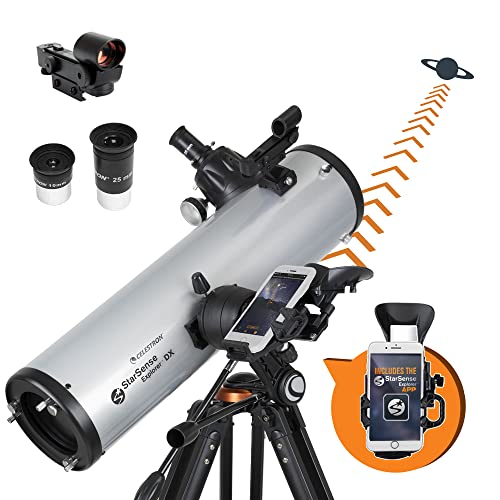
Celestron StarSense Explorer DX 130AZ App-Enabled Telescope – 130mm Newtonian Reflector with Smartphone Dock & StarSense App – iPhone & Android Compatible – Easy-to-Use for Beginners
SMARTPHONE-POWERED SKY TOUR: No experience needed! Just dock your phone, launch the StarSense Explorer app, and follow the...
As an affiliate, we earn on qualifying purchases.
Celestron StarSense Explorer DX 130AZ Telescope with Smartphone Dock
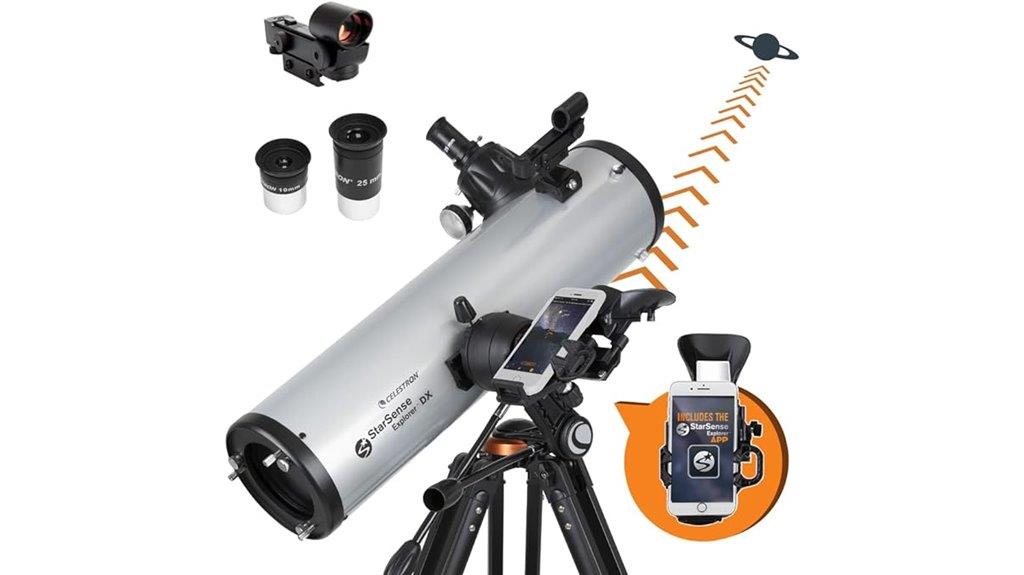
If you’re new to astrophotography and want an easy-to-use telescope that offers guided stargazing, the Celestron StarSense Explorer DX 130AZ is an excellent choice. This 130mm Newtonian reflector features StarSense technology, which uses sky recognition to identify star patterns and pinpoint your telescope’s position. The smartphone dock makes it simple to connect your iPhone or Android device, and the StarSense app guides you to celestial objects with on-screen arrows. Its manual altazimuth mount allows smooth tracking, perfect for beginners. Bright images of planets, the Moon, and deep-sky objects make this telescope ideal for those starting their astrophotography journey.
Best For: beginners and amateur astronomers seeking an easy-to-use, guided stargazing experience with smartphone integration.
Pros:
- User-friendly app with on-screen arrows for easy navigation to celestial objects
- Sky recognition technology ensures accurate telescope positioning without complex setup
- Bright, sharp images of the Moon, planets, and deep-sky objects suitable for beginners
Cons:
- Manual altazimuth mount may require some adjustment for tracking moving objects
- Heavier weight (18 pounds) can make setup and transport less convenient
- Limited to smartphone compatibility (iPhone 6+ and Android 7.1.2+), which may restrict use with older devices

Explore Scientific FCD100 Series 80mm Air-Spaced Apochromatic Triplet Refractor Telescope for Astrophotography Astronomy
BRILLIANT, HIGH-CONTRAST VIEWS: This refractor telescope’s combination of genuine, high-performance Hoya FCD100 extra-low dispersion (ED) optical glass and...
As an affiliate, we earn on qualifying purchases.
Explore Scientific FCD100 Series 80mm Air-Spaced Apochromatic Triplet Refractor Telescope

The Explore Scientific FCD100 Series 80mm Air-Spaced Apochromatic Triplet Refractor Telescope stands out as an excellent choice for astrophotographers seeking high-contrast, sharp images in a portable package. Its combination of genuine Hoya FCD100 ED glass and multi-layer coatings guarantees detailed, brilliant views with minimal chromatic aberration. With an 80mm aperture, 480mm focal length, and f/6 ratio, it captures ample light for deep-sky imaging and planetary detail. The compact design, weighing just 7 pounds, includes a dew shield, hybrid finder scope, and high-precision focuser, making it perfect for on-the-go astrophotography without sacrificing optical quality.
Best For: amateur astronomers and astrophotographers seeking a portable, high-quality refractor telescope for detailed planetary and deep-sky imaging.
Pros:
- High-contrast, sharp images due to genuine Hoya FCD100 ED glass and multi-layer coatings
- Virtually eliminates chromatic aberration with air-spaced triplet design
- Lightweight and compact, making it highly portable for spontaneous observing sessions
Cons:
- Slightly higher price point compared to entry-level telescopes
- Requires additional accessories (such as mounts and cameras) for astrophotography setup
- Limited aperture size may restrict very deep-sky object viewing compared to larger telescopes

Explore Scientific FCD100 Series 127mm f/7.5 Carbon Fiber Triplet ED APO Refractor Telescope with 2.5" HEX Focuser
Item Number FCD100–127075-CF-01
As an affiliate, we earn on qualifying purchases.
Explore Scientific FCD100 Series 127mm f/7.5 Carbon Fiber Triplet ED APO Refractor Telescope
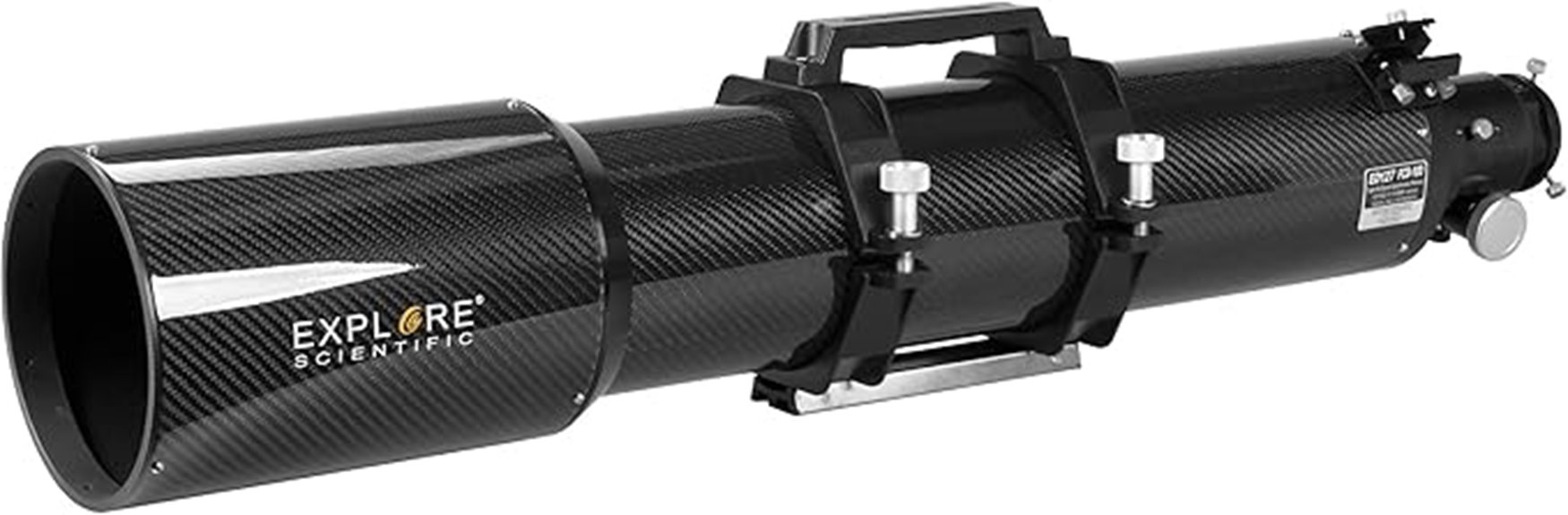
For astrophotographers seeking a lightweight yet high-performance refractor, the Explore Scientific FCD100 Series 127mm f/7.5 Carbon Fiber Triplet ED APO stands out. It features a 127mm aperture, 952mm focal length, and a fast f/7.5 ratio, making it suitable for detailed imaging. The triplet ED lens promises high contrast and minimal chromatic aberration, delivering sharp, vibrant images. Despite its impressive optical design, some users find the focuser and diagonal components underwhelming for the price. At just 14 pounds, it’s portable, but mixed reviews about its value and customer support suggest it’s best for those willing to weigh performance against cost.
Best For: amateur astronomers and astrophotographers seeking a lightweight, high-contrast refractor for detailed imaging and observation who are willing to accept some limitations in accessories and customer support.
Pros:
- High-quality triplet ED apochromatic lens for sharp, vibrant images with minimal chromatic aberration
- Lightweight and portable at only 14 pounds, ideal for travel and field use
- Compatible with various eyepieces, offering flexibility for different observing and imaging needs
Cons:
- Underwhelming focuser and diagonal components for the price point, potentially affecting image quality and ease of use
- Mixed customer reviews regarding value, with some users finding it comparable to less expensive telescopes
- Difficulties with warranty service and customer support, leading to concerns about after-sales assistance

Explore Scientific ED102 Essential Series Air-Spaced Apochromatic 102mm Triplet Refractor Telescope for Astrophotography Astronomy
BRILLIANT, HIGH-CONTRAST VIEWS: This refractor telescope’s combination of genuine FCD1 HOYA extra-low dispersion (ED) optical glass and proprietary...
As an affiliate, we earn on qualifying purchases.
Explore Scientific ED102 Refractor Telescope for Astrophotography

Designed for amateur astrophotographers seeking high-quality images without breaking the bank, the Explore Scientific ED102 Refractor Telescope stands out as an excellent choice. Its 102mm air-spaced apochromatic triplet uses genuine FCD1 HOYA ED glass and multi-layer coatings to produce sharp, high-contrast images with minimal chromatic aberration. With a focal length of 714mm at f/7, it’s versatile for both visual observing and astrophotography. The scope features a retractable dew shield, precise collimation system, and portability with easy breakdowns. Users praise its stellar image quality, especially for deep-sky objects, making it a reliable, value-packed option for beginners and intermediate astronomers alike.
Best For: amateur astronomers and astrophotographers seeking a high-quality, portable refractor telescope with excellent optical performance at an affordable price.
Pros:
- High-contrast, sharp images with minimal chromatic aberration thanks to FCD1 ED glass and multi-layer coatings
- Versatile for both visual observation and astrophotography due to its 714mm focal length and f/7 ratio
- Portable and easy to breakdown, ideal for travel and light-polluted environments
Cons:
- Slight slop in the focuser can make fine adjustments challenging
- Mounting screws may cause minor star shape distortions if not properly adjusted
- Some users notice minor collimation or optical imperfections, such as a slightly misshapen airy disc
Explore Scientific FCD100 Series ED102 Refractor Telescope (OTA Only)

If you’re serious about astrophotography and need a compact, high-performance refractor, the Explore Scientific FCD100 Series ED102 is an excellent choice. This 102mm f/7 apochromatic triplet features genuine HOYA FCD100 ED glass, multi-layer coatings, and advanced chromatic aberration correction, delivering sharp, color-accurate images with a resolution of 1.14 arcseconds. Its air-spaced aluminum tube is lightweight and portable, weighing just 10.9 pounds. Perfect for detailed imaging and observation, it’s highly rated, backed by a solid warranty, and available at competitive prices. The OTA-only design offers flexibility for custom mounts and accessories, making it ideal for serious astrophotographers.
Best For: astrophotographers and amateur astronomers seeking a compact, high-quality refractor for detailed imaging and observation.
Pros:
- Features genuine HOYA FCD100 ED glass for minimal chromatic aberration and sharp, color-accurate images.
- Lightweight and portable design, weighing only 10.9 lbs, ideal for travel and field use.
- Advanced multi-layer coatings and chromatic aberration correction ensure high optical performance and crisp images.
Cons:
- OTA-only design requires separate mounts and accessories, which may increase overall setup cost.
- Limited aperture size of 102mm might be less suitable for very deep-sky imaging compared to larger telescopes.
- Price may be higher compared to less advanced or beginner-level refractors.
Askar 120APO Telescope for Astrophotography and Viewing

The Askar 120APO Telescope stands out as an excellent choice for astrophotographers seeking high-quality images with minimal chromatic aberration. Its 120mm triplet apochromatic lens, including an ED glass element, provides sharp, color-accurate images ideal for planetary and deep-sky imaging. With an 840mm focal length and f/7 ratio, it offers detailed views and precise astrophotography potential. The lightweight design, weighing around 5.7kg, makes setup easy and portable. The package includes sturdy rings, a handle, a Vixen-style dovetail, and a protective carrying case, all enhancing convenience and stability for both viewing and imaging sessions.
Best For: amateur astrophotographers and stargazing enthusiasts seeking a portable, high-quality refracting telescope for detailed planetary and deep-sky imaging.
Pros:
- High-quality triplet apochromatic lens with ED glass for minimal chromatic aberration and sharp images
- Compact and lightweight design for easy setup and transport
- Includes sturdy mounting accessories and protective carrying case for convenience and stability
Cons:
- Limited to a 120mm aperture, which may be less suitable for extremely faint deep-sky objects compared to larger telescopes
- Requires additional accessories like mounts and cameras for astrophotography, which are not included
- May need precise alignment and calibration for optimal imaging results
Celestron Omni XLT 120 Refractor Telescope

For amateur astronomers seeking reliable and high-quality optics, the Celestron Omni XLT 120 Refractor Telescope stands out as an excellent choice. It features hand-selected, high-grade optical glass and StarBright XLT coatings on all surfaces, ensuring bright, sharp images. The fully multi-coated lens delivers maximum light transmission, perfect for detailed viewing. Its optical tube, mounted on a smooth German Equatorial EQ mount with precise controls, provides steady tracking. Included accessories like a finderscope, sturdy tripod, and eyepiece make it ready to use right away. Plus, the free Starry Night software adds educational value, making this telescope a versatile tool for both observation and learning.
Best For: amateur astronomers seeking reliable, high-quality optics and comprehensive accessories for detailed celestial observation and learning.
Pros:
- Hand-selected, high-grade optical glass with StarBright XLT coatings for superior image clarity and maximum light transmission.
- Precise German Equatorial EQ mount with smooth slow-motion controls and setting circles for accurate tracking.
- Includes essential accessories such as finderscope, sturdy tripod, and educational software for immediate use and learning enhancement.
Cons:
- May be heavier and bulkier due to robust construction, requiring a stable setup area.
- Slightly higher price point compared to entry-level telescopes, reflecting its advanced features.
- Requires basic understanding of mount operation for optimal tracking and alignment.
SVBONY SV550 Telescope, 80mm F6 APO Triplet Refractor OTA
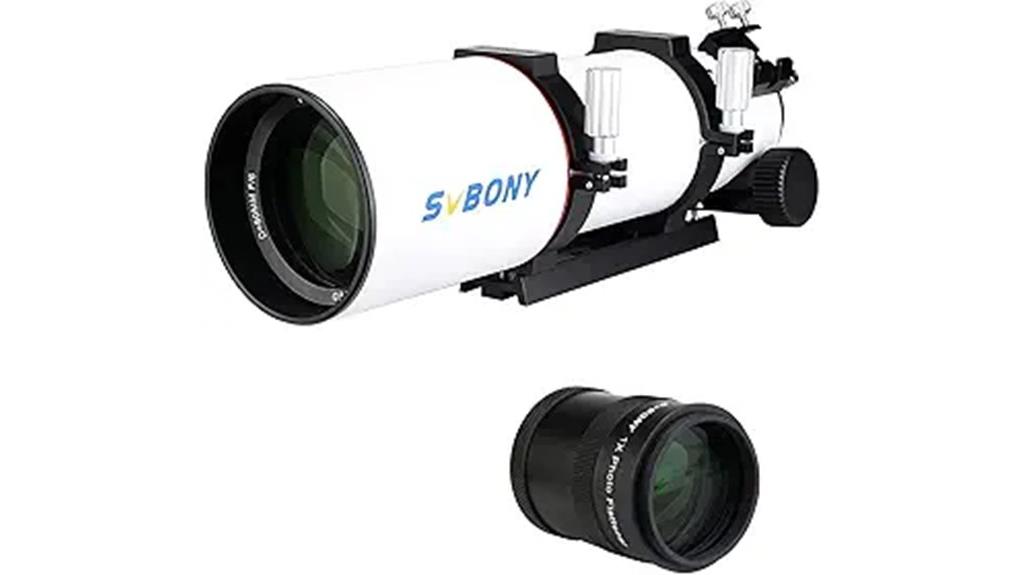
Designed with astrophotographers in mind, the SVBONY SV550 Telescope offers an impressive 80mm F6 APO triplet refractor that delivers sharp, color-rich images across the entire field. Its 480mm focal length and large 45mm target surface support both half-frame and full-frame cameras, making it versatile for deep-sky imaging. Extensive internal extinction measures ensure high image quality with minimal reflections. The magnesium alloy focusing seat reduces weight for portability, while the hollow dovetail plate simplifies accessory mounting. Despite some minor focus lock and clearance quirks, users praise its stellar performance for a fraction of the price of more expensive models, making it a smart choice for astrophotographers.
Best For: amateur and semi-professional astrophotographers seeking an affordable yet high-quality refractor telescope for deep sky imaging and celestial observation.
Pros:
- Excellent optical performance with sharp, color-rich images across the entire field of view.
- Supports both half-frame and full-frame cameras, offering versatile imaging options.
- Lightweight magnesium alloy build and easy-to-mount dovetail plate enhance portability and setup convenience.
Cons:
- Focus locks function more like tension knobs and may shift during handling.
- Low-profile mount and rail can cause clearance issues when balancing the scope.
- Internal dust may be present but is easy to clean, requiring minimal maintenance.
SVBONY SV105 Telescope Camera, 1.25″ CMOS Astrophotography Camera
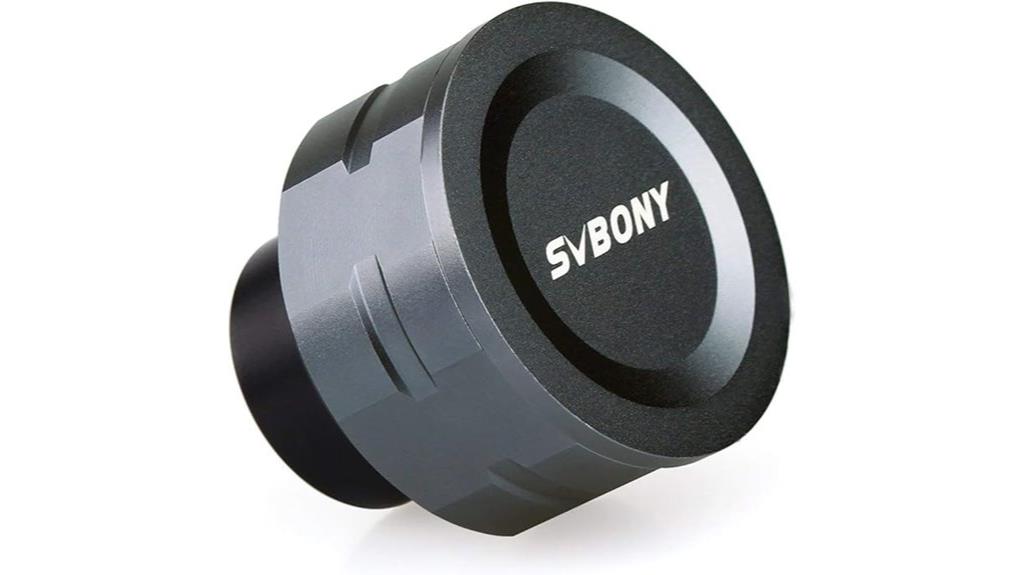
Are you a beginner looking to capture stunning lunar and planetary images without breaking the bank? The SVBONY SV105 Telescope Camera is an excellent entry-level choice. It’s a 1.25-inch CMOS camera with a 1/2.8 IMX307 sensor, capable of recording up to 30 fps at 1080p and 2K videos. Its dark light compensation tech improves image clarity in low-light conditions, ideal for planetary and lunar shots. Compatible with Windows, Linux, and Android, it’s easy to set up and use. With its affordability and straightforward operation, the SV105 helps beginners immerse themselves in astrophotography without hassle while delivering impressive celestial images.
Best For: beginners in astrophotography seeking an affordable and easy-to-use camera for lunar, planetary, and terrestrial imaging.
Pros:
- User-friendly setup with plug-and-play compatibility across Windows, Linux, and Android systems
- Capable of recording high-speed 2K videos and 1080p at 30 fps with excellent low-light performance due to dark light compensation technology
- Standard 1.25-inch threaded design allows easy integration with various telescope filters and accessories
Cons:
- Not compatible with iOS devices such as iPhones or iPads
- Slightly limited resolution compared to more advanced astrophotography cameras
- May require additional software like Sharpcap or AstroDMx Capture for optimal functionality
SVBONY SV550 Triplet APO Telescope (122mm F7 ED)

If you’re seeking a portable yet high-performance telescope for astrophotography, the SVBONY SV550 Triplet APO offers an excellent balance of features. With a 122mm aperture and F7 focal ratio, it captures detailed images of planets, nebulae, and galaxies. Its FPL-51 triplet lens minimizes chromatic aberration, ensuring sharp, vibrant images. The dual-speed 2.5-inch focuser supports precise focusing, while its lightweight design (around 14 pounds) makes field setup easy. Built with high-quality materials, it boasts a durable exterior and a robust focuser. Overall, the SV550 delivers impressive optical performance and portability at a very competitive price point.
Best For: amateur astronomers and astrophotographers seeking a portable, high-quality APO refractor for detailed planetary, nebulae, and deep sky imaging on a budget.
Pros:
- Excellent optical quality with minimal chromatic aberration thanks to FPL-51 triplet lens.
- Robust dual-speed 2.5-inch focuser supports precise focusing and heavy accessories.
- Lightweight and portable design ideal for field use and travel.
Cons:
- Slightly heavier than smaller scopes, which may require sturdy mounts for optimal stability.
- Initial reports of dust or dirt between lens elements can occur but are usually resolved.
- Limited included accessories, potentially requiring additional purchases for advanced astrophotography setups.
Explore Scientific ED80 Refractor Telescope for Astrophotography
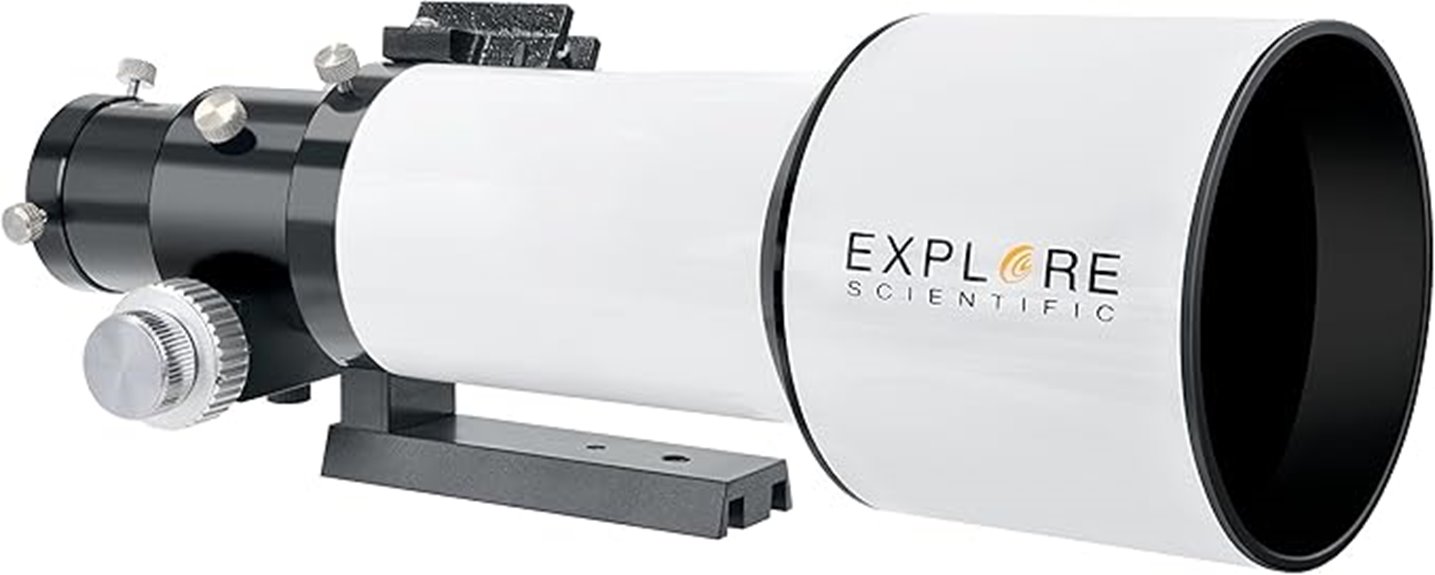
The Explore Scientific ED80 Refractor Telescope stands out as an excellent choice for astrophotographers seeking high-quality images in a compact package. Its optical design features genuine FCD1 HOYA ED glass and multi-layer coatings, delivering high-contrast, detailed views while virtually eliminating chromatic aberrations. With an 80mm aperture and f/6 focal ratio, it excels at capturing stunning images of the Moon, planets, nebulae, and star clusters. Its portable size, retractable dew shield, and precise collimation system make setup and alignment easy, whether for quick sessions or more advanced imaging. Plus, Explore Scientific’s reliable customer support adds confidence to your astrophotography adventures.
Best For: amateur and intermediate astrophotographers seeking a portable, high-quality refractor telescope for capturing detailed lunar, planetary, and deep-sky images.
Pros:
- High-contrast, detailed views with virtually no chromatic aberration due to genuine FCD1 ED glass and multi-layer coatings
- Compact and portable design with a retractable dew shield, ideal for spontaneous and travel setups
- Precise push-pull collimation system ensures optimal optical alignment and sharp star images
Cons:
- Limited aperture size may restrict very deep-sky imaging compared to larger telescopes
- Requires additional mounting and accessories (e.g., camera adapters, mount) for astrophotography setup
- May have a higher price point relative to other beginner refractors with similar features
Factors to Consider When Choosing 130MM Triplet APO Refractors for Astrophotography
When selecting a 130mm triplet APO refractor for astrophotography, I consider several key factors that impact performance and usability. These include optical quality, focal length, mount compatibility, portability, and focusing precision. Understanding these points helps me choose a scope that best fits my imaging needs and setup.
Optical Quality and Glass
Optical quality and glass selection are crucial factors that directly impact the performance of 130mm triplet APO refractors in astrophotography. High-quality telescopes use genuine FPL-53 or FCD-100 ED glass, which minimizes chromatic aberration and ensures sharp, color-accurate images. The triplet design, with three lens elements, enhances optical correction and reduces spherical aberrations, leading to clearer, more detailed celestial shots. Multi-layer coatings on all optical surfaces boost light transmission and contrast, resulting in brighter, crisper images. Air-spaced lens configurations, free of internal glue or air gaps, provide stable optical alignment and minimize distortions. Overall, premium glass and coatings are essential for achieving high resolution and contrast, making them critical considerations for astrophotographers seeking exceptional image quality.
Focal Length and Ratio
Focal length and ratio considerably influence how a 130mm triplet APO refractor performs in astrophotography. The focal length typically ranges from 650mm to 840mm, affecting the field of view and magnification. A shorter focal length, like 650mm, provides a wider field, ideal for capturing nebulae and galaxies, while longer focal lengths, such as 840mm, deliver higher magnification, perfect for planets and the Moon. The focal ratio, calculated by dividing the focal length by the aperture, usually falls between f/5 and f/7. Lower ratios (f/5) enable faster imaging with shorter exposures, but higher ratios (f/7) produce sharper, more detailed images with longer exposures. Choosing the right focal length and ratio depends on your target objects and desired image scale.
Mount Compatibility and Stability
Choosing the right mount is crucial for getting the most out of your 130mm triplet APO refractor, especially for astrophotography. Make certain the mount can support the telescope’s weight, typically between 10 and 20 pounds, to prevent strain and guarantee smooth operation. A stable mount with precise tracking, like a German equatorial or high-quality altazimuth, is essential for sharp images and minimal star trails. Look for mounts with dual-axis slow-motion controls and reliable motors, which allow fine adjustments and steady tracking during long exposures. Compatibility with auto-guiders or guiding systems further enhances stability by reducing periodic error and vibration. Also, proper balancing and secure attachment of your scope help maintain consistent stability and protect the mount’s gears and bearings during imaging sessions.
Portability and Size
Portability plays an essential role when selecting a 130mm triplet APO refractor for astrophotography, especially if you plan to travel or set up in different locations. Compact models typically measure between 20-30 inches in length, making them easier to transport and store. Lightweight options, weighing around 10-15 pounds, reduce physical strain during setup or travel. Some designs incorporate folding or collapsible features, further decreasing their size for field use. Smaller dimensions allow for mounting on portable tripods or lightweight mounts, perfect for astrophotography on the go. A more portable refractor enables quick setup and breakdown, letting you seize spontaneous observation sessions and travel efficiently without sacrificing optical quality. Overall, size and weight are vital for maximizing flexibility and convenience.
Focusing Mechanism Precision
A high-quality focusing mechanism can make or break your astrophotography experience, especially when working with high magnifications on a 130mm triplet APO refractor. Precise focus control is vital for capturing sharp images, and dual-speed or fine-focus controls help achieve incremental adjustments, minimizing focus shift during imaging sessions. The quality of the focuser, such as a 2.5-inch dual-speed rack-and-pinion or Crayford style, markedly impacts stability and ease of focusing. Properly calibrated focusers ensure consistent focus across different camera setups and accessories. Additionally, smooth, backlash-free movement is essential to prevent image degradation and maintain focus accuracy. Investing in a high-quality focuser ensures you can fine-tune focus with confidence, resulting in better astrophotographic results.
Astrophotography Accessories
Selecting the right astrophotography accessories is vital for getting the most out of your 130mm triplet APO refractor. Proper tools like field flatteners and auto-focusers ensure sharp, edge-to-edge images, reducing distortions. Compatible eyepieces and filters can greatly boost contrast and reveal finer details, especially when imaging faint deep-sky objects. A sturdy mount with precise tracking is essential for long exposures, preventing star trails and blurring. Additionally, spacers and adapters help maintain ideal back focal length, minimizing optical distortions like vignetting or oblong stars. Accessories such as dew shields, carrying cases, and cable management gear protect your equipment and keep your setup stable during extended sessions. Investing in quality accessories enhances your imaging experience and helps produce stunning celestial shots.
Price and Value
Choosing the right 130mm triplet APO refractor for astrophotography depends heavily on balancing price and value. Higher-quality models with advanced optics, such as ED glass and multi-layer coatings, tend to cost more but offer superior image clarity and better chromatic aberration correction. When evaluating value, I consider whether the scope’s optical performance justifies its price, ensuring it meets my astrophotography needs without overspending. Budget-friendly options might lack some refinements, so I weigh whether they still deliver acceptable results for my goals. Additionally, the overall value includes accessories, build quality, and support; these factors can markedly enhance or reduce perceived worth relative to the cost. Striking this balance helps me find a scope that offers great performance within my budget.
Support and Warranty
Since technical issues and repairs can arise unexpectedly, having reliable support and a solid warranty are essential when investing in a 130mm triplet APO refractor for astrophotography. A dependable support system ensures you get prompt assistance with troubleshooting, repairs, and questions, helping maintain peak performance. A thorough warranty, especially one lasting 2-3 years, offers peace of mind by covering manufacturing defects and certain damages, reducing repair costs. Good customer support should include accessible communication channels, knowledgeable staff, and clear guidance for troubleshooting and maintenance. Before making a purchase, review the warranty terms and support services offered. This ensures you’ll have the necessary after-sales assistance, keeping your setup trustworthy and your astrophotography pursuits uninterrupted.
Frequently Asked Questions
What Are the Main Advantages of 130MM Triplet APO Refractors?
The main advantages of 130mm triplet APO refractors are their exceptional image quality, thanks to their high-quality optics that minimize chromatic aberration. I love how they offer sharp, detailed celestial images with vibrant colors. Their compact size makes them portable, yet powerful enough for both astrophotography and visual observing. Plus, their sturdy build guarantees stability during long exposure shots, helping me capture stunning, clear images of the night sky.
How Do I Choose the Best Focal Length for Astrophotography?
Choosing the right focal length is like tuning a musical instrument; it shapes your entire celestial symphony. I look for a balance—longer focal lengths for detailed deep-sky objects, shorter for wide-field views like star clusters and the Milky Way. Typically, I consider my targets and camera capabilities, aiming for a focal length that complements my skill level and equipment, ensuring I capture stunning, crisp images without overcomplicating my setup.
Are These Telescopes Suitable for Beginner Astrophotographers?
Yes, these telescopes are suitable for beginner astrophotographers. I’ve found that their high-quality optics and manageable size make them user-friendly, even for those just starting out. They offer sharp, clear images and are versatile enough to explore a variety of celestial objects. Plus, their solid build and relatively straightforward setup help build confidence as you learn the ropes of astrophotography without feeling overwhelmed.
What Accessories Are Recommended for Optimal Imaging?
They say a chain is only as strong as its weakest link, so I recommend investing in good accessories. For ideal imaging, I use a sturdy mount, high-quality guide scope, and a reliable camera with filters to enhance details. A field flattener helps produce sharper images, and a remote shutter minimizes vibrations. These tools really make a difference in capturing stunning celestial shots and getting the most out of your telescope.
How Does Aperture Size Impact Image Quality and Detail?
Aperture size directly impacts image quality and detail because a larger aperture gathers more light, revealing finer details in celestial objects. With a 130mm refractor, I notice brighter images and better resolution, especially in faint deep-sky objects. It improves contrast and reduces the need for long exposures. So, bigger apertures give me sharper, more detailed images, making my astrophotography more rewarding and stunning.
Conclusion
Choosing the right 130mm triplet APO refractor is like selecting a trusted compass for your celestial journey. Each telescope symbolizes a gateway to explore the universe’s mysteries, guiding your astrophotography with clarity and precision. Trust your instincts, and let your passion be the star that lights your path. Remember, every great astronomer begins with a single step—your perfect instrument is the key to revealing the cosmos’s secrets.