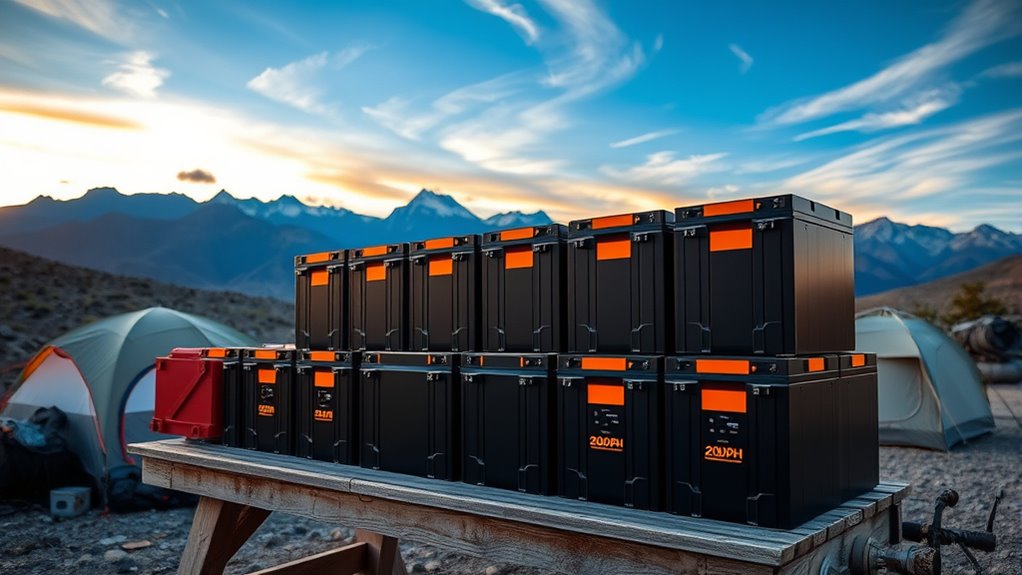

Choosing the right 200Ah LiFePO4 battery for a base camp involves balancing capacity, durability, and cost. The best overall pick is the HumsiENK 12V 200Ah LiFePO4 Lithium Battery, thanks to its high amperage BMS and robust build. The 12V 200Ah LiFePO4 Deep Cycle Battery offers impressive capacity with a focus on deep cycling, ideal for long-term off-grid use. Meanwhile, the 24V 200Ah LiFePO4 Battery with Bluetooth BMS stands out for its smart features and low-temperature protection. Buyers face tradeoffs between upfront cost, longevity, and advanced features—continue reading for a full breakdown to help you decide which battery fits your base camp setup best.

Get movie nights delivered free with Prime
- Fast, free delivery on millions of items
- Prime Video, Amazon Music and more included
- Member-only deals all year
Key Takeaways
- Higher amperage BMS units (e.g., 200A) generally provide better protection and longevity for off-grid use.
- Batteries with integrated Bluetooth or smart BMS enable easier monitoring and management in remote base camp setups.
- Capacity consistency, such as 2560Wh or 5248Wh models, ensures reliable power for extended periods.
- Build quality and IP ratings vary, influencing durability in harsh outdoor environments.
- Choosing between 12V and 24V configurations impacts system integration and scalability.


| 200ah lifepo4 batteries for base camp | Voltage | Capacity | Weight | Dimensions |
|---|---|---|---|---|
| 12V 200Ah LiFePO4 Lithium Batt | 12V | 200Ah | 50.5 pounds | 13.35 x 7.6 x 9.84 inches |
| 12V 200Ah LiFePO4 Deep Cycle B | 12.8V | 200Ah | — | — |
| 12V 200Ah Lithium LiFePO4 Batt | 12V | 200Ah | — | — |
| 12V 200Ah LiFePO4 Lithium Batt | 12V | 200Ah | 58.86 lbs | 20.08 × 8.07 × 8.46 inches |
| 24V 200Ah LiFePO4 Battery with | 25.6V | 200Ah | 88 lbs | — |
| POERUNI 12V 200Ah LiFePO4 Batt | 12V | 200Ah | 64 pounds | 17.7 x 6.5 x 9.5 inches |
| 12V 200Ah LiFePO4 Lithium Batt | 12V | 200Ah | 50.5 pounds | 13.4 x 7.6 x 9.8 inches |
| 12V 200Ah LiFePO4 Lithium Batt | 12.8V | 200Ah | 20.48 kg | 20.47"D x 8.7"W x 9.32"H |
| 12V 200Ah LiFePO4 Lithium Batt | 12V | 200Ah per unit | 45.2 pounds per unit | 20.47"D x 9.45"W x 8.58"H |
| 12V 200Ah LiFePO4 Lithium Batt | 12.8V | 200Ah | 58.86 lbs | 21.06 × 8.07 × 8.46 inches |
| HumsiENK 12V 200Ah LiFePO4 Lit | 12.8 volts | 200 amp-hours | 58.2 pounds | 20.53 x 8.69 x 9.37 inches |
| 12V 200Ah LiFePO4 Lithium Batt | 12V | 200Ah | 50.5 pounds | — |
More Details on Our Top Picks
12V 200Ah LiFePO4 Lithium Battery with Built-in 150A BMS for RV, Solar, Marine, Camping, Off-Grid, Home Energy Storage
This battery stands out for its impressive combination of long lifespan, portability, and versatile connection options, making it a top choice for large-scale base camp setups. Compared to the 12V 200Ah Lithium LiFePO4 Battery with 150A BMS, it offers a similar 10-year lifespan but with a slightly lighter weight and integrated safety features. The 150A BMS ensures reliable protection, though it requires careful handling during parallel connections to avoid voltage imbalance. Its support for series and parallel configurations provides flexibility for expanding power capacity as your needs grow. The main tradeoff is its higher upfront cost, which is justified by the durability and ease of installation for demanding off-grid applications.
Pros:- Long lifespan of over 10,000 cycles and 10-year warranty
- Lightweight at 50.5 pounds, easy to handle and install
- Supports series and parallel setups for customization
Cons:- Requires careful connection management to prevent voltage imbalances
- Higher initial price compared to traditional lead-acid batteries
Best for: Campers and off-grid enthusiasts needing a reliable, long-lasting battery with flexible connections
Not ideal for: Budget-conscious users who prioritize initial cost over longevity and safety features
- Voltage:12V
- Capacity:200Ah
- BMS:150A
- Dimensions:13.35 x 7.6 x 9.84 inches
- Weight:50.5 pounds
- Lifespan:up to 10 years
- Cycle Life:over 10,000 cycles
Our verdict“This battery is best suited for users seeking a durable, high-capacity power solution with flexible expansion options for their base camp.”
12V 200Ah LiFePO4 Deep Cycle Battery, 2560Wh
This model excels in providing a high-capacity energy supply with integrated smart features, making it ideal for large off-grid or base camp setups. Its 2560Wh capacity surpasses many competitors like the 12V 200Ah LiFePO4 Lithium Battery with 150A BMS, offering more energy for extended use. The Bluetooth monitoring allows real-time system data, which is invaluable for managing larger or more complex power systems. Its waterproof IP65 rating adds durability in harsh environments, though it requires compatible systems for expansion and comes at a higher price point. Compared to the lightweight 12V 200Ah LiFePO4 with 200A BMS, it trades some portability for increased capacity and monitoring features.
Pros:- High energy capacity of 2560Wh for longer power duration
- Smart Bluetooth monitoring for real-time data and control
- Waterproof IP65 rating ensures durability outdoors
- Supports expansion for larger systems
Cons:- Requires compatible system for expansion and integration
- Higher cost compared to basic batteries
Best for: Campers and off-grid operators needing extensive energy storage with remote monitoring capabilities
Not ideal for: Users with limited space or those seeking a lightweight, compact battery for small setups
- Capacity:200Ah
- Voltage:12.8V
- Energy:2560Wh
- Cycle Life:Over 4000 cycles
- Temperature Cut-off:Stops charging below 0°C
- Protection:IP65 waterproof
Our verdict“This battery is well-suited for users who prioritize capacity and monitoring in large-scale off-grid camps or remote setups.”
12V 200Ah Lithium LiFePO4 Battery with 150A BMS
This battery offers a solid balance of capacity and expandability, making it a flexible choice for larger or evolving power systems such as solar or RV setups. Its 150A BMS provides reliable safety, similar to the 12V 200Ah LiFePO4 Lithium Battery with Built-in 150A BMS, but with support for expansion up to 1200Ah through various configurations. Its high-quality A+ cells and 10-year warranty suggest long-term durability. However, the need for proper installation to realize its expansion potential, along with its weight and size, can be a limiting factor for smaller setups. Compared to the Built-in 200A BMS model, it emphasizes flexibility over simplicity.
Pros:- High-capacity 200Ah with expandable options up to 1200Ah
- Built-in 150A BMS for safety and longevity
- Supports multiple configurations for complex setups
- Long 10-year warranty
Cons:- Requires careful installation to achieve expansion potential
- Heavier and bulkier than smaller batteries
Best for: Experienced users planning to expand their power system over time, such as solar farm or large RV owners
Not ideal for: Beginners or those with limited space who prefer plug-and-play solutions
- Voltage:12V
- Capacity:200Ah
- BMS:150A
- Max Load Power:1920W
- Expansion Support:up to 6S6P
- Warranty:10 years
Our verdict“This battery fits users who need a long-lasting, expandable power solution for large or growing base camps or RV systems.”
12V 200Ah LiFePO4 Lithium Battery with Built-in 200A BMS
This pick emphasizes longevity and protection, with a built-in 200A BMS and an astonishing cycle life of up to 15,000 cycles at 60% DOD, surpassing most other options like the 12V 200Ah LiFePO4 with 150A BMS. Its lightweight design at just under 59 pounds makes it easier to handle, while the flexible series and parallel connection options support diverse off-grid and backup setups. The main tradeoff is that it’s not suitable for starting engines or golf carts, and it requires proper terminal management for longevity. Compared to the Smart Bluetooth model, it emphasizes durability over remote system monitoring.
Pros:- Extra-long cycle life, up to 15,000 cycles at 60% DOD
- Built-in 200A BMS offers comprehensive protection
- Lightweight and space-efficient design
- Flexible series and parallel expansion options
Cons:- Not suitable for starting engines or golf carts
- Requires correct terminal connections for safety
Best for: Power users who prioritize high cycle life and durability, especially in remote or off-grid applications
Not ideal for: Casual users or those needing a lightweight, portable solution for small setups
- Voltage:12V
- Capacity:200Ah
- Weight:58.86 lbs
- Cycle Life:up to 15,000 cycles at 60% DOD
- Dimensions:20.08 × 8.07 × 8.46 inches
- Max Series Connection:4 batteries
Our verdict“This battery is ideal for users seeking maximum cycle life and durability in off-grid or backup power applications.”
24V 200Ah LiFePO4 Battery with Bluetooth BMS, 5248Wh, Low-Temperature Protection
This high-voltage option delivers over 5,200Wh, making it suitable for sizable base camps or demanding off-grid systems. The Bluetooth BMS allows remote management, akin to the 2560Wh model, but at nearly double the energy capacity. Its wide temperature range (-20°C to 65°C) makes it adaptable to harsh environments, and the low-temperature protection helps prevent damage during cold conditions. Its weight of 88 pounds makes handling more challenging, especially for mobile setups, which is a clear tradeoff compared to smaller, lighter options like the 12V 200Ah BMS 200A. This battery is ideal where high capacity and environmental resilience are priorities.
Pros:- High capacity of 5248Wh for extended use
- Bluetooth BMS for remote monitoring and control
- Exceptional temperature tolerance for cold environments
- Deep discharge capability for maximum utilization
Cons:- Heavy and bulky, challenging to handle and install
- Higher cost compared to smaller batteries
Best for: Remote or off-grid users needing large energy reserves with monitoring and cold-weather tolerance
Not ideal for: Users with limited space or those needing a lightweight, portable battery for small-scale setups
- Voltage:25.6V
- Capacity:200Ah
- Energy:5248Wh
- Temperature Range:-20°C to 65°C
- Charging Temperature:0°C to 60°C
- Weight:88 lbs
Our verdict“This battery is well-suited for large, remote base camps requiring substantial energy storage with environmental resilience.”
POERUNI 12V 200Ah LiFePO4 Battery, 2560Wh Trolling Motor Lithium Battery
This POERUNI battery stands out for its exceptional lifespan, offering over 15,000 deep cycles, which far exceeds standard models like the 12V 200Ah LiFePO4 Lithium Battery with Built-in 150A BMS. Its built-in BMS ensures safety, while the lightweight design at 64 pounds makes installation easier, especially compared to heavier options. However, its size may be a drawback for tight spaces, and it cannot be mounted inverted, limiting some mounting options. Compared with the more compact 12V 200Ah LiFePO4 Lithium Battery with Built-in 150A BMS, it sacrifices some versatility for a longer lifespan and broader temperature range. This pick makes the most sense for users who need a durable, all-around battery capable of handling extreme conditions and multiple applications, from RVs to marine use.
Pros:- Long lifespan with over 15,000 deep cycles
- Built-in BMS ensures safety and protection
- Lightweight and easy to install
- Versatile for multiple applications
Cons:- Cannot be mounted inverted
- Size may be large for some setups
Best for: Heavy-duty off-grid and marine users who prioritize lifespan and durability over size.
Not ideal for: Users with very limited space or those needing an inverted mount, due to size and mounting restrictions.
- Voltage:12V
- Capacity:200Ah
- Energy:2560Wh
- Weight:64 pounds
- Dimensions:17.7 x 6.5 x 9.5 inches
- Temperature Range:-20°C to 60°C
Our verdict“This battery is ideal for those seeking maximum longevity and safety in versatile applications, accepting some size constraints.”
12V 200Ah LiFePO4 Lithium Battery with Built-in 150A BMS, Compact and Lightweight
This 12V 200Ah LiFePO4 battery is designed for users who need a portable, space-efficient power source, making it a better option than the bulkier POERUNI for those prioritizing ease of transport. Its compact dimensions of 13.4 x 7.6 x 9.8 inches and weight of just 50.5 pounds make it an excellent choice for RVers or campers with limited space. The advanced BMS offers solid protection, and the capacity can be expanded, supporting up to 10,000+ cycles—comparable to the long-term durability of the POERUNI. However, the smaller size demands careful management during expansion to balance voltage, and it may come at a higher initial cost than traditional lead-acid options. Compared to the larger POERUNI, it trades some size for portability and expansion potential, making it perfect for mobile setups.
Pros:- Lightweight and compact for portability
- Supports expansion for increased capacity
- High cycle life with over 10,000 cycles
- Advanced BMS for safety
Cons:- Requires careful charging during expansion
- Potentially higher upfront cost
Best for: Campers and RV owners needing lightweight, expandable power systems with straightforward installation.
Not ideal for: Those with fixed, large-scale base camps where space and weight are less of a concern.
- Voltage:12V
- Capacity:200Ah
- Weight:50.5 pounds
- Dimensions:13.4 x 7.6 x 9.8 inches
- Max Power Output:1920W
- Lifespan:Up to 10 years
Our verdict“Ideal for mobile and expandable power needs, especially where weight and size matter most.”
12V 200Ah LiFePO4 Lithium Battery, Max. 2560Wh, 15000 Deep Cycle
This model offers an impressive cycle life—up to 15,000 cycles at 60% DOD—making it a top choice for long-term off-grid systems compared to the 12V 200Ah Lithium Battery with Built-in 150A BMS. Its larger dimensions (20.47″D x 8.7″W x 9.32″H) and weight of approximately 45 pounds make it less portable but more suitable for stationary base camps. The high number of cycles and reliable protections make it ideal for continuous, demanding use. The heavier weight and slightly larger size can be a drawback for those needing quick installation or frequent transport. Compared with the 12V 200Ah LiFePO4 Lithium Battery with Built-in 150A BMS, it emphasizes durability over portability, making it best suited for fixed setups with ample space.
Pros:- Extremely long cycle life
- Reliable safety protections
- Scalable and versatile for large systems
- Suitable for demanding applications
Cons:- Heavy and less portable
- Larger size may require more space
Best for: Permanent base camps or off-grid installations that prioritize longevity and durability over mobility.
Not ideal for: Campers or mobile users needing lightweight, quick-to-move batteries.
- Voltage:12.8V
- Capacity:200Ah
- Max Energy:2560Wh
- Cycle Life:15000 cycles
- Weight:20.48 kg
- Dimensions:20.47″D x 8.7″W x 9.32″H
Our verdict“This battery is best for stationary setups demanding maximum cycle life and robustness, with less focus on portability.”
12V 200Ah LiFePO4 Lithium Battery (2 Pack) with 200A BMS, 2560Wh Energy
This two-pack offers scalable power with a combined capacity of 2560Wh, providing redundancy and flexibility for larger base camps or backup systems. Its compact dimensions and weight of 45.2 pounds per unit make handling manageable, especially compared to the POERUNI. The built-in 200A BMS ensures safe operation across a wide temperature range, and the ability to expand up to four units makes it a strong contender for future capacity upgrades. However, the initial investment is higher, and proper wiring is essential to ensure balanced charging across both units. Compared to single-unit options like the 12V 200Ah LiFePO4 Lithium Battery with Built-in 150A BMS, it offers increased capacity and redundancy, appealing to users with growing power needs or who prioritize reliability.
Pros:- Scalable with expansion support
- High cycle life and safety protections
- Compact for its capacity
- Reliable in extreme temperatures
Cons:- Requires careful wiring for expansion
- Higher initial cost per unit
Best for: Large base camps or users requiring reliable backup power with room to expand capacity.
Not ideal for: Small-scale or lightweight setups where simplicity and minimal wiring are priorities.
- Voltage:12V
- Capacity:200Ah per unit
- Energy:2560Wh total
- BMS:200A
- Weight:45.2 pounds per unit
- Dimensions:20.47″D x 9.45″W x 8.58″H
Our verdict“This dual-battery setup suits those seeking scalable, redundant power for sizable or critical off-grid applications.”
12V 200Ah LiFePO4 Lithium Battery with BMS and IP65 Protection
This battery features an IP65 rating, providing superior dust and water resistance, ideal for harsh outdoor conditions. Its smart 200A BMS offers full protection, comparable to other premium options like the POERUNI. With over 15,000 deep cycles, it ensures long-term performance in demanding environments. The dimensions (21.06 × 8.07 × 8.46 inches) and weight of 58.86 pounds make it somewhat bulkier, which could be a concern for mobile applications. Its expandable design supports up to four units, similar to the 12V 200Ah LiFePO4 Lithium Battery with Built-in 150A BMS. This model excels where durability and weather resistance are priorities, though it lacks a specified price, which could influence decision-making.
Pros:- High durability with IP65 rating
- Long lifespan with 15,000 cycles
- Smart BMS for full protection
- Expandable for increased capacity
Cons:- Bulkier and heavier than some alternatives
- Price not specified can be a barrier
Best for: Marine or off-grid users facing challenging weather conditions needing durable, waterproof batteries.
Not ideal for: Indoor or protected setups where IP65 protection isn’t necessary, or users on a tight budget.
- Voltage:12.8V
- Capacity:200Ah
- Energy:2560Wh
- BMS:200A
- Dimensions:21.06 × 8.07 × 8.46 inches
- Weight:58.86 lbs
Our verdict“This battery is well-suited for rugged environments demanding reliable, weather-resistant power, with some tradeoffs in size.”
HumsiENK 12V 200Ah LiFePO4 Lithium Battery with 2560Wh and 250A BMS
This HumsiENK model stands out for its robust 200Ah capacity combined with a high 250A BMS, making it ideal for demanding off-grid setups and large-scale solar integrations. Compared to the 12V 200Ah LiFePO4 Lithium Battery with Built-in 150A BMS for RV, Solar, Marine, Camping, Off-Grid, it offers a higher current capacity, supporting more substantial power draws and faster recharging. The tradeoff lies in its weight—over 58 pounds—which might challenge portability but pays off in long-term durability and scalability. Its waterproof IP65 rating and ability to operate in extreme temperatures reinforce its suitability for rugged environments. This makes it best suited for users who need reliable, scalable power with maximum safety margins—and who can handle its heavier weight and higher initial investment.
Pros:- High-capacity 200Ah with a 250A BMS for demanding loads
- Supports fast charging in just over 3 hours
- IP65 waterproof rating and extreme temperature operation
Cons:- Heavy weight of 58.2 pounds complicates mobility
- Higher initial cost compared to lower-capacity batteries
- Requires careful handling during installation due to high output
Best for: Large off-grid setups, serious solar energy systems, and extended base camps requiring high power and durability
Not ideal for: Lightweight, portable camping or temporary setups where ease of transport is a priority
- Voltage:12.8 volts
- Capacity:200 amp-hours
- Energy:2560Wh
- Max Continuous Output:3200W
- BMS:250A
- Dimensions:20.53 x 8.69 x 9.37 inches
- Weight:58.2 pounds
- Warranty:5 years
Our verdict“This battery is best for large, demanding base camps where durability and scalability outweigh portability concerns.”
12V 200Ah LiFePO4 Lithium Battery with Built-in 150A BMS for RV, Solar, Marine, Camping, Off-Grid
This 12V 200Ah LiFePO4 battery emphasizes portability without sacrificing much capacity. At just 50.5 pounds, it is easier to handle than the HumsiENK, making it a strong choice for mobile or smaller-scale base camps. Its built-in 150A BMS offers sufficient protection for most recreational and moderate off-grid applications, but it isn’t designed for the highest current demands like the HumsiENK. Its support for series and parallel connections provides flexible expansion, which is a distinct advantage over the more fixed configuration of the 12V 200Ah Lithium LiFePO4 Battery with 150A BMS. The limited operating temperature range—especially during charging—may be a concern for extreme climates, but overall, it balances weight, capacity, and safety well for semi-permanent setups. This makes it ideal for users prioritizing ease of transport and simple scalability in their base camp systems.
Pros:- Lightweight and easy to handle at 50.5 pounds
- Over 10,000 cycle life for long-term use
- Built-in 150A BMS for comprehensive protection
Cons:- Limited to a 150A BMS, less suited for high current demands compared to HumsiENK
- Restricted operating temperature range for charging and discharging
- Requires careful matching when connecting batteries in parallel to ensure balanced operation
Best for: Mobile or semi-permanent base camps, RV owners, and users needing easy-to-carry power solutions
Not ideal for: Heavy-duty, high-demand off-grid installations where maximum current capacity and longevity are critical
- Voltage:12V
- Capacity:200Ah
- Weight:50.5 pounds
- Cycle Life:10000+
- BMS Protection:150A
- Energy:2.56kWh
- Max Power Output:1.92kW
- Operating Temperature (Charge):32℉-113℉
- Operating Temperature (Discharge):-4℉-140℉
Our verdict“This battery provides a portable, scalable option for users who need reliable capacity without the bulk of heavier models, though it may fall short in extreme power or climate demands.”

How We Picked
The products in this roundup were selected based on their capacity, build quality, safety features, and suitability for off-grid base camp applications. Priority was given to batteries with proven longevity, robust BMS protection, and versatility for diverse energy setups. We also considered ease of installation, monitoring features, and overall value, aiming to highlight options that balance performance with affordability. The ranking reflects how well each battery meets these criteria, with a focus on durability, safety, and user convenience in remote or rugged environments.Factors to Consider When Choosing 200ah Lifepo4 Batteries For Base Camps
Selecting the right 200Ah LiFePO4 battery for a base camp involves understanding several key factors that influence performance, safety, and longevity. Beyond capacity, consider system compatibility, environmental resilience, and smart features that can streamline management. Making the wrong choice can lead to reduced battery life or system failures, especially in demanding outdoor settings. Here are critical considerations to guide your decision-making process.Capacity and Power Output
While all batteries in this category are rated at 200Ah, understanding their energy capacity in watt-hours (Wh) is crucial for estimating runtime. Batteries with higher Wh ratings provide more energy, reducing the need for frequent recharges. However, ensure your system’s power demands align with the battery’s output to avoid overloading or underutilization. Also, check the continuous and peak discharge ratings—higher ratings often translate to better handling of surge loads typical in camp setups.
Build Quality and Durability
Base camps often expose batteries to outdoor elements, so durability matters. Look for batteries with robust casing and high IP ratings, such as IP65, which offer water and dust resistance. Well-constructed batteries with sturdy terminals and vibration resistance will withstand the rigors of outdoor use better. Investing in quality reduces replacement frequency and minimizes maintenance needs over time.
Safety Features and BMS
A strong Battery Management System (BMS) is vital for safe operation, especially in remote locations. Features like over-current, over-voltage, short-circuit protection, and thermal management extend the lifespan and prevent accidents. Some batteries include smart BMS with Bluetooth connectivity, allowing remote monitoring of voltage, current, and temperature—an advantage for managing power in a base camp without frequent physical checks.
System Compatibility and Configuration
Deciding between 12V and 24V systems affects how easily the battery integrates into your setup. 12V batteries are straightforward but may require multiple units for larger power needs, while 24V options can reduce the number of batteries needed for bigger systems. Consider your existing or planned inverter and charger compatibility to avoid costly modifications. Modular systems offer scalability but may involve additional complexity and cost.
Price, Warranty, and Support
While higher-priced batteries often come with better warranties and support, it’s essential to evaluate the total cost of ownership. Longer warranties indicate manufacturer confidence in durability, but verify what’s covered. Good customer support can be invaluable when troubleshooting in remote settings. Balancing upfront investment with expected lifespan and service quality ensures you get reliable power without overpaying.
Additional Features and Monitoring
Features like Bluetooth-enabled BMS, low-temperature protection, and lightweight design add significant convenience. Smart monitoring can preempt issues before they become critical, especially in environments with temperature fluctuations. However, added features may increase initial costs and complexity, so weigh their importance against your specific needs and technical comfort level.
Frequently Asked Questions
How do I know if a 200Ah LiFePO4 battery is right for my base camp?
Assess your daily power consumption and planned usage duration. If your camp requires consistent power for extended periods, a 200Ah battery offers a substantial energy reserve. Consider your system’s voltage compatibility, and whether you need features like Bluetooth monitoring or low-temperature protection. Larger or more complex setups might benefit from modular batteries, while simpler systems can succeed with a single, high-quality unit. Matching your energy needs with the battery’s capacity and features ensures reliable performance in the field.
Can I use multiple 200Ah batteries together for more power?
Yes, connecting multiple batteries in series or parallel can increase system capacity or voltage, respectively. Series connections sum voltages, suitable for higher-voltage systems, while parallel connections combine capacity, maintaining voltage. It’s essential to use batteries of the same model, age, and capacity to prevent imbalances that could shorten lifespan. Proper wiring and balanced charging are critical to ensure safety and longevity when expanding your power system with multiple units.
What’s the benefit of a Bluetooth or smart BMS in a base camp setting?
Smart BMS features provide real-time data on voltage, current, and temperature, accessible remotely via Bluetooth or Wi-Fi. This capability allows you to monitor your battery’s health without physical inspections, which is particularly valuable in remote or rugged environments. Early detection of issues like overheating or voltage drops can prevent failures and extend battery life. For base camps with multiple batteries or complex setups, smart monitoring simplifies management and troubleshooting.
Are 12V or 24V batteries better for off-grid base camps?
Both configurations have advantages depending on your system design. 12V batteries are straightforward and easier to replace or upgrade but may require multiple units for larger loads. 24V systems reduce wiring complexity and can be more efficient for higher power demands, often resulting in fewer batteries needed. Your choice should align with your inverter specifications, future expansion plans, and the technical expertise available. Proper planning ensures your system remains scalable and reliable over time.
How important is the IP rating for a battery used in outdoor base camps?
IP ratings indicate a battery’s resistance to dust and water ingress, which is vital for outdoor use. Higher ratings like IP65 or IP68 offer better protection against rain, dust, and dirt, reducing the risk of damage and failure. While higher IP ratings may come at a premium, they provide peace of mind in harsh conditions or wet environments. Choosing a battery with an adequate IP rating helps ensure your power supply remains reliable regardless of weather or terrain challenges.