If you’re looking for the best in-ear monitor systems for live performances in 2025, I recommend models like the IEM810 PRO for its exceptional RF stability, XTUGA for its extensive range and multi-user support, and Xvive or LEKATO for portable, high-quality sound. These systems offer low latency, durable builds, and easy setup—perfect for stage use. Keep exploring to find the perfect fit for your needs and guarantee smooth, reliable performances.
Key Takeaways
- Consider RF bands (UHF, 2.4GHz, 5.8GHz) for reliable interference resistance and optimal range in live performance environments.
- Look for systems supporting multi-receiver setups and multiple channels for group or band monitoring needs.
- Prioritize high audio fidelity with low latency (under 3-5ms) for real-time in-ear monitoring without delay.
- Ensure compatibility with your existing gear, including input types (XLR, TRS), and features like auto-pairing or quick setup.
- Evaluate durability, battery life, and portability to match performance demands and stage conditions for live use.
IEM810 PRO UHF Wireless In-Ear Monitor System
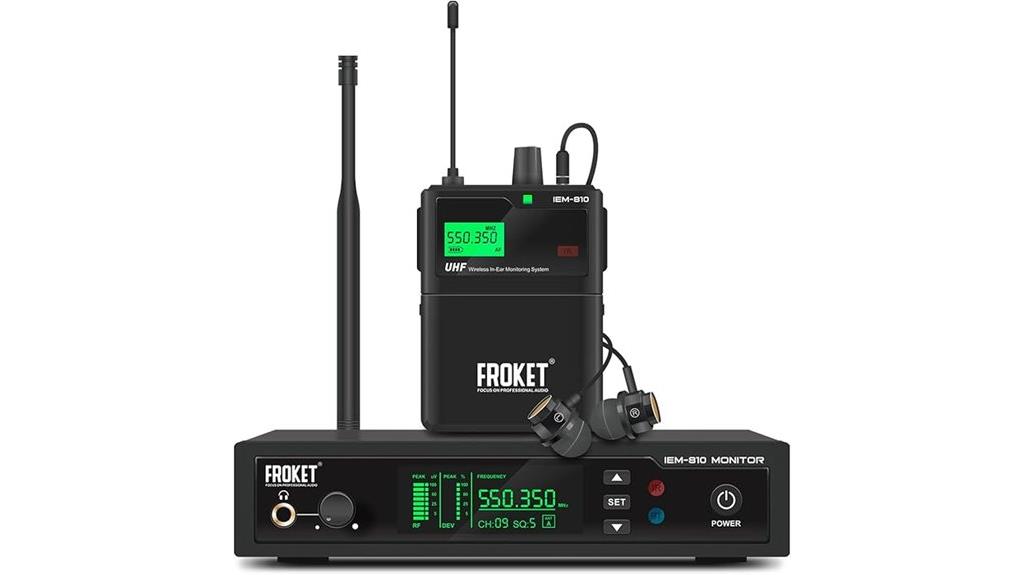
If you’re a live performer looking for reliable, high-quality in-ear monitoring without breaking the bank, the IEM810 PRO UHF Wireless In-Ear Monitor System is an excellent choice. Operating in the 530-580MHz band with 100 channels, it guarantees stable signals even in busy RF environments. Its ultra-low latency of under 3 milliseconds provides real-time audio with minimal delay, while broadcast-grade fidelity captures every nuance across 30Hz-20kHz. Built with aircraft-grade aluminum, it’s durable and lightweight, featuring intuitive controls and versatile connectivity options. Customers praise its sound quality, reliability, and affordability, making it a top pick for performers demanding professional performance on stage.
Best For: live performers and musicians seeking a reliable, high-quality, and affordable wireless in-ear monitoring system for stage performances.
Pros:
- Reliable UHF transmission with 100 channels for stable signals in crowded RF environments
- Ultra-low latency of less than 3 milliseconds ensures real-time audio with minimal delay
- Durable construction with aircraft-grade aluminum and versatile connectivity options
Cons:
- Earphone clip durability can be a minor issue, potentially requiring tape reinforcement
- Earphones are consumables with a limited lifespan of about 10-12 hours per set
- Slightly heavier carrying case may be less convenient for long gigs or transport
XTUGA Wireless In-Ear Monitor System, 2.4G Stereo/Mono IEM System
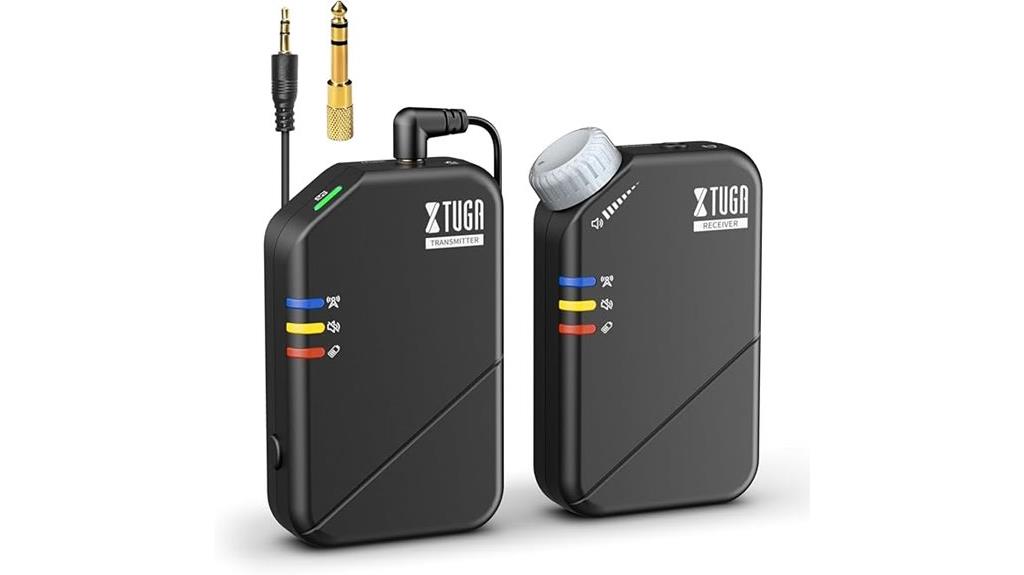
The XTUGA Wireless In-Ear Monitor System stands out as an excellent choice for live performers who need reliable, high-quality audio on expansive stages or during remote rehearsals. Its 2.4GHz wireless technology guarantees stable transmission up to 50 meters, even through walls, with low latency for both mono and stereo modes. The system delivers crisp sound with a 24bit/48KHz sampling rate and a high 100dB SNR. With up to 8 hours of battery life, quick pairing, and support for six receivers, it’s user-friendly and versatile. Despite some minor noise issues with certain earbuds, it offers a great balance of performance, portability, and affordability for live use.
Best For: live performers, bands, and DJs seeking reliable, high-quality wireless in-ear monitoring on large stages or during remote rehearsals.
Pros:
- Stable 2.4GHz wireless connection with up to 50 meters range, suitable for expansive venues
- Clear, crisp audio with high sampling rate and strong signal-to-noise ratio
- Supports up to six receivers simultaneously, making setup efficient and cost-effective
Cons:
- Slight white noise reported with certain high-impedance or lower-quality earbuds
- Lacks XLR inputs, limiting compatibility with some professional audio equipment
- Build quality is lightweight and may be less durable over extended heavy use
Xvive U4 Wireless In-Ear Monitor System
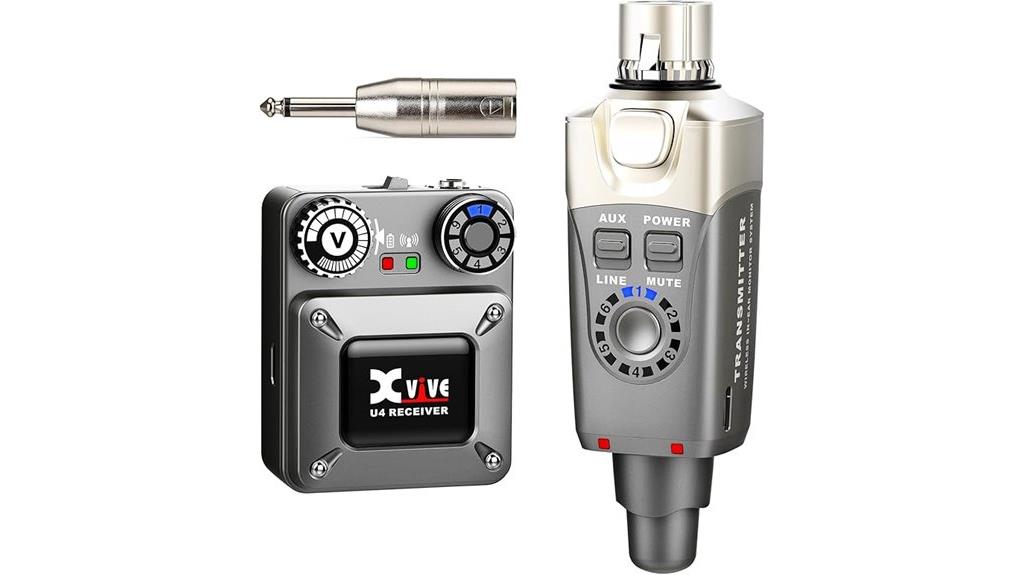
The Xvive U4 Wireless In-Ear Monitor System stands out as an excellent choice for live performers who prioritize high-quality, low-latency audio without the hassle of complex setups. It uses a 2.4GHz bandwidth for uncompressed wireless transmission, ensuring clear sound with minimal noise and less than 5ms latency. Supporting mono balanced XLR or unbalanced TS inputs, it’s versatile across various audio sources. The system offers 24-bit/48kHz audio, a broad 20Hz-20kHz range, and a durable metal housing with about 5 hours of rechargeable power. Easy to set up and reliable, it’s perfect for stage, rehearsal, or studio use.
Best For: live performers, musicians, and audio professionals seeking reliable, high-quality wireless in-ear monitoring with minimal setup.
Pros:
- Offers uncompressed 24-bit/48kHz audio with a broad 20Hz-20kHz frequency response for clear, detailed sound.
- Low latency of less than 5ms ensures real-time monitoring without noticeable delay.
- Durable metal housing and rechargeable batteries provide long-lasting use and rugged performance in various environments.
Cons:
- Limited to approximately 5 hours of battery life per charge, which may require additional power management during long performances.
- Only supports mono monitoring, which may not suit users needing stereo sound.
- Requires manual pairing via a long press on the channel button, which could be less intuitive for some users.
Xvive U4 Wireless In-Ear Monitor System
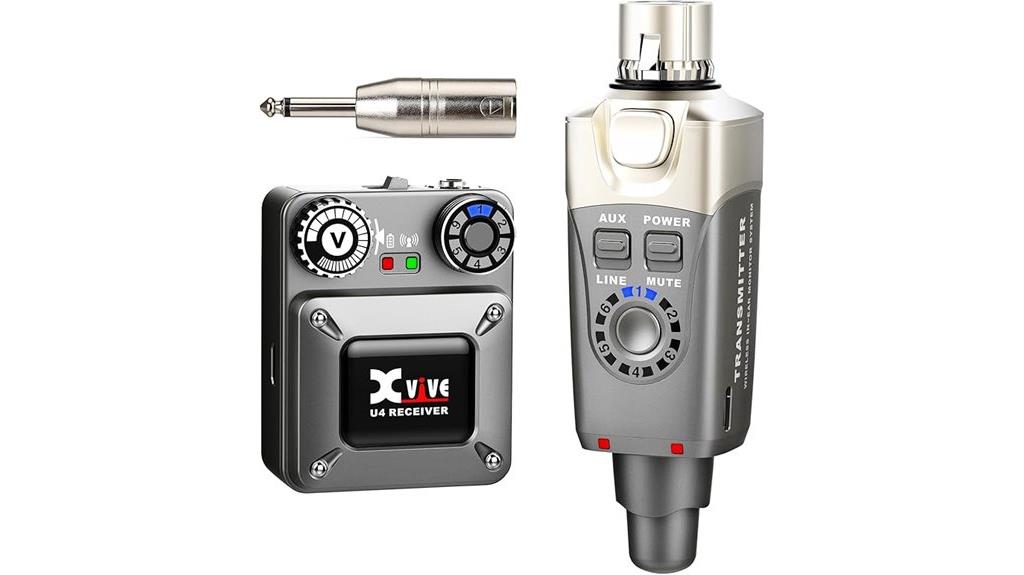
Designed for live performers seeking reliable, high-quality in-ear monitoring, the Xvive U4 Wireless In-Ear Monitor System stands out with its uncompressed 2.4GHz transmission, ensuring low noise and minimal latency. It offers professional-grade audio with 24-bit/48kHz clarity, a broad 20Hz-20kHz frequency response, and less than 5ms latency. Compatible with mono balanced XLR or unbalanced TS inputs, it supports multiple channels without interference. The system’s durable metal housing, rechargeable batteries, and simple setup make it perfect for stage or studio use. Overall, the U4 delivers consistent, clear sound in a compact, user-friendly package.
Best For: live performers and musicians who need reliable, high-quality in-ear monitoring with minimal latency and easy setup.
Pros:
- Uncompressed 24-bit/48kHz audio ensures clear, professional sound quality
- Supports multiple channels with low interference, ideal for complex stage setups
- Rugged metal housing and rechargeable batteries provide durability and extended use
Cons:
- Limited to approximately 5 hours of operation per charge, requiring recharging during long performances
- May require additional equipment for integration with certain audio sources or sound systems
- The system’s complexity might be overwhelming for users seeking ultra-simple, plug-and-play solutions
LEKATO Wireless In-Ear Monitor System (MS-1)

If you’re looking for a reliable in-ear monitoring solution for small to medium gigs, rehearsals, or studio sessions, the LEKATO Wireless In-Ear Monitor System (MS-1) offers an excellent choice. It supports up to six receivers simultaneously, making it ideal for band setups or church services. The auto-pairing feature ensures quick, effortless connections, while the switchable stereo/mono modes provide flexibility. Operating on a 2.4GHz band, it delivers lossless sound with minimal latency and a broad frequency response. With over five hours of battery life and a range of up to 90 feet, it’s a dependable, easy-to-use system perfect for various live and studio environments.
Best For: musicians, band members, or audio professionals needing reliable, wireless in-ear monitoring for small to medium gigs, rehearsals, or studio sessions.
Pros:
- Supports up to six receivers simultaneously for versatile multi-user monitoring.
- Easy auto-pairing feature for quick, hassle-free setup.
- Offers high-quality sound with low latency and broad frequency response.
Cons:
- Limited to a range of 90 feet, which may be restrictive in very large venues.
- Requires stereo source for optimal stereo transmission.
- Battery life of just over 5 hours may necessitate additional power management for extended sessions.
LEKATO Wireless In-Ear Monitor System MS-02
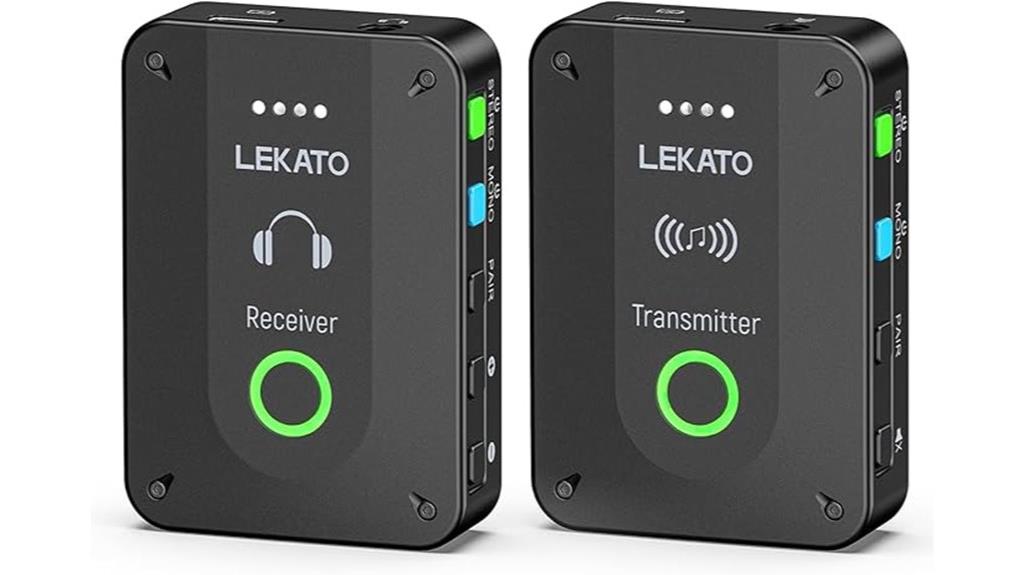
For live performers seeking reliable, high-quality wireless monitoring, the LEKATO MS-02 stands out with its ultra-low latency of less than 4.5 milliseconds and 24bit/48KHz sampling, ensuring crystal-clear sound in real time. Its support for one transmitter with up to four receivers makes it ideal for small to medium groups, rehearsals, or multi-performer setups. The system is easy to pair—just turn on and press the pairing buttons until LEDs confirm connection. With a wireless range of up to 100 feet, 6-8 hours of battery life, and adjustable volume on the receiver, it offers flexible, professional monitoring in a compact, lightweight package.
Best For: small to medium stage bands, performers, and recording professionals seeking reliable, high-quality wireless in-ear monitoring with minimal latency.
Pros:
- Ultra-low latency (<4.5ms) ensures real-time audio monitoring without noticeable delay
- Supports up to four receivers from a single transmitter, ideal for group performances
- Long battery life of 6-8 hours and easy pairing process for quick setup
Cons:
- Limited to a maximum of four receivers, not suitable for large ensembles
- May require careful handling to maintain connection stability over 100 feet in complex environments
- Mono/stereo mode switching involves a long-press, which might be less intuitive for some users
Stereo Wireless In-Ear Monitor System (One Receiver + One Transmitter, 90° Rotate)
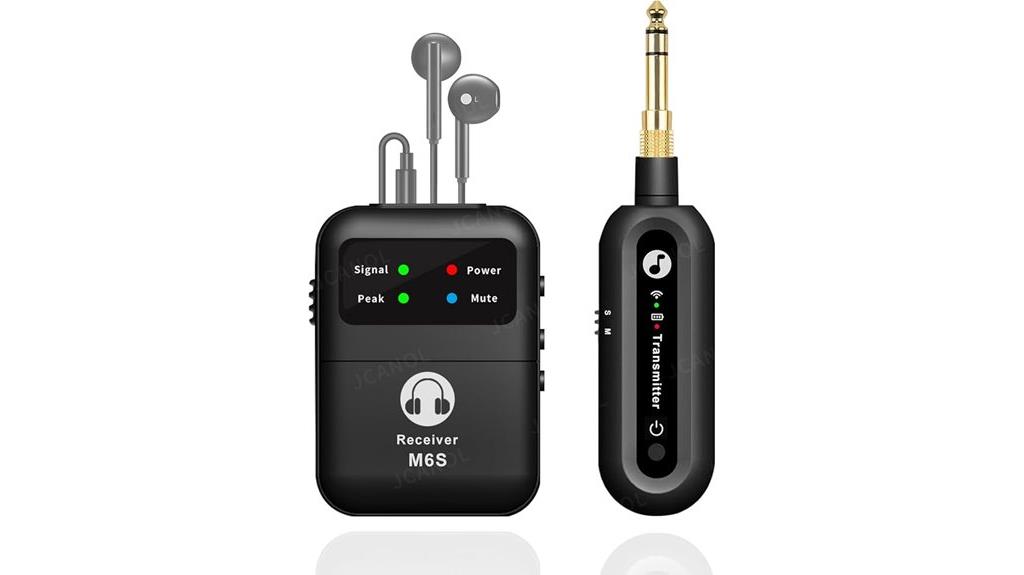
The Stereo Wireless In-Ear Monitor System with a 90° rotate receiver is ideal for live performers who need reliable, high-quality wireless monitoring on stage. Operating on 2.4GHz, it offers up to 164 feet of stable range with minimal latency and zero feedback. It supports Hi-Fi audio and broad frequency response, suitable for stage, studio, or DJ use. The system features easy plug-and-play setup, automatic pairing, and manual options. With up to 10 channels and a lightweight design, it ensures clear sound, minimal dropouts, and long battery life—perfect for extended performances or rehearsals. It’s a versatile, affordable choice for performers seeking dependable wireless monitoring.
Best For: musicians, DJs, and stage performers seeking reliable, high-quality wireless in-ear monitoring with easy setup and long battery life.
Pros:
- Easy plug-and-play operation with automatic pairing for quick setup
- Stable 164 ft. wireless range with minimal latency and feedback
- Supports multiple channels (up to 10) with compatible, high-quality audio
Cons:
- Instructions could be clearer for first-time users
- Limited to one receiver and transmitter included, requiring additional units for more users
- Battery life, while long, may still require management during very extended performances
Wireless In-Ear Monitor System with UHF 500MHz, 1 Beltpack Transmitter & 4 Receivers

When searching for a reliable wireless in-ear monitor system suitable for small gigs or rehearsals, the UHF 500MHz model with a beltpack transmitter and four receivers stands out. It offers stable, interference-resistant connectivity with frequency hopping technology and supports up to 10 channels. The system delivers HD audio with low latency, adjustable mono/stereo modes, and a range of up to 130 feet. Its compact, portable design, quick setup, and extensive accessories make it user-friendly. While some users note limited volume control and occasional dropouts over obstacles, overall, it provides a dependable, cost-effective solution for small-scale performances.
Best For: musicians, bands, or small performance groups seeking a reliable, easy-to-use wireless in-ear monitoring system for rehearsals and small gigs.
Pros:
- Stable UHF 500MHz connection with interference resistance and multiple channel options
- Compact, lightweight design with quick, automatic pairing for easy setup
- HD audio quality with low latency and versatile mono/stereo switching
Cons:
- Limited volume adjustment, with jumps that make precise control difficult
- Occasional dropouts over obstacles or at distances beyond 15-20ft
- Included accessories like splitter cables can introduce noise or stereo duplication issues
Wireless In-Ear Monitor System with Transmitter and Receiver

A wireless in-ear monitor system with a transmitter and receiver offers live performers a reliable and high-quality audio experience, especially in dynamic stage environments. It provides a clear, stable signal with low noise, minimal latency, and no interference, with transmission distances exceeding 50 meters. The system’s built-in high-sensitivity condenser microphone captures instrument sound accurately, delivering realistic audio for various applications. Its plug-and-play design allows easy setup through automatic pairing. Compatible with voice amplifiers and speaker systems, it’s ideal for concerts, rehearsals, and studio work. With over 8 hours of rechargeable power and 12-channel options, it supports multiple instruments and group performances seamlessly.
Best For: Musicians, performers, and audio professionals seeking reliable wireless in-ear monitoring with high-quality sound and easy setup.
Pros:
- Clear, stable audio transmission with low noise and minimal latency
- Easy plug-and-play operation with automatic pairing for quick setup
- Long-lasting rechargeable battery with over 8 hours of continuous use
Cons:
- Transmission range may be limited in large or obstructed venues
- One transmitter cannot connect to multiple receivers simultaneously
- Compatibility may vary with certain voice amplifiers or speaker systems
Xvive U45 Wireless In-Ear Monitor System
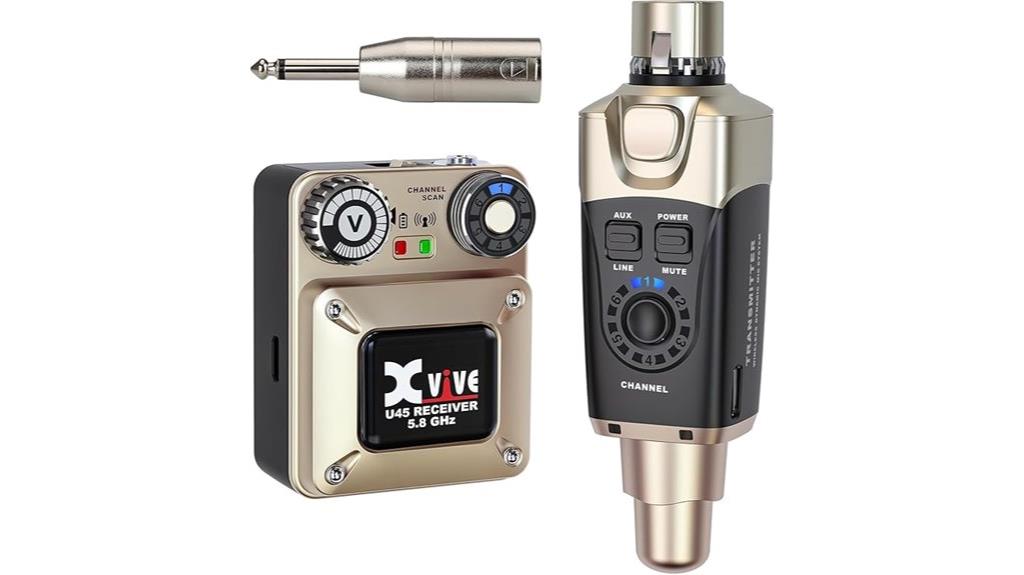
For live performers seeking reliable wireless in-ear monitoring, the Xvive U45 System stands out with its true diversity design and robust 5.8 GHz operation. It includes a transmitter and bodypack receiver, making it versatile for studio, rehearsal, or live shows. With a solid RF connection over 100 feet, it minimizes interference and guarantees stable audio. The system offers a broad 20Hz–20kHz frequency response, delivering high-resolution 24-bit/48kHz sound with a 110 dB signal-to-noise ratio. Easy channel scanning and manual matching simplify setup, while USB-C charging provides up to 5 hours of use, making it a reliable choice for performers on the go.
Best For: performers and musicians seeking a reliable, high-quality wireless in-ear monitoring system for live performances, rehearsals, or studio use.
Pros:
- Solid RF connection over 100 feet minimizes interference and ensures stable audio.
- Broad frequency response of 20Hz–20kHz with high-resolution 24-bit/48kHz sound quality.
- Easy channel scanning and manual matching simplify setup and operation.
Cons:
- Limited to approximately 5 hours of battery life per charge, which may require extra batteries or charging plans.
- USB-C charging port may not be compatible with older charging cables without adapters.
- The system may be more expensive compared to basic wired in-ear monitor options.
PM-1 Wireless In-Ear Monitor System
https://m.media-amazon.com/images/I/61aYOSojFrL._AC_SX679_.jpg
The PM-1 Wireless In-Ear Monitor System stands out as an excellent choice for live performers seeking a reliable, interference-resistant wireless solution. Operating on UHF 500MHz frequency hopping technology, it offers a stable, low-latency connection with minimal dropouts, even in crowded environments. The system includes a beltpack transmitter and receiver, supporting mono and stereo modes with easy switching. Its HD audio quality, compact design, and up to five hours of battery life make it perfect for gigs, rehearsals, or studio use. Despite some minor issues with volume control and stereo splitting, the PM-1 delivers solid performance and versatile connectivity at a competitive price point.
Best For: musicians, performers, and studio professionals seeking a reliable, interference-resistant wireless in-ear monitoring system for live performances and rehearsals.
Pros:
- Stable connection with UHF 500MHz frequency hopping technology reduces interference and dropouts
- Compact, lightweight design with up to 5 hours of battery life for extended use
- Supports mono/stereo switching with HD audio quality and easy pairing
Cons:
- Limited volume control with large jumps, which can hinder fine adjustments during performances
- Occasional dropouts and stereo crackling issues, especially with obstacles or interference
- Noisy stereo splitter cable and suboptimal stereo separation for some users
Xvive U45 Wireless In-Ear Monitor System
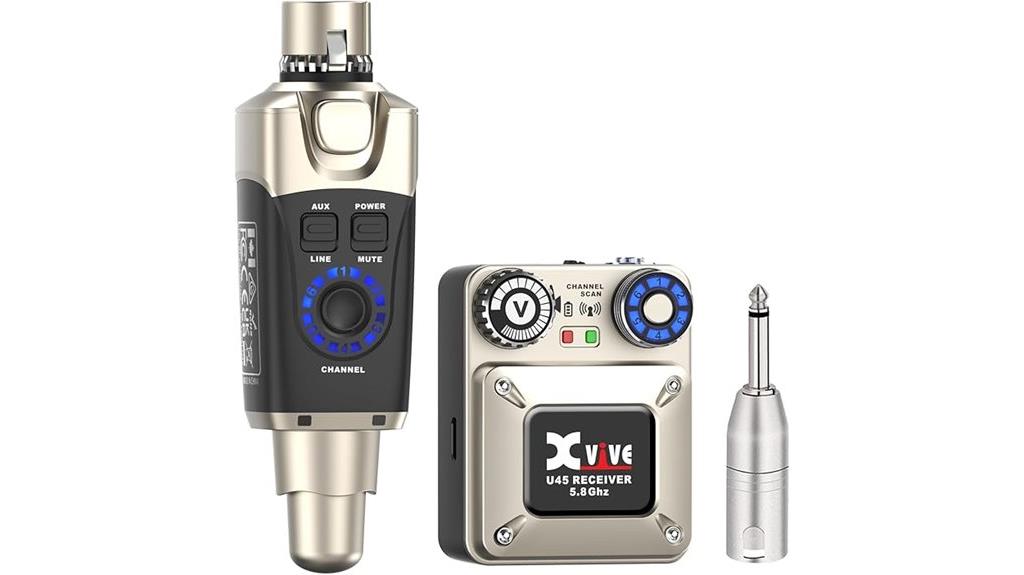
Designed with live performers in mind, the Xvive U45 Wireless In-Ear Monitor System offers a reliable and high-quality audio solution that keeps you moving freely on stage. Its 5.8GHz wireless technology guarantees a stable, interference-free connection with a range of up to 100 feet. The system includes a transmitter, receiver, USB-C charging cable, and a convenient bag. With less than 5 milliseconds of latency, you get near-instantaneous sound, perfect for live performance. Rechargeable batteries provide up to 5 hours of use, and the automatic channel scan assures a consistent, clear signal. It’s a top choice for performers seeking mobility and excellent audio quality.
Best For: performers and musicians seeking a reliable, high-quality wireless in-ear monitoring system with mobility and minimal latency.
Pros:
- Stable and interference-free 5.8GHz wireless connection with up to 100 feet range
- Low latency of less than 5 milliseconds for real-time audio monitoring
- Rechargeable batteries providing up to 5 hours of continuous use, ideal for live performances
Cons:
- Limited to 5-hour battery life, which may require additional charging or backup for longer gigs
- Slightly bulkier setup with transmitter and receiver units, potentially affecting portability
- Availability and pricing may vary as the product is relatively new to the market
Factors to Consider When Choosing In-Ear Monitor Systems for Live Performers
When choosing an in-ear monitor system, I focus on sound quality to guarantee clear, accurate audio on stage. I also consider wireless options, battery life, and how well the system connects with my gear to avoid disruptions. Finally, I pay attention to latency and delay to make sure my performance feels natural and synchronized.
Sound Quality Importance
Choosing an in-ear monitor system with excellent sound quality is essential for live performers because it directly impacts how accurately and expressively they can hear themselves and the band. High-quality audio ensures you catch subtle nuances and details, boosting accuracy and stage presence. A system with a broad frequency response (20Hz-20kHz) and a high signal-to-noise ratio (over 96dB) delivers clear, natural sound, making it easier to stay in tune and in sync. Low total harmonic distortion (<0.1%) preserves the integrity of your sound, preventing unwanted coloration. Uncompressed audio formats like 24-bit/48kHz maintain richness and depth, creating an immersive experience. Ultimately, professional-grade sound quality reduces fatigue and helps performers pick up on subtle cues, enhancing overall performance.
Wireless Technology Options
Wireless technology options play a essential role in selecting the right in-ear monitor system because they directly affect your performance’s reliability, range, and susceptibility to interference. Different frequency bands offer unique advantages: UHF systems, operating in the 500-580MHz range, feature multiple channels for reduced interference and scalability. 2.4GHz systems provide stable connections with a range up to 164 feet and low latency, ideal for stage and studio use. 5.8GHz systems, like the U45, deliver interference-free operation within about 100 feet but are more resistant to Wi-Fi and other wireless device interference. Your choice impacts latency, how far you can perform from the receiver, and how many users can operate simultaneously. Picking the right wireless tech depends on your specific performance environment and needs.
Battery Life Duration
Battery life is a crucial factor in selecting an in-ear monitor system because it directly impacts your ability to perform without interruptions. Most systems offer between 5 to 12 hours of use per charge, with some models reaching up to 8-10 hours on a single charge. Longer battery life means fewer breaks for recharging, ensuring continuous monitoring during extended rehearsals or gigs. Rechargeable batteries with quick-charging features are especially helpful, allowing you to quickly top off power during breaks. Keep in mind that usage volume, wireless distance, and environmental temperature can affect runtime, so real-world performance may vary. Additionally, choosing systems with clear battery indicators helps you monitor remaining power, preventing unexpected dropouts and ensuring you’re always ready to perform.
Connectivity Compatibility
When selecting an in-ear monitor system, guaranteeing compatibility with your existing audio equipment is vital. First, check that the system supports your audio input connections, like XLR, TRS, or unbalanced TS, to match your gear. It’s also important to confirm the wireless technology, whether UHF, 2.4GHz, or 5.8GHz, aligns with your setup to prevent interference and maintain stable signals. Additionally, verify if the system offers mono or stereo outputs, depending on whether you need single or dual-ear monitoring. Compatibility between the transmitter, receiver, and your headphones or in-ear monitors—considering impedance and connector types—is essential. Lastly, look for features like automatic pairing and multi-channel support, which simplify setup and ensure reliable multi-user monitoring during live performances.
Latency and Delay
Latency and delay are critical factors to contemplate because they directly affect how synchronized and natural your in-ear monitoring experience feels during live performances. A low-latency system, typically under 5 milliseconds, ensures that the audio reaches your ears almost instantly, maintaining tight timing and preventing disorientation. Higher latency, above 10 milliseconds, can cause noticeable echoes, lip-sync issues, or phase problems, especially when singing along with a click track or live instruments. Wireless systems with advanced digital modulation usually deliver lower latency than older analog setups, making them more reliable for professional use. Minimizing latency is essential for performers to stay in sync with the band and audience, ensuring a seamless, natural sound that doesn’t distract or hinder performance.
Ease of Use
Choosing an in-ear monitor system that’s easy to operate can make a significant difference during live performances. An intuitive interface with simple controls, like one-touch pairing and straightforward volume adjustments, helps performers stay focused on their performance. Automatic pairing features that connect transmitters and receivers instantly reduce setup time and cut down user errors. Long-press pairing buttons and LED indicators allow quick confirmation of successful connections without hassle. Systems with minimal setup steps, such as plug-and-play designs, let performers concentrate on playing rather than fiddling with settings. Additionally, clear, concise user manuals and easy-to-understand controls are especially helpful for beginners or those less familiar with wireless tech. Overall, ease of use enhances reliability and confidence on stage.
Frequently Asked Questions
How Does Frequency Range Impact IEM System Performance?
Frequency range directly affects an IEM system’s ability to reproduce sound accurately across the spectrum. A wider range ensures I hear everything from deep bass to crisp high frequencies, which is vital for live performances. If the range is too narrow, some details get lost, impacting my performance and audience experience. I always look for systems with broad frequency ranges to guarantee clarity, precision, and full sound reproduction.
What Is the Typical Battery Life for Top IEM Systems?
Most top IEM systems offer around 8 to 12 hours of battery life on a single charge, which easily lasts through a live performance or rehearsal. I personally look for systems with quick charging options or spare batteries, so I don’t worry about running out of power mid-show. It’s essential to check each model’s specs, as some newer systems now provide even longer battery life, giving performers peace of mind.
How Do IEM Systems Handle Interference in Crowded Venues?
Did you know that over 80% of live performers face interference issues in crowded venues? IEM systems handle this by using advanced technologies like dual-receiver designs and adaptive frequency hopping, which constantly scan and switch to cleaner channels. This helps minimize disruptions. I always recommend choosing IEM systems with these features, so you can perform confidently without worrying about signal drops or noise from a packed crowd.
Are There Differences in Sound Quality Between UHF and 2.4g Systems?
Yes, there are differences in sound quality between UHF and 2.4G systems. UHF systems generally offer more stable connections and better audio clarity, especially in crowded venues with lots of wireless signals. 2.4G systems can sometimes experience more interference and slightly lower sound fidelity, but they’re often more convenient and easier to set up. I recommend UHF for professional performances where sound quality is critical.
What Is the Best Way to Ensure a Secure Fit for Performers?
Imagine your in-ear monitors are a delicate bird perched on your ear. To keep it secure, I recommend custom-molded ear tips or high-quality silicone tips that mold perfectly to your ear’s shape. Using ear hooks or over-ear cables adds extra stability. I always make certain a snug fit, like a lock and key, so your monitors stay in place no matter how vigorous your performance.
Conclusion
Choosing the right in-ear monitor system can be a game-changer for any live performer. With so many solid options on the market, it’s all about finding the one that fits your needs and budget. Remember, don’t put all your eggs in one basket—test different systems and trust your ears. Once you find the perfect fit, you’ll be singing a different tune on stage.