
The best science kit for a teenager depends on whether they want to build, experiment, or explore a specific subject. My best overall pick is the EUDAX Electricity and Magnetism Lab Kit for its high-school focus and practical physics experiments. The Evviva Sciences Microbiology Kit stands out for students curious about lab methods, while the Thames & Kosmos Mega Cyborg Hand makes engineering tangible through a buildable mechanism. Many kits in this lineup are labeled for younger children, so age fit, depth, and how much adult help a project needs are key tradeoffs. Read on for my full comparison and picks by interest.

Get movie nights delivered free with Prime
- Fast, free delivery on millions of items
- Prime Video, Amazon Music and more included
- Member-only deals all year
Key Takeaways
The EUDAX physics kit is the clearest high-school match: its electricity and magnetism focus gives older students a more subject-specific option than the many broad kits labeled for ages 8–12.
Microbiology offers a different kind of challenge: Evviva’s pre-poured agar plates point toward lab-style observation, while crystal kits emphasize growing and displaying a finished result.
Building kits suit learners who want a working object: the cyborg hand, robot arm, and speaker-and-radio project turn the activity into a mechanical or electronic build.
Large experiment counts do not indicate deeper learning: the 100-plus and 150-experiment kits promise variety, but buyers should check whether the activities match a teen’s interests and desired level of challenge.
Several popular picks are aimed at younger children: National Geographic and Doctor Jupiter options can work for younger teens or shared family activities, but advanced teens may prefer the more focused physics, microbiology, or engineering projects.
| Evviva Sciences Microbiology Science Project Kit, Pre-Poured Agar Plates for Students, Petri Dishes with Educational Experiment eBook |  | Best for Teen Microbiology | Brand: ES Evviva Sciences | Recommended age: 15 years and older | Educational focus: Hands-on microbiology and science education | VIEW ON AMAZON | See Our Full Breakdown |
| 4M Crystal Growing Science Experimental Kit with Display Cases |  | Best for Crystal Display | Brand: 4M | Recommended age: 10 years and up | Experiment count: 7 crystal-growing experiments | VIEW ON AMAZON | See Our Full Breakdown |
| National Geographic Science Magic Kit with 100+ Experiments for Kids 8-12 |  | Best for Science-Shy Beginners | Brand: Blue Marble | Recommended age: 8 years and up | Included activities: 20 magic experiments | VIEW ON AMAZON | See Our Full Breakdown |
| Robot Arm Kit for Kids and Teens – STEM Building Engineering Toy for Ages 8-16 |  | Best for Hands-On Engineering | Recommended age: 8–16 years | Included parts: Motors, PCB microcontroller, wires, wooden pieces | Batteries required: 6 AA batteries, not included | VIEW ON AMAZON | See Our Full Breakdown |
| UNGILINGA 150 Experiments Science Kit for Kids | 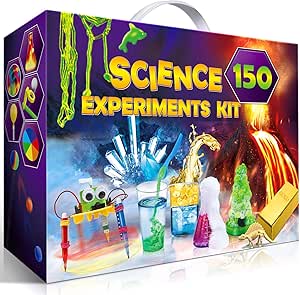 | Best for Broad Exploration | Brand: UNGILINGA | Recommended age: 8 years and up | Number of experiments: 150 | VIEW ON AMAZON | See Our Full Breakdown |
| National Geographic Gross Science Kit with 45 Experiments for Kids 8-12 |  | Best for Gross-Out Beginners | Experiments: 45 | Age range: 8–12 | Included: Experiment guide | VIEW ON AMAZON | See Our Full Breakdown |
| National Geographic Chemistry Set with 45 Experiments for Kids 8-12 |  | Best for Classic Chemistry Demonstrations | Experiments: 45 | Age guidance: 8 years and up | Educational objective: STEM | VIEW ON AMAZON | See Our Full Breakdown |
| Doctor Jupiter Ultimate Science Experiments Kit for Kids Ages 8+ |  | Best for Experiment Variety | Experiments: 135+ | Bonus experiments: 90+ | Recommended age: 8+ | VIEW ON AMAZON | See Our Full Breakdown |
| Thames & Kosmos Plasma Ball – 5-inch Scientific Device for STEM Learning |  | Best Compact Science Display | Diameter: 5 inches | Battery power: 4 AAA batteries | Wired power: USB-C cable | VIEW ON AMAZON | See Our Full Breakdown |
| National Geographic Amazing Chemistry Set with 100+ Experiments for Ages 8-12 |  | Best for a Broader Chemistry Set | Experiments: 100+ | Age range: 8–12 | Educational objective: STEM | VIEW ON AMAZON | See Our Full Breakdown |
| Doctor Jupiter Girls’ Ultimate Science Experiments Kit for Kids Ages 8+ |  | Best for a Broad Experiment Mix | Number of experiments: 135+ | Recommended age: 8+ | Experiment themes: Volcano, water, and crystal growing activities | VIEW ON AMAZON | See Our Full Breakdown |
| EUDAX School Physics Labs Basic Electricity and Magnetism Experiment Kit for High School Students |  | Best for High School Physics | Electricity items: 56 | Magnetism items: 21 | Repair tools: 2 | VIEW ON AMAZON | See Our Full Breakdown |
| Thames & Kosmos Mega Cyborg Hand STEM Experiment Kit |  | Best Wearable Engineering Build | Configurations: Right hand, left hand, and claw-like | Adjustable: Yes | Power source: Air pressure, water, and manual operation | VIEW ON AMAZON | See Our Full Breakdown |
| Stem Projects Toys for Boys Age 8-14 – Build Your Own Bluetooth Speaker & FM Radio Science Kit |  | Best for Practical Electronics | Age range: 8–14 years | Number of projects: 2 | Included projects: FM radio and Bluetooth speaker | VIEW ON AMAZON | See Our Full Breakdown |
| National Geographic Mega Crystal Growing Kit with 6 Crystals for Kids 8-12 |  | Best for a Focused Geology Display | Number of crystals: 6 | Colors: Blue, red, purple, green, yellow, and glow in the dark | Growing time: 3–4 days | VIEW ON AMAZON | See Our Full Breakdown |
| science kits for teenager | Recommended age |
|---|---|
| Evviva Sciences Microbiology S | 15 years and older |
| 4M Crystal Growing Science Exp | 10 years and up |
| National Geographic Science Ma | 8 years and up |
| Robot Arm Kit for Kids and Tee | 8–16 years |
| UNGILINGA 150 Experiments Scie | 8 years and up |
| National Geographic Gross Scie | — |
| National Geographic Chemistry | — |
| Doctor Jupiter Ultimate Scienc | 8+ |
| Thames & Kosmos Plasma Ball | — |
| National Geographic Amazing Ch | — |
| Doctor Jupiter Girls’ Ultimate | 8+ |
| EUDAX School Physics Labs Basi | — |
| Thames & Kosmos Mega Cyborg Ha | — |
| Stem Projects Toys for Boys Ag | — |
| National Geographic Mega Cryst | 8–12 |
More Details on Our Top Picks
Evviva Sciences Microbiology Science Project Kit, Pre-Poured Agar Plates for Students, Petri Dishes with Educational Experiment eBook
For teenagers ready to study microbes, this kit offers a more focused project than the broad activity collections in the UNGILINGA 150 Experiments Science Kit. Its 10 pre-poured agar plates remove the need to prepare the growth medium, so students can spend more time on sampling and observation. The included swabs, pipette, vial, and instructional eBook make it a practical starting point for structured microbiology work. That focus is also its main limit: there are only 10 plates, and students seeking a range of chemistry and physics activities will get more variety from UNGILINGA. The recommended age is 15 and older, and more advanced investigations may call for lab equipment beyond what is included. I’d choose it for a teen who wants a specific, guided introduction to microbiology.
Pros:- Pre-poured agar plates simplify setup for student experiments.
- Includes swabs, a pipette, and a vial alongside the plates.
- Instructional eBook supports a more structured learning activity.
Cons:- Ten plates limit the number of trials or repeated observations.
- Recommended only for ages 15 and older.
- Advanced experiments may require additional lab equipment.
Best for: Students aged 15 and older who want a guided, hands-on introduction to microbiology.
Not ideal for: Younger teens or students seeking a large variety of experiments, since this kit is age-rated 15+ and centers on a limited number of agar plates.
- Brand:ES Evviva Sciences
- Recommended age:15 years and older
- Educational focus:Hands-on microbiology and science education
- Set name:Microbiology Science Project Kit (Complete)
- Number of items:10
- Included components:Plastic pipette, plastic vial, agar Petri dishes, cotton-tipped swabs, instructions
Our verdict“Choose this kit for an older teen interested in guided microbiology and comfortable with a narrower project focus.”
4M Crystal Growing Science Experimental Kit with Display Cases
This kit is a good fit for teens who enjoy watching a project develop and want a result they can keep on display. It offers seven crystal-growing experiments and includes display cases, giving the activities a visible finish that the more open-ended Evviva Sciences Microbiology Science Project Kit does not promise. That makes 4M the more decorative, geology-leaning choice, while Evviva suits students looking for a focused lab-style topic. The tradeoff is limited breadth: once the crystal activities are complete, there is less variety than in the UNGILINGA 150 Experiments Science Kit. The listed age guidance starts at 10, so this may feel less challenging to older teenagers seeking deeper investigation. I’d pick it for a teen who values a tangible display as much as the experiment itself.
Pros:- Provides materials for seven crystal-growing experiments.
- Display cases give completed crystals a place to be shown.
- Introduces chemistry and geology through hands-on observation.
Cons:- Narrower subject range than broad experiment collections such as UNGILINGA’s.
- Age guidance begins at 10, which may feel less tailored to older teens.
- Adult supervision is recommended for safe handling.
Best for: Teens who like crystal formation, geology themes, and keeping finished projects on display.
Not ideal for: Older students seeking varied or more advanced experiments, since the kit is limited to seven crystal activities.
- Brand:4M
- Recommended age:10 years and up
- Experiment count:7 crystal-growing experiments
- Included components:Parts to perform the science project and detailed instructions
- Display:Display cases included
- Manufacturer:Toysmith
- Model number:5557
Our verdict“Pick 4M for a teen who wants a focused crystal-growing project and a displayable result.”
National Geographic Science Magic Kit with 100+ Experiments for Kids 8-12
Magic tricks give science-shy beginners a playful reason to try demonstrations, and this set pairs 20 magic experiments with a bonus booklet listing 85-plus additional activities. That format is more performance-oriented than the 4M Crystal Growing Science Experimental Kit, which keeps attention on one topic and displayable results. It also offers more activity ideas than Evviva’s focused microbiology kit, though the subject depth is different: a long list of magic activities does not make this a dedicated lab or engineering project. The stated audience is children ages 8 and up, so teenagers who want more technical challenge may find it young. Some activities may need adult supervision. I’d choose it for a younger teen who enjoys demonstrations and wants to build confidence with approachable experiments.
Pros:- Includes materials for 20 magic experiments.
- Bonus booklet adds 85-plus further magic experiment ideas.
- Combines science activities with creative, performance-friendly demonstrations.
Cons:- The magic focus may feel less technical than a dedicated engineering or microbiology kit.
- Age guidance of 8 and up may not suit teens seeking more advanced work.
- Some experiments may require adult supervision.
Best for: Younger teens who enjoy performing tricks and want approachable, varied science activities.
Not ideal for: Teens seeking advanced experiments or a sustained focus on a single scientific subject; the kit is aimed at ages 8 and up and centers on magic activities.
- Brand:Blue Marble
- Recommended age:8 years and up
- Included activities:20 magic experiments
- Bonus content:Booklet with 85-plus additional magic experiments
- Number of packs:1
- Model number:NGMEGAMAGIC
- Manufacturer:JMW Sales, Inc.
Our verdict“Choose this for a younger teen who prefers playful demonstrations over a deeper single-topic science project.”
Robot Arm Kit for Kids and Teens – STEM Building Engineering Toy for Ages 8-16
Teens who would rather build a working mechanism than follow a sequence of experiments may get more from this robot arm than from the National Geographic Science Magic Kit. Assembly connects mechanical parts, motors, wires, and a PCB microcontroller, giving the project a clear engineering focus. No soldering is required, which lowers one barrier for a first electronics build, though the instructions may still call for adult help, especially for younger builders. It also needs six AA batteries that are not included, so the kit is not ready to run straight from the box. Compared with the many short activities in the National Geographic kit, this is a more concentrated build with fewer kinds of science activity. The listed age range is 8–16, making it most relevant to teens who like assembly and mechanisms.
Pros:- Combines motors, wiring, a PCB microcontroller, and mechanical parts.
- No soldering is required for assembly.
- A single substantial build can suit teens drawn to engineering over demonstrations.
Cons:- Requires six AA batteries that are not included.
- Assembly may be difficult for younger users.
- Instructions may not provide enough detail for independent assembly.
Best for: Teens interested in mechanical engineering who want to assemble an electronic device without soldering.
Not ideal for: Teens who want a ready-to-start kit or a wide range of experiments, since six AA batteries are needed and the project centers on one build.
- Recommended age:8–16 years
- Included parts:Motors, PCB microcontroller, wires, wooden pieces
- Batteries required:6 AA batteries, not included
- Assembly:No soldering required
- Educational focus:Electronics, circuits, mechanical engineering
Our verdict“Pick this robot arm for a teen who wants one focused electronics and mechanics build and can arrange the batteries and assembly help.”
UNGILINGA 150 Experiments Science Kit for Kids
For a teen still deciding which branch of science holds their attention, UNGILINGA’s 150 experiments across chemistry, physics, and earth science offer the widest starting range in this batch. That variety sets it apart from the 4M Crystal Growing Science Experimental Kit, which stays with crystals, and the Evviva kit, which concentrates on microbiology. Its illustrated manual is designed to help children follow activities, but the age guidance is 8 years and up, so older teens wanting more specialized or technically demanding work may outgrow the approach. Some activities also need household items beyond the kit, which can interrupt a project if those materials are not on hand. I’d choose UNGILINGA for exploration and variety, while students with a settled interest will likely prefer a more focused kit.
Pros:- Lists 150 experiments spanning chemistry, physics, and earth science.
- Illustrated manual supports step-by-step activities.
- Broad subject coverage lets a young learner explore several interests.
Cons:- Some activities require household materials not included.
- Recommended for ages 8 and up, which may not challenge older teens.
- Broad coverage offers less depth in any one subject than focused kits such as Evviva’s microbiology set.
Best for: Families with a younger teen who wants to sample chemistry, physics, and earth science through guided activities.
Not ideal for: Older teens seeking specialized, advanced work or a kit with every experiment material supplied.
- Brand:UNGILINGA
- Recommended age:8 years and up
- Number of experiments:150
- Subjects:Chemistry, physics, earth sciences
- Included components:Science experiments, tools, and materials
- Recommended uses:School breaks, weekends, birthdays, holidays, and home activities
Our verdict“Choose UNGILINGA for broad, guided exploration when a teen has not settled on one science interest.”
National Geographic Gross Science Kit with 45 Experiments for Kids 8-12
I’d choose this kit for a younger teen who is more likely to engage with science when the experiments are silly and a little gross. Its 45 guided activities, such as boiling boogers and glowing worms, give it a focused theme that makes chemistry and observation feel playful. Compared with the broader National Geographic Amazing Chemistry Set, though, this one offers less variety in subject matter and fewer listed experiments. The illustrated guide and extra activities using household items help extend the kit beyond the supplied projects, but they don’t change its gross-science focus. Some activities can be messy, and younger users may need an adult nearby. I’d skip it for teens looking for sustained chemistry projects or a more age-advanced challenge.
Pros:- 45 experiments give beginners a clear set of guided activities
- Gross-out themes can make scientific ideas appealing to reluctant learners
- Illustrated instructions support independent reading
- Household-item experiments add activities beyond the kit contents
Cons:- The gross-science theme limits subject variety
- Messy activities may require adult help and cleanup
Best for: Younger teens who enjoy silly, hands-on experiments and are comfortable with messy activities
Not ideal for: Teens seeking broad chemistry topics, a mature presentation, or projects with little cleanup
- Experiments:45
- Age range:8–12
- Included:Experiment guide
- Additional activities:Household-item experiments
- Example activities:Boiling boogers and glowing worms
- Award:Toy of the Year Award
Our verdict“Choose it for a younger teen who wants playful gross science, but pick the Amazing Chemistry Set for wider chemistry variety.”
National Geographic Chemistry Set with 45 Experiments for Kids 8-12
This set suits a teen who wants recognizable chemistry demonstrations—volcano eruptions, geysers, and rocket activities—with a guided format. Its 45 experiments make the scope easy to approach, while the illustrated instructions help beginners follow each activity. Compared with the National Geographic Amazing Chemistry Set, it has a smaller stated experiment count and a stronger emphasis on spectacle; the Amazing set adds crystal growing and a larger collection of projects. That narrower focus can be a plus for a teen who wants energetic, visible reactions rather than a longer sequence of different activities. The listed age range centers on children 8–12, so older teenagers may find the level introductory. Some experiments may also call for adult supervision.
Pros:- 45 activities focus on approachable chemistry demonstrations
- Volcano, geyser, and rocket themes make reactions visible
- Illustrated instructions suit beginning experimenters
- Hands-on format encourages curiosity about chemical reactions
Cons:- Fewer listed activities than the National Geographic Amazing Chemistry Set
- Age guidance and introductory activities may not challenge older teens
- Some projects may need adult supervision
Best for: Younger teens who want guided chemistry demonstrations with visible reactions and a manageable project set
Not ideal for: Older teens looking for deeper chemistry study, crystal projects, or a broad experiment collection
- Experiments:45
- Age guidance:8 years and up
- Educational objective:STEM
- Set name:Stunning Chemistry Set
- Example activities:Volcano eruption, geyser, and rocket activities
- Included components listing:Mega Science Kit with 100+ easy experiments
- Model number:NGMEGACHEMX
- Manufacturer:JMW Sales, Inc.
Our verdict“Pick this for accessible, dramatic chemistry activities; choose the Amazing Chemistry Set for more projects and crystal growing.”
Doctor Jupiter Ultimate Science Experiments Kit for Kids Ages 8+
For a teen who likes switching between different kinds of activities, the Doctor Jupiter kit’s 135+ experiments give it a clear advantage over the focused National Geographic sets with 45 projects. Examples such as color changes, glowing water, and underwater volcanoes promise a broader mix, and the 90+ bonus household experiments add ways to keep exploring once the included materials are used. The instructions are designed for children and parents to follow together, which makes this a better shared-project choice than the more narrowly themed Gross Science Kit. That breadth comes with a tradeoff: chemical materials require supervision, and some bonus projects depend on household supplies. Its age guidance starts at 8, so older teens seeking advanced theory or specialized equipment may outgrow the activity level.
Pros:- 135+ experiments provide more variety than the 45-project National Geographic kits
- 90+ bonus household activities extend the project list
- Activities range across color changes, glowing water, and underwater volcanoes
- Leak-proof bottles are specified for the chemical materials
Cons:- Chemical materials call for adult supervision
- Some bonus activities require household items not included
- The age-8-and-up activity level may feel basic to older teens
Best for: Families with a younger teen who wants many different guided experiments and is happy to work with an adult
Not ideal for: Older teens seeking advanced chemistry concepts or a kit that supplies every material for every activity
- Experiments:135+
- Bonus experiments:90+
- Recommended age:8+
- Materials:Chemical materials in leak-proof bottles
- Example activities:Color changes, glowing water, and underwater volcanoes
- Instruction format:Easy-to-follow instructions
Our verdict“Choose this for a younger teen who values a large variety of shared experiments over advanced, specialized study.”
Thames & Kosmos Plasma Ball – 5-inch Scientific Device for STEM Learning
The Thames & Kosmos Plasma Ball is the most compact, demonstration-led option here: a 5-inch device that lets a teen observe glowing filaments responding to touch and sound. Its sound-activated mode and tabletop or wall display options make it easier to revisit than a one-time experiment, while the Gross Science Kit and Doctor Jupiter kit offer hands-on activities across many projects. That distinction matters: this is a focused visual device for observing electricity, matter, and energy, not a collection of experiments to complete. It can suit a desk or shared study space, but it provides less guided practice than the larger kits. Power needs planning too: batteries are not included, and wired use requires a USB-C cable.
Pros:- Compact 5-inch size fits a desk or display area
- Sound-activated mode adds an interactive demonstration
- Can be used as a tabletop or wall display
- Shows electricity and energy through a visible light effect
Cons:- Offers a single focused demonstration rather than a range of experiments
- Four AAA batteries are not included
- Wired operation requires a USB-C cable
Best for: Teens who want a compact, repeatable electricity demonstration for a desk or shared study space
Not ideal for: Buyers seeking a large set of guided experiments or a kit that builds skills through varied projects
- Diameter:5 inches
- Battery power:4 AAA batteries
- Wired power:USB-C cable
- Interactive feature:Sound-activated mode
- Display options:Tabletop or wall display
- Demonstrated concepts:Electricity, matter, and energy
Our verdict“Choose the plasma ball for a compact, repeatable electricity display; pick an experiment kit for broader hands-on learning.”
National Geographic Amazing Chemistry Set with 100+ Experiments for Ages 8-12
I’d rank this ahead of National Geographic’s 45-experiment Chemistry Set for a teen who wants more ways to explore chemistry: it lists 100+ hands-on projects, including crystal growing, reactions, and color-changing solutions. Real scientific tools such as test tubes and beakers help make the activities feel more like lab work than a sequence of demonstrations. The bonus guide adds 85 household-item experiments, so the project list can continue beyond the supplied materials. Compared with the Doctor Jupiter kit, this set has a more explicit chemistry focus, while Doctor Jupiter offers a larger stated total and a broader mix of example activities. The 8–12 age range may feel introductory to older teenagers, and some projects take time or require extra materials.
Pros:- 100+ experiments offer more listed projects than the National Geographic 45-experiment Chemistry Set
- Crystal growing, reactions, and color changes add topic variety
- Test tubes and beakers support hands-on lab-style activities
- Bonus guide includes 85 household-item experiments
Cons:- Some experiments take time or require extra household materials
- The 8–12 age range may be introductory for older teenagers
- The available product details do not specify tool durability
Best for: Younger teens who want varied chemistry projects, basic lab tools, and activities that include crystal growing
Not ideal for: Older teens seeking advanced chemistry instruction or buyers who need every project material supplied
- Experiments:100+
- Age range:8–12
- Educational objective:STEM
- Example projects:Crystal growing, chemical reactions, and color-changing solutions
- Tools:Test tubes and beakers
- Bonus experiments:85 household-item experiments
- Model number:NGMEGACHEMAR
- Manufacturer:JMW Sales, Inc.
Our verdict“Choose this for a younger teen who wants an extensive chemistry-focused set with basic lab tools and crystal projects.”
Doctor Jupiter Girls’ Ultimate Science Experiments Kit for Kids Ages 8+
With 135+ activities spanning volcanoes, water, and crystal growing, this kit offers more variety than the 4M Crystal Growing Science Experimental Kit, which centers on one type of activity. That breadth can help a younger teen try several areas of science before choosing a favorite. The easy-to-follow instructions suit children who want guidance, and can make it easier for an adult to join in. Its stated 8+ age recommendation means teens seeking more advanced experiments may outgrow the level of challenge. Some activities also need basic household materials, so not every experiment is ready straight from the box. The girls-focused branding may not fit every buyer, and small parts call for supervision.
Pros:- 135+ experiments cover multiple science themes
- Instructions are described as easy to follow
- Includes volcano, water, and crystal activities
- Stated ASTM F963-17 safety standard
Cons:- Some activities require basic materials from home
- Small parts may need adult supervision
- Girls-focused branding may not appeal to every child
Best for: Younger teens who want to sample several types of guided experiments with an adult nearby
Not ideal for: Teens seeking advanced, electronics-focused projects or a kit that supplies every material
- Number of experiments:135+
- Recommended age:8+
- Experiment themes:Volcano, water, and crystal growing activities
- Instructions:Easy-to-follow instructions
- Safety standard:ASTM F963-17
- Materials:Some basic materials from home required
- Small parts:Included; supervision may be required
Our verdict“Choose this for a younger teen who values variety and guided activities over advanced depth in one subject.”
EUDAX School Physics Labs Basic Electricity and Magnetism Experiment Kit for High School Students
For teens studying circuits and magnetism, this kit has a clearer academic focus than the Doctor Jupiter Girls’ Ultimate Science Experiments Kit, which spreads its 135+ activities across several themes. EUDAX supplies 56 electricity items and 21 magnetism items, plus a color manual, giving students components for hands-on exploration of two related physics topics. That specialization makes it a stronger fit for coursework or a teen who already knows what they want to investigate, but it offers less variety for casual experimentation. The kit needs three AA batteries, which are not included, and some projects involve setup. Buyers should expect to work through the manual and assemble experiments rather than start with a finished device.
Pros:- Dedicated components for electricity and magnetism
- 56 electricity items and 21 magnetism items
- Color manual supports guided experiments
- Includes two repair tools
Cons:- Requires three AA batteries that are not included
- Some experiments need assembly and setup
- Focused on electricity and magnetism rather than varied science topics
Best for: High school students in grades 9–11 who want hands-on circuit and magnetism activities alongside physics study
Not ideal for: Younger beginners or teens who want a broad range of science topics or fully assembled projects
- Electricity items:56
- Magnetism items:21
- Repair tools:2
- Manual:Color page manual
- Batteries:Three AA batteries required; not included
- Intended student level:Grades 9–11
- Experiment focus:Electricity, circuits, and magnetism
Our verdict“Pick EUDAX for a high school student ready to explore circuits and magnetism through component-based experiments.”
Thames & Kosmos Mega Cyborg Hand STEM Experiment Kit
The wearable, manually operated hand gives this kit a more physical engineering challenge than the EUDAX School Physics Labs, which focuses on separate electricity and magnetism experiments. By using air pressure and water to move hydraulic pistons, the build shows how force can drive gripping motion without motors or batteries. Its adjustable joints and right-hand, left-hand, and claw-like configurations give teens ways to adapt the finished model, while keeping the learning centered on pneumatics and hydraulics. That focus is also its limit: it does not offer EUDAX’s circuit work or the broad experiment mix of the Doctor Jupiter kit. Manual setup and adjustment can take patience, and younger users may need help assembling it.
Pros:- Demonstrates pneumatic and hydraulic motion
- Operates manually without motors or batteries
- Adjustable finger joints and configurations
- Can be set up as a right hand, left hand, or claw-like form
Cons:- Manual setup and adjustment are required
- Learning focus is limited to pneumatic and hydraulic systems
- May be complex for very young children
Best for: Teens who enjoy building a wearable mechanism and learning how air and water pressure move parts
Not ideal for: Buyers looking for electronics, a wide range of experiment topics, or a build with minimal setup
- Configurations:Right hand, left hand, and claw-like
- Adjustable:Yes
- Power source:Air pressure, water, and manual operation
- Mechanism:Hydraulic pistons
- Build type:Wearable mechanical hand
- Learning focus:Pneumatic and hydraulic systems, engineering, and mechanics
- Award:2021 Toy Association STEAM Toy of the Year
Our verdict“Choose this for a teen who would rather build and adjust one moving mechanism than complete a variety of experiments.”
Stem Projects Toys for Boys Age 8-14 – Build Your Own Bluetooth Speaker & FM Radio Science Kit
This kit turns electronics into two recognizable projects: a Bluetooth speaker and an FM radio. That gives it a more tangible end result than the EUDAX School Physics Labs, where the supplied components support broader circuit and magnetism experiments instead of two finished devices. The stated 8–14 age range covers younger builders and teens, though screwdriver assembly may call for adult help at the lower end. Two projects are a narrow scope compared with the 135+ activities in the Doctor Jupiter kit, so it makes more sense for someone specifically curious about audio and radio. A small Phillips screwdriver is needed, and the listing notes instructions may not be sufficient for every builder.
Pros:- Builds both a Bluetooth speaker and an FM radio
- Focuses on practical electronics
- Instructions are included for assembly
- Material is described as non-toxic and durable
Cons:- Limited to two projects
- Requires a small Phillips screwdriver
- Assembly instructions may not be sufficient for every user
Best for: Teens who want to assemble functional audio devices and are curious about radios or Bluetooth speakers
Not ideal for: Teens seeking many different experiments or a project that needs no tools or adult assistance
- Age range:8–14 years
- Number of projects:2
- Included projects:FM radio and Bluetooth speaker
- Material:Described as non-toxic and durable
- Assembly:Requires a small Phillips screwdriver
- Educational objective:STEM learning and electronics
- UPC:074655950645
Our verdict“Pick this for an electronics-minded teen who prefers assembling two recognizable devices to sampling many science activities.”
National Geographic Mega Crystal Growing Kit with 6 Crystals for Kids 8-12
For teens drawn to minerals, this kit trades the broad activity selection of the Doctor Jupiter Girls’ Ultimate Science Experiments Kit for one clear project: growing six colorful crystals. The stated 3–4 day growing time gives each batch a waiting period that can make crystal formation easier to observe over time. Real gemstone specimens and a learning guide add context about minerals, while the USB-powered light display provides a way to show the results. Compared with the 4M Crystal Growing Science Experimental Kit, this National Geographic set specifies six colors and includes gemstones and a light display. Its focus remains narrow, and it calls for adult supervision and USB setup; teens wanting repeated, varied experiments may prefer a broader kit.
Pros:- Grows six crystals in different colors, including a glow-in-the-dark option
- Includes real gemstone specimens
- Learning guide adds geology context
- USB-powered display provides a way to showcase crystals
Cons:- Focused on crystal growing rather than a range of experiments
- Adult supervision is recommended for safe handling
- USB power requires additional setup
Best for: Younger teens interested in crystals and gemstones who want a guided growing project with a display
Not ideal for: Teens seeking chemistry variety or a kit that avoids supervision and external power setup
- Number of crystals:6
- Colors:Blue, red, purple, green, yellow, and glow in the dark
- Growing time:3–4 days
- Growing chambers:Silicone chambers
- Gemstones:Rose quartz, fluorite, blue calcite, and quartz geode
- Display:Light-up display
- Power source:USB
- Included guide:Learning guide
- Recommended age:8–12
Our verdict“Choose this for a teen who wants a focused crystal-growing project and a display for the finished specimens.”

How We Picked
I compared the 15 kits by how well their stated subjects and activities fit teenagers, with attention to the age ranges in their product names. I gave more weight to a clear learning focus, meaningful hands-on work, and a project that can hold an older learner’s interest than to a high experiment count alone. I also considered whether a kit offers a distinct kind of activity, such as building a mechanism, working with circuits, observing cultures, or growing crystals.
The ranking favors options with a stronger fit for teen interests and a clear purpose. That puts the EUDAX high-school physics kit, Evviva’s microbiology set, and the Thames & Kosmos cyborg hand ahead of broad kits marketed mainly to younger children. Those general kits can still suit younger teens, beginners, or families seeking variety, but they rank lower for age fit and subject depth. Since project instructions, supervision needs, and included materials can vary, I recommend checking the current listing and package details before choosing.
Factors to Consider When Choosing Science Kits For Teenagers
Before picking a kit, match the activity to the teenager’s interests and experience. A focused project can offer more satisfying work than a bigger assortment, but it may also need extra patience, space, or help.
Match the Challenge to the Teen, Not Just the Age Label
Age labels are a starting point, not a reliable measure of how much a teenager will learn. Several kits here are marketed for children ages 8–12, which may suit a younger teen who is new to science activities but feel familiar to an older student. Look at the actual task: following a sequence of simple demonstrations differs from assembling a mechanism or exploring high-school physics. A teen who already knows the basics may prefer a narrower subject with room to observe, troubleshoot, or repeat a test. A younger beginner may value clear steps and quick results more than technical depth. The common mistake is to buy based on the word “science” while overlooking whether the project asks enough of its intended user.
Choose a Subject They Will Want to Return To
Science kits are more likely to hold attention when they connect to an existing interest, such as electronics, biology, chemistry, or engineering. A broad assortment can help a curious beginner sample several areas, but dozens of unrelated activities do not automatically form a sustained project. A crystal kit may appeal to someone who likes watching gradual changes and keeping a display, while a build kit may suit a teen who wants an object to assemble and operate. Consider whether they enjoy observing, mixing, building, or solving problems before you prioritize variety. If you are buying a gift and do not know their preferences, a kit with multiple experiment types may be a safer fit. For a teen with a clear interest, a subject-specific kit can feel more purposeful.
Check What the Experiments Actually Require
A kit’s title or experiment count does not tell you whether every activity has the needed materials. Check the product details for included components, household supplies, and any items that must be replaced or sourced separately. This matters especially when an activity depends on consumables, since a kit may not support repeating it without additional materials. For build projects, check whether the set includes the parts needed to finish the device and whether assembly tools are expected. Missing supplies can turn an exciting gift into a delay while a family shops for extras. Reading the materials list before purchase gives a more realistic sense of the full project.
Think About Supervision, Space, and Cleanup
Teenagers vary in how independently they can follow instructions and manage a workspace, so consider the adult involvement your household can offer. Some activities need careful handling or close attention to directions; others may be easier to set up and put away. Kits involving wet experiments, growing materials, or several small components can call for a dedicated surface and a plan for cleanup. A project that takes longer or needs monitoring may be a good shared activity, but a poor choice if the teen expects to work alone. Check the kit instructions and safety guidance before buying, especially if younger siblings may be nearby. A realistic setup plan can matter as much as the science topic.
Decide Whether a Finished Object or an Open-Ended Experiment Matters More
Some kits lead to a visible result, such as a crystal display or a working build, while others center on trying experiments and seeing what happens. A finished object can make a satisfying gift and give the teen something to revisit, but assembly may be the main activity rather than extended scientific exploration. Experiment-focused kits can invite comparison and repetition, though they may not leave behind a durable keepsake. Think about what motivates the recipient: completion, discovery, or learning how a system works. Avoid assuming a polished result means the kit is more educational, or that a high activity count means each experiment is substantial. The right format is the one that fits how they like to learn.
Know When a Focused Kit Is Worth Choosing
A broad kit makes sense when the teen is still exploring what interests them, but a focused kit may be a better match once they have a favorite subject. A physics or microbiology project can provide a clearer direction than a collection of unrelated demonstrations. That focus can also mean fewer kinds of activities, so it is not automatically the right choice for someone who wants variety. Pay closer attention to subject depth and the work involved if the teenager has already done beginner kits. For a shared gift, consider whether an adult or sibling can take part without taking over the project. The best fit depends on whether the priority is exploration, a specific skill, or a sustained build.
Frequently Asked Questions
Are kits labeled for ages 8–12 suitable for teenagers?
They can suit younger teens who are new to experiments or want an easy activity to do with family. For older teens, the age label is a reason to check the actual instructions and project depth before buying. Look for activities that involve building, observation, or explaining results rather than relying on the experiment count. A teen who has completed several beginner kits may find a focused high-school physics or engineering project more engaging. If the recipient is between levels, choose based on their experience and interests rather than age alone.
Which type of kit is better for a teen interested in engineering: a robot arm or a cyborg hand?
Both offer a build-centered route into mechanisms, but the better choice depends on the kind of project the teen wants. A robot arm suggests an interest in assembling a device with a mechanical function, while the cyborg hand centers on a wearable hand-like mechanism. Check each listing’s instructions and parts to see how much assembly and adjustment the project involves. A teen who enjoys seeing how parts work together may prefer either over a broad experiment assortment. If they want electronic circuits as well as construction, compare the speaker-and-radio kit too.
Is a kit with 100 or more experiments a better choice than a focused kit?
Not by itself. A large activity count can offer variety for a beginner or a family, but it does not show how challenging each experiment is or how much a teen will want to repeat it. A focused kit may suit someone with a strong interest in physics, microbiology, or a specific build. Check whether the activities use a shared set of skills or materials, and whether the instructions support independent work. Choose breadth for exploration and focus for a teen who already knows what they want to study.
What should I check before buying a microbiology kit for a teenager?
Read the current product details for included materials, instructions, storage needs, and safety guidance. With pre-poured agar plates, the activity centers on handling and observing samples, so clear directions and appropriate adult guidance matter. Check whether the kit explains how to manage completed plates and whether any supplies are needed beyond the package. Consider the teen’s comfort with careful procedures and waiting for results, since microbiology may be less immediate than a build project. If independent work is the goal, verify that the directions give enough support for the teenager’s experience level.
Should I choose a chemistry experiment kit or a crystal-growing kit?
Choose based on whether the teen wants a range of chemical activities or a project centered on growing and displaying crystals. A chemistry set may offer more varied tasks, while crystal growing gives one outcome to monitor over time. Neither format guarantees more depth; check the instructions, materials, and amount of active work involved. A teen who enjoys repeated observation may appreciate the slower crystal process, while someone seeking variety may prefer chemistry experiments. Also consider workspace, cleanup, and whether an adult should help with setup.
Conclusion
For a teen ready for a subject-specific challenge, my best overall pick is the EUDAX Electricity and Magnetism Kit, which is the clearest high-school match in this lineup. The best value for broad exploration is the UNGILINGA 150 Experiments kit, provided the recipient is comfortable with a kit marketed to children. For a more focused, advanced-feeling project, choose the Evviva Microbiology Kit; for beginners, the National Geographic Chemistry Set offers an approachable introduction, though its stated age range skews young. Teens drawn to building should look at the Thames & Kosmos Cyborg Hand or robot arm, while crystal fans may prefer the 4M kit for a defined growing project or National Geographic’s Mega Crystal set for multiple varieties. Start with the teen’s interest and experience, then check the activity details and supervision needs before deciding.