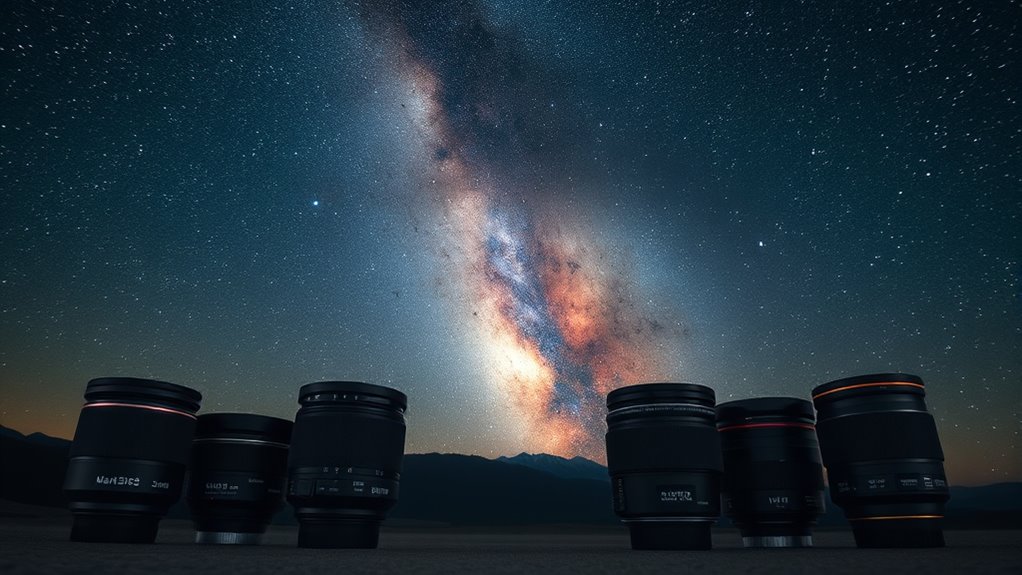

If you’re looking to capture stunning Milky Way shots in 2025, I recommend the AstrHori 6mm F2.8 fisheye for its ultra-wide perspective and sharpness, along with the Sony E 16mm F2.8 for its compact size and bright aperture. For APS-C cameras, the VILTROX 75mm f/1.2 lenses deliver excellent light gathering and clarity. Considering optical quality, distortion control, and portability, these five lenses are ideal choices—if you want to discover which suits you best, keep going.
Key Takeaways
- Wide-angle lenses (14mm-24mm) maximize sky coverage, capturing expansive Milky Way scenes with minimal distortion.
- Fast apertures (f/1.4–f/2.8) enable better low-light performance and shorter exposures for crisp star images.
- High optical quality minimizes aberrations, ensuring sharp, detailed astrophotos with minimal flare and ghosting.
- Optical distortion control maintains accurate star shapes, enhancing realism and reducing post-processing correction.
- Compact, durable designs facilitate outdoor shooting, stability, and portability in remote or low-light environments.

AstrHori 6mm F2.8 Circular Fisheye Lens for Nikon Z Mount, 220° Ultra-Wide Full Frame Manual Lens for Astronomy, Night Sky & Milky Way Photography, Landscape, Architecture and Creative Shots
【Extraordinary 220° Field of View】Capture an ultra-wide perspective beyond the human eye. With a massive 220° angle of...
As an affiliate, we earn on qualifying purchases.
AstrHori 6mm F2.8 Fisheye Lens for Nikon Z Mount
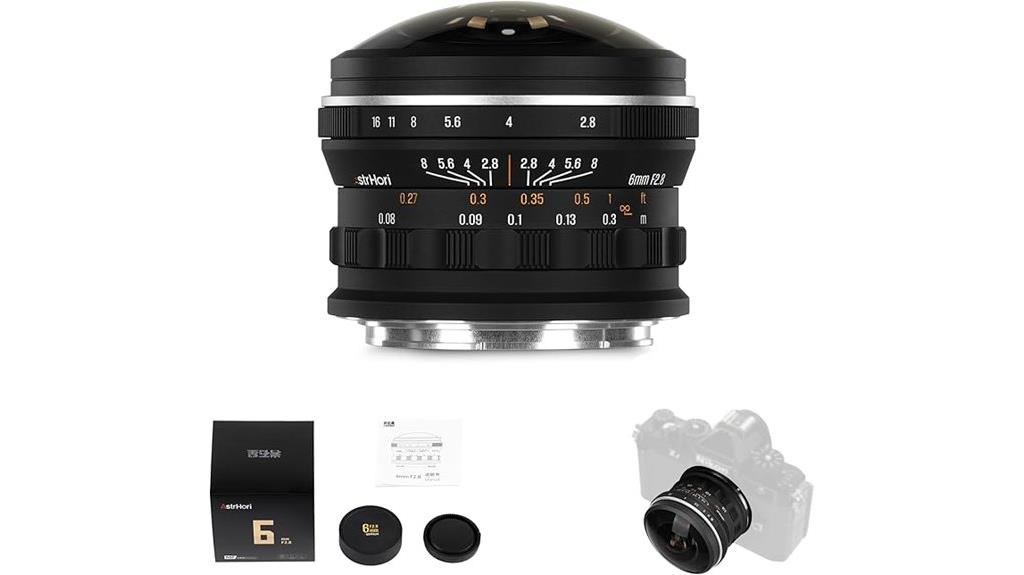
If you’re serious about capturing the vastness of the night sky, the AstrHori 6mm F2.8 Fisheye Lens for Nikon Z Mount is an excellent choice because of its 220° ultra-wide field of view. It creates immersive, circular images perfect for showcasing the Milky Way, landscapes, or cityscapes with dramatic distortion. The bright F2.8 aperture ensures sharpness in low-light conditions, making it ideal for astrophotography. Its compact, all-metal design offers durability and portability, so you can take it anywhere. Manual focus gives you precise control, and the lens’s unique spherical effect adds an artistic touch to your creative projects.
Best For: astrophotographers, creative storytellers, and landscape enthusiasts seeking an ultra-wide, immersive fisheye perspective for low-light and artistic photography.
Pros:
- Creates a 220° ultra-wide circular field of view for dramatic, immersive images
- Bright F2.8 aperture delivers excellent low-light performance for astrophotography and night scenes
- Compact all-metal design ensures durability and portability for outdoor shoots
Cons:
- Manual focus may require additional effort for precise adjustments
- Compatibility limited to Nikon Z mount full-frame mirrorless cameras, requiring manual operation
- Slight edge distortion may not be suitable for all professional applications needing rectilinear accuracy

VILTROX 75mm f/1.2 F1.2 EF PRO EF Lens for Sony E-Mount Ultra Wide Angle APS-C Auto Focus Prime Lens Compatible with Sony E-Mount Mirrorless Cameras A7M/R/S Series A7Cc A9 A1 A6x00 Fs5
F1.2 Super Large Aperture: VILTROX 75mm F1.2 EF lens is equipped with bright f/1.2 maximum aperture suits that...
As an affiliate, we earn on qualifying purchases.
VILTROX 75mm f/1.2 PRO E Lens for Sony APS-C Cameras

The VILTROX 75mm f/1.2 PRO E Lens is an excellent choice for astrophotographers using Sony APS-C cameras, thanks to its fast f/1.2 aperture that captures ample light in dark sky conditions. Its 16-element optical design, including high-refractive index lenses, guarantees sharp, detailed images even at wide open settings. The autofocus, driven by a quiet STM motor, is fast and precise, ideal for capturing fleeting moments. Weighing just under 3 pounds, it’s versatile and durable, with all-metal construction and a rubber focus ring. Despite some vignetting and recognition quirks on older models, it offers superb optical performance, making it perfect for Milky Way and landscape astrophotography.
Best For: photographers and videographers using Sony APS-C cameras who need a high-quality, versatile prime lens with excellent low-light performance and sharp image quality.
Pros:
- Exceptional sharpness and detail even at wide-open aperture f/1.2
- Fast, quiet autofocus with precise tracking suitable for both stills and video
- Durable all-metal construction with lightweight design enhances portability and build quality
Cons:
- Lacks built-in image stabilization, relying on camera IBIS which may vary in effectiveness
- Some vignetting and recognition issues on older Sony camera models
- Heavier weight and somewhat firm bokeh may affect handling and aesthetic preferences

VILTROX 75mm f/1.2 F1.2 XF PRO Level Ultra Wide Angle Auto Focus APS-C Lens Compatible with Fuji X-Mount Cameras X-T5 X-H2 X-H2S X-T30 II X-T4 X-A7 X-E3 X-E4 X-H1X-Pro2 X-T4 X-T10 X-T20
【F1.2 Large Aperture Lens】VILTROX 75mm F1.2 XF lens is equipped with bright f/1.2 maximum aperture suits working in...
As an affiliate, we earn on qualifying purchases.
VILTROX 75mm f/1.2 XF PRO APS-C Lens for Fuji X-Mount Cameras

For astrophotographers using Fuji X-mount APS-C cameras, the VILTROX 75mm f/1.2 XF PRO lens stands out as an excellent choice thanks to its bright f/1.2 aperture. Its sharp, vibrant images with beautiful bokeh make it ideal for capturing the Milky Way’s details and depth. The lens features a solid metal build and advanced coatings to minimize aberrations, ensuring clarity even at wide open settings. Fast, quiet autofocus combined with manual override offers versatility for both stills and videos. Weighing just under three pounds, it’s relatively lightweight for its size, making it a practical, high-performance option for astrophotography in low light.
Best For: amateur and enthusiast photographers seeking a versatile, high-quality portrait and low-light lens for Fuji X-mount APS-C cameras, including astrophotographers capturing night skies.
Pros:
- Exceptional f/1.2 aperture provides excellent low-light performance and beautiful depth of field.
- Sharp, vibrant images with minimal chromatic aberration and high-quality bokeh.
- Solid metal build with advanced coatings ensures durability and clarity even at wide apertures.
Cons:
- Slightly heavier (just under three pounds), which may affect portability for some users.
- Higher price point compared to standard kit lenses, though still more affordable than premium Fuji lenses.
- Minor chromatic aberration at very high contrast, especially in astrophotography or extreme lighting conditions.

Sony E 16mm F2.8 Wide-Angle Prime Lens (SEL16F28) | Compact Pancake Design, Lightweight Travel |Filter Kit, Cap Keeper, Cleaning Kit, and More
Sony USA Authorized. Sony E 16mm f/2.8 Lens (Silver) with 49mm 3-piece filter kit, cleaning kit, and lens...
As an affiliate, we earn on qualifying purchases.
Sony E 16mm F2.8 Wide-Angle Prime Lens
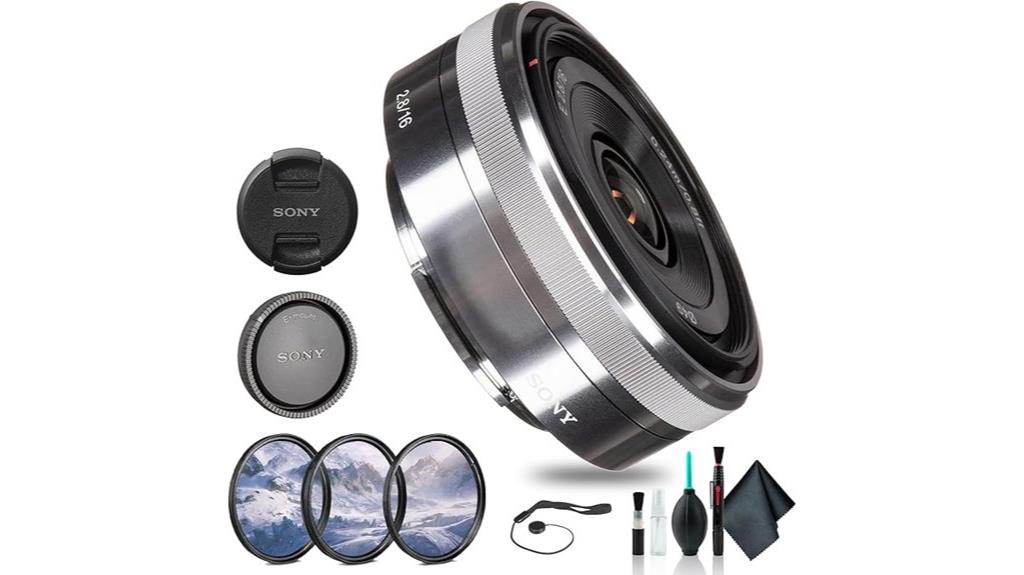
The Sony E 16mm F2.8 Wide-Angle Prime Lens stands out as an excellent choice for astrophotographers seeking a compact, affordable lens with impressive optical quality. Its ultra-lightweight design (67g) and pancake form make it perfect for travel and outdoor shoots. Despite its small size, it features aspherical elements that minimize distortion and aberrations, ensuring sharp, contrast-rich images with natural colors. The bright F2.8 aperture allows for great low-light performance and beautiful background blur. With a close focusing distance of 0.24 meters and quiet autofocus, it’s versatile for both stills and videos. Its compatibility with converters adds even more creative options.
Best For: travel, street, landscape, and astrophotography enthusiasts seeking a lightweight, versatile wide-angle prime lens with excellent optical quality.
Pros:
- Ultra-lightweight and compact design (67g), ideal for portability and travel.
- Sharp, contrast-rich images with minimal distortion thanks to aspherical elements.
- Bright F2.8 aperture provides good low-light performance and pleasing background blur.
Cons:
- Limited professional features and advanced control options.
- Customer reviews indicate some concerns about noise performance and overall functionality.
- Included accessories and build quality may not meet the expectations of all professional users.
78 D Double Aspheric Lens
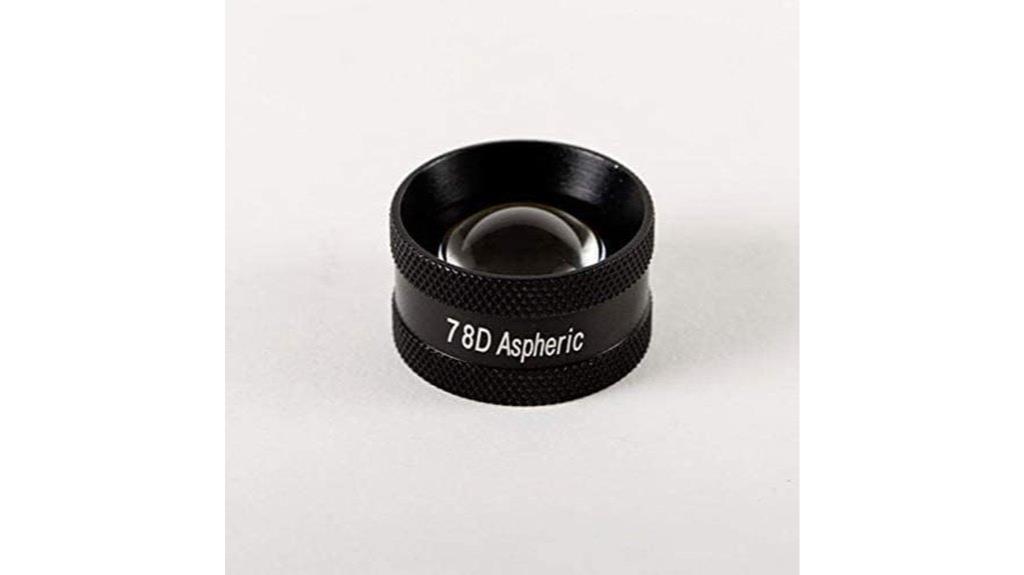
If you need a lens that offers an ideal balance of field and magnification, the 78 D Double Aspheric Lens is an excellent choice. Designed with double aspheric elements, it enhances optical clarity and performance, making it perfect for detailed ophthalmic examinations. Its extended working distance from the cornea adds versatility, especially when working with slit lamp equipment. Weighing just about 5 ounces and measuring roughly 3 inches, it’s compact and easy to handle. Manufactured by KASHSURG, this lens has earned a solid reputation, with a 4.4-star rating from users. Its popularity and reliable quality make it a versatile option, even beyond ophthalmology.
Best For: ophthalmologists and eye care professionals seeking precise, high-quality slit lamp examinations with an extended working distance.
Pros:
- Offers a balanced combination of field and magnification for detailed observations
- Double aspheric elements enhance optical clarity and performance
- Compact design weighing only about 5 ounces for ease of handling
Cons:
- Compatibility may require specific slit lamp models
- Slight variations in specifications could occur due to ongoing research
- Limited information on warranty and after-sales support details
Factors to Consider When Choosing Wide-Field Lenses for Milky Way Photography

When selecting a wide-field lens for Milky Way photography, I focus on factors like a broad field of view and a large aperture for better light gathering. Low-light performance and minimal optical distortion are also essential to capture sharp, vibrant night sky images. Additionally, I consider how compact and lightweight the lens is for easier handling during long night shoots.
Wide Field of View
A wide field of view is essential for capturing the grandeur of the Milky Way and its surrounding landscape in a single shot. It allows you to include more of the night sky and foreground, creating an immersive scene that highlights the scale and beauty of the universe. Lenses with ultra-wide angles, typically between 14mm and 24mm on full-frame cameras, are perfect for maximizing sky coverage. This broad perspective also reduces the need for multiple shots, making panoramic compositions easier to achieve. Additionally, a wide field of view helps minimize distortion while providing a sense of vastness and scale. It opens up more creative framing options, enabling you to include foreground elements that add depth and context to your astrophotography.
Aperture Size Importance
Ever wondered why aperture size matters so much in Milky Way photography? It’s because a wider aperture (smaller f-number) lets in more light, which is essential for capturing the faint details of the night sky. An aperture of f/2.8 or larger—like f/1.8 or f/1.4—ensures your camera gathers enough light quickly, reducing the need for long exposures. Larger apertures also create a shallow depth of field, helping the Milky Way stand out sharply against the darker sky. They directly influence image brightness and noise levels, with wider openings producing cleaner, less noisy photos in low-light conditions. Plus, a bright aperture gives you creative flexibility, whether you’re aiming for star trails or emphasizing specific celestial features.
Low-Light Performance
Choosing a lens with excellent low-light performance is essential for capturing the beauty of the Milky Way. A large maximum aperture, ideally f/2.8 or wider, allows more light to hit the sensor, which is crucial in dark sky conditions. Fast lenses with wide apertures enable shorter exposure times, helping to prevent star trails caused by Earth’s rotation. High-quality optics that minimize chromatic aberration and maximize light transmission ensure sharp, bright images of faint celestial objects. Low-light performance also depends on how well the lens maintains sharpness and contrast at wide apertures in darkness. Additionally, controlling flare and ghosting is vital to preserving the brightness and fine details of the night sky, making these factors key when selecting your wide-field lens for Milky Way photography.
Optical Distortion Control
Optical distortion can profoundly impact the quality of wide-field Milky Way images, making straight lines appear curved or warped. This distortion, such as barrel or pincushion distortion, compromises the realism of your shots. Thankfully, high-quality lenses incorporate design features like aspherical elements and specialized coatings that minimize these aberrations. Advanced optical formulas help reduce edge distortion, ensuring celestial objects and star trails stay true to their natural shapes. Excessive distortion complicates post-processing, making it harder to correct star shapes and diminishing overall image clarity. Choosing lenses with built-in distortion correction or minimal inherent distortion is vital. These lenses preserve the spherical appearance of stars and the night sky, leading to sharper, more accurate astrophotography results without extensive editing.
Compact and Lightweight
When selecting a wide-field lens for Milky Way photography, its size and weight play a crucial role in your shooting experience. Compact and lightweight lenses are much easier to carry during outdoor sessions, helping reduce fatigue during long nights under the stars. Smaller lenses also allow for more discreet shooting, making it easier to capture natural scenes without drawing attention. If you enjoy traveling or backpacking, lightweight lenses are perfect, enabling you to explore remote locations without carrying heavy gear. They also cause less vibration, resulting in sharper images, especially when used handheld or with stabilization. Plus, their portability makes it possible to set up more stable, slower tripods, which improves image quality in low-light conditions.
Autofocus Capabilities
While compact and lightweight lenses make for easy outdoor shooting, autofocus capabilities are often less important for Milky Way photography. In low-light conditions, manual focus provides more control and accuracy, which is vital for capturing sharp night sky images. Many wide-field lenses designed for astrophotography lack autofocus motors altogether, relying solely on manual focus adjustments. Autofocus can be unreliable or slow in darkness because of limited contrast, making it difficult to achieve precise focus on distant stars. Some modern lenses feature autofocus with improved low-light performance, but they still may struggle to lock onto distant celestial objects. For Milky Way shots, the ability to quickly switch to manual focus and fine-tune it is generally more beneficial than autofocus features.
Build Durability
Durability is a critical factor when choosing a wide-field lens for Milky Way photography, especially since outdoor conditions can be unpredictable. I look for lenses with all-metal construction, which can withstand rough handling and harsh environments. Weather-sealing features like gaskets and seals are essential to protect against dust, moisture, and temperature swings that can occur during outdoor shoots. A sturdy lens mount and reinforced joints prevent damage from impacts or prolonged use in challenging conditions. High-quality coatings and scratch-resistant elements help maintain optical clarity and extend the lens’s lifespan. Additionally, I prefer lightweight but durable materials that reduce fatigue during long shooting sessions without sacrificing strength. Prioritizing build durability ensures I can focus on capturing stunning night skies without worrying about equipment failure.
Compatibility With Cameras
Choosing a wide-field lens that’s compatible with your camera is crucial to guarantee smooth operation and ideal image quality. First, check that the lens mount matches your camera’s mount type, whether Nikon Z, Sony E-mount, or Fuji X-mount. Next, confirm if the lens is designed for full-frame or APS-C sensors to ensure it fits your camera’s sensor size and achieves the desired wide perspective. Also, consider whether the lens offers autofocus or if you’ll need to rely on manual focus, depending on your camera’s capabilities. Additionally, verify if the lens supports electronic communication for aperture control and EXIF data transfer. In conclusion, ensure compatibility with your camera’s firmware and whether any updates are necessary to guarantee top performance during your Milky Way shoots.
Frequently Asked Questions
How Do Aperture Sizes Affect Milky Way Astrophotography?
Aperture size plays a vital role in Milky Way photography because a larger aperture lets in more light, allowing me to capture the galaxy’s details even in darker skies. With a wide aperture, I can use shorter exposures, reducing star trail effects caused by Earth’s rotation. So, I always look for lenses with wide apertures, like f/2.8 or wider, to get brighter, sharper, and more vibrant Milky Way shots.
What Is the Optimal Focal Length for Wide-Field Milky Way Shots?
I find that an ideal focal length for wide-field Milky Way shots is between 14mm and 24mm. This range allows me to capture a broad expanse of the night sky while maintaining sharpness across the frame. I prefer wider lenses because they let me include more stars and landscape, creating stunning, immersive images. Keep in mind, the wider the lens, the more dramatic your shot can be.
Are Lens Coatings Important for Reducing Star Glare and Reflections?
Think of lens coatings like a raincoat for your camera; they protect against unwanted reflections. Yes, coatings are essential—they reduce star glare and reflections, making your Milky Way shots clearer. I once used a lens without coatings, and reflections blurred my stars. Upgrading to a coated lens made a huge difference, sharpening the celestial details and eliminating distracting flares. So, investing in coated lenses truly elevates your astrophotography.
How Does Lens Weight Influence Long Exposure Night Photography?
Lens weight really impacts long exposure night photography because heavier lenses can be harder to stabilize on your tripod, leading to potential vibrations or movement. I find that lightweight lenses make it easier to set up and keep steady, which is essential for sharp star images. Plus, lighter gear is more comfortable to carry during long nights of shooting, helping me stay focused and avoid fatigue.
Can These Lenses Be Used Effectively With Smartphone Adapters?
Yes, these lenses can be used effectively with smartphone adapters. I’ve found that attaching a wide-field lens to my phone enhances my night sky shots considerably. Just make certain your adapter is compatible with your device and lens. Stability is key, so I recommend using a tripod or steady surface. With the right setup, you’ll capture stunning, wide-angle Milky Way images right from your smartphone.
Conclusion
Choosing the right wide-field lens can feel like finding a clear night’s sky amid a sea of stars. Each option I’ve shared offers a unique window to the cosmos, helping you capture the Milky Way’s gentle glow. Trust your instincts and envision the scenes you want to create—sometimes, a lens is the brush that paints your celestial masterpiece. Embrace your journey, and let your photography light up the night sky.