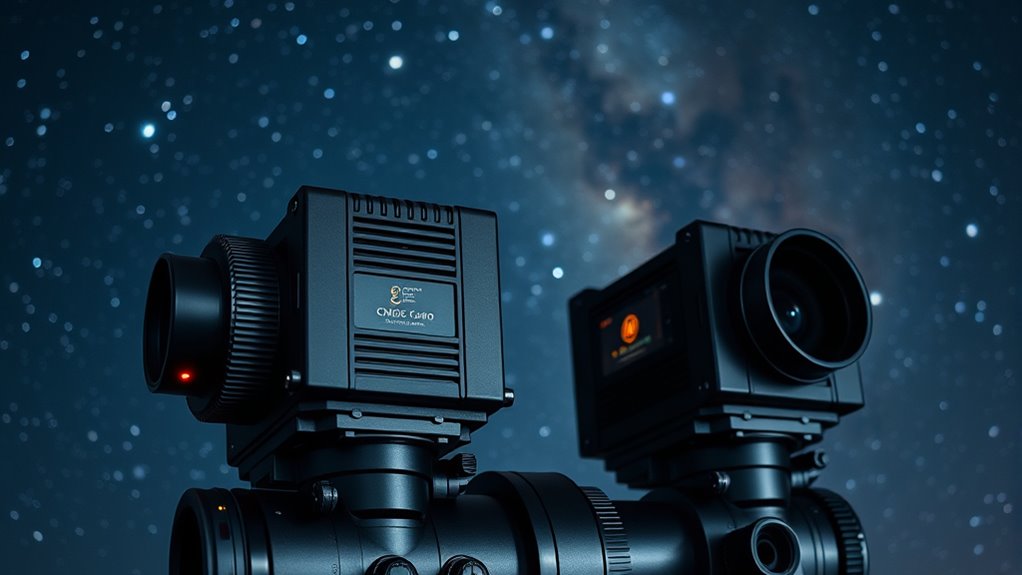

Choosing the right cooled CMOS astro camera in 2026 hinges on balancing sensitivity, cooling efficiency, and system compatibility. The SVBONY SV605CC stands out for its high sensitivity and dual-band nebula filter, making it ideal for capturing faint nebulae even in light-polluted skies. Meanwhile, the SVBONY SV405CC offers a larger sensor with high resolution and excellent noise reduction, suited for deep sky enthusiasts aiming for detailed images. Both cameras excel in different ways, but their main tradeoffs involve size, complexity, and price—factors I consider crucial for making a well-informed choice.

Get movie nights delivered free — and shop member deals
- Fast, free delivery on millions of items
- Access to Prime Big Deal Days deals on October 6–7
- Prime Video, Amazon Music and more included
Key Takeaways
- The SVBONY SV605CC is best suited for users seeking a compact, lightweight camera with specialized nebula imaging capabilities.
- The SVBONY SV405CC offers higher resolution and broader system compatibility, though it is bulkier and more complex to operate.
- Cooling performance is strong in both models, significantly reducing thermal noise during long exposures.
- Filter options and sensor sizes differ, affecting suitability for specific deep sky targets and setups.
- Price and ease of use vary, making it essential to match each camera’s strengths with the user’s experience level and budget.
| SVBONY SV605CC Cooled Astrophotography Camera with 9MP IMX533 Sensor and 2″ Dual-Band Nebula Filter |  | Best for Specialized Nebula Imaging | Sensor: IMX533 9MP CMOS | Sensor Size: 1 inch | Resolution: 3008×3008 | VIEW ON AMAZON | See Our Full Breakdown |
| SVBONY SV405CC Astrophotography Camera, Cooled Telescope Eyepiece IMX294 |  | Best for High-Resolution Deep Sky Imaging | Sensor: IMX294 4/3″ CMOS | Resolution: 4144×2822 pixels | Pixel Size: 4.63μm | VIEW ON AMAZON | See Our Full Breakdown |
| cooled cmos astro cameras for deep sky imaging | Sensor | Resolution | Pixel Size | Cooling |
|---|---|---|---|---|
| SVBONY SV605CC Cooled Astropho | IMX533 9MP CMOS | 3008×3008 | 3.76μm | Double layer semiconductor refrigeration to 30°C below ambient |
| SVBONY SV405CC Astrophotograph | IMX294 4/3" CMOS | 4144×2822 pixels | 4.63μm | Two-Stage TEC to 30°C below ambient |
More Details on Our Top Picks
SVBONY SV605CC Cooled Astrophotography Camera with 9MP IMX533 Sensor and 2″ Dual-Band Nebula Filter
The SVBONY SV605CC stands out for its high-sensitivity 9MP IMX533 sensor and dedicated dual-band nebula filter, making it an excellent choice for capturing faint nebulae and galaxies even under light-polluted skies. Its dual-layer semiconductor refrigeration cools the sensor to 30°C below ambient, significantly lowering thermal noise during long exposures. Compared with the SV405CC, this camera is more compact and lightweight, which benefits portable setups. However, it requires manual focus adjustments and is primarily designed for more experienced astrophotographers who are comfortable with filter configurations and system integration.
Pros:- High sensitivity and low noise for detailed imaging
- Effective cooling system reduces thermal noise significantly
- Dual-band nebula filter enhances nebula details and reduces light pollution
- Compact and lightweight for portable use
Cons:- Requires manual focus adjustments, which can be challenging
- Limited compatibility with some filters and mounts
- Designed mainly for advanced users
Best for: Advanced deep sky astrophotographers focused on nebula and galaxy imaging in light-polluted environments
Not ideal for: Beginners or those seeking plug-and-play simplicity, as it demands manual focus and filter handling
- Sensor:IMX533 9MP CMOS
- Sensor Size:1 inch
- Resolution:3008×3008
- Pixel Size:3.76μm
- Cooling:Double layer semiconductor refrigeration to 30°C below ambient
- Filter:SV220 2″ dual-band nebula filter (OIII and H-Alpha)
- Weight:50g
Our verdict“This camera excels for experienced astrophotographers who prioritize nebula detail and compactness but demands manual operation and specialized filter use.”
SVBONY SV405CC Astrophotography Camera, Cooled Telescope Eyepiece IMX294
The SVBONY SV405CC features a 4/3″ IMX294 sensor with 11.7MP resolution, offering detailed imaging of deep-sky objects. Its two-stage TEC cooling system pulls sensor temperatures down by approximately 30°C below ambient, dramatically reducing thermal noise for long exposures. This camera’s USB 3.0 interface ensures fast data transfer, which is essential when capturing high-resolution images. Compared with the SV605CC, the SV405CC’s larger sensor and higher resolution make it more suitable for capturing intricate details of nebulae and galaxies. However, its size and weight—over 3 pounds—may be a drawback for portability, and its setup can be more complex, requiring some technical expertise.
Pros:- High-sensitivity sensor with excellent detail capture
- Efficient cooling reduces thermal noise significantly
- Fast USB 3.0 data transfer supports high-resolution imaging
- Compatible with multiple software and operating systems
Cons:- Relatively heavy and large, less portable
- More complex setup requiring technical knowledge
- Price point may be higher, depending on configuration
Best for: Intermediate to advanced astrophotographers needing high resolution and system versatility
Not ideal for: Beginners or those with limited space or portability needs, due to its weight and setup complexity
- Sensor:IMX294 4/3″ CMOS
- Resolution:4144×2822 pixels
- Pixel Size:4.63μm
- Cooling:Two-Stage TEC to 30°C below ambient
- Interface:USB 3.0
- Weight:3.08 pounds
Our verdict“The SV405CC offers a compelling mix of resolution and cooling efficiency for dedicated deep sky imagers who prioritize image detail over portability.”

How We Picked
My selection process focused on key factors critical for deep sky imaging with cooled CMOS cameras. I prioritized sensor sensitivity, cooling efficiency, image resolution, and system compatibility. I also considered the practicality of setup and size for different user levels, from amateurs to advanced astrophotographers. Features like filter integration, noise reduction, and overall system weight played a vital role in distinguishing between models. Ultimately, I aimed for options that offer a clear balance between performance and usability, ensuring each appeals to a specific segment of deep sky enthusiasts.
| cooled cmos astro cameras for deep sky imaging | Sensor | Cooling |
|---|---|---|
| SVBONY SV605CC Cooled Astropho | IMX533 9MP CMOS | Double layer semiconductor refrigeration to 30°C below ambient |
| SVBONY SV405CC Astrophotograph | IMX294 4/3" CMOS | Two-Stage TEC to 30°C below ambient |
Factors to Consider When Choosing Cooled Cmos Astro Cameras For Deep Sky Imaging
Selecting the ideal cooled CMOS astro camera for deep sky imaging involves considering several key factors. Sensor sensitivity and cooling efficiency directly influence your ability to capture faint objects with minimal noise. Resolution determines how much detail you’ll record, especially for large or intricate nebulae and galaxies. Compatibility with your existing mount, software, and system setup also plays a crucial role. Understanding these elements helps ensure your investment aligns with your imaging goals and experience level.
Sensor Sensitivity and Cooling
The core of any deep sky camera is its sensor. Larger sensors generally collect more light, allowing for better detail in faint objects. The cooling system’s effectiveness—whether it’s TEC or semiconductor refrigeration—reduces thermal noise, which is critical during long exposures. Cameras like the SV605CC with its dual-layer refrigeration excel here, especially for light-polluted environments. But higher cooling capacity often comes with increased complexity and cost, so consider your typical imaging conditions and budget.
Resolution and Image Quality
Higher resolution sensors, like the 11.7MP IMX294 in the SV405CC, enable capturing more fine detail, ideal for large or detailed deep sky objects. However, high resolution also means larger data files and potentially slower processing. Conversely, 9MP sensors are still capable of excellent results but might be more manageable for beginners or setups with limited processing power. Match resolution to your target objects and your system’s processing capabilities.
System Compatibility and Size
Compatibility extends beyond software—consider mount adapters, filter sizes, and system weight. The compact design of the SV605CC makes it easier for portable setups, while the larger SV405CC provides higher resolution at the expense of portability. If you plan to travel or set up in different locations, size and weight become more critical. Also, check if your preferred software supports the camera’s interface and sensor type to avoid integration issues.
Frequently Asked Questions
How does cooling improve deep sky imaging?
Cooling reduces the temperature of the camera sensor, which in turn diminishes thermal noise that can obscure faint deep sky objects. Lower noise levels allow for longer exposures without sacrificing image quality, making it easier to capture subtle details in nebulae and galaxies. Both models here utilize different cooling methods, but their goal is to achieve a stable, low-noise image even during extended imaging sessions.
Is higher resolution always better for deep sky astrophotography?
While higher resolution sensors capture more detail, they also produce larger data files and may require more processing power. For many deep sky projects, a balance between resolution and system capability is ideal. The SV405CC’s 11.7MP sensor provides excellent detail for large objects, but for users with limited processing resources or smaller targets, a 9MP sensor like the one in the SV605CC can still deliver impressive results without the added complexity.
Can I use these cameras with my existing telescope mount?
Both cameras are designed with standard thread sizes—M48 for the SV605CC and a similar mounting system for the SV405CC—making them compatible with many mounts through appropriate adapters. However, weight and size differences matter: the SV605CC is more suitable for portable, lightweight setups, while the SV405CC’s bulkier profile may require more robust mounting hardware. Always confirm your mount’s weight capacity and compatibility before purchase.
Do I need special software to operate these cameras?
Most modern cooled CMOS cameras, including these models, support popular astrophotography software like SharpCap, PHD2, and ASCOM-compatible applications. The SV405CC’s USB 3.0 interface offers faster data transfer, which benefits high-resolution imaging. Compatibility is usually straightforward, but it’s wise to verify that your chosen software supports the specific sensor and interface used in each camera to avoid setup issues.
Are these cameras suitable for beginner astrophotographers?
While both cameras offer impressive features, the SV605CC’s manual focus and filter requirements may present a learning curve for beginners. The SV405CC, with its higher resolution and broad compatibility, can appeal to more experienced users who want detailed images and system flexibility. For newcomers, simpler, integrated cameras might be preferable, but these models are excellent options for those ready to handle a bit more complexity for superior results.
Conclusion
If you are just starting out or prefer a lightweight, easy-to-use setup, the SVBONY SV605CC provides excellent sensitivity and nebula imaging capabilities, making it ideal for light-polluted environments. For dedicated deep sky enthusiasts seeking high resolution, detailed images, and broader compatibility, the SVBONY SV405CC stands out despite its larger size and setup complexity. Both are solid choices in 2026, depending on your experience level, imaging goals, and system constraints.
Fall Picks
fall essentials
As an affiliate, we earn on qualifying purchases.