
A strong security command structure involves dividing your area into zones to target monitoring and management effectively. Radios are vital for reliable, quick communication, ensuring alerts, updates, and escalation notices reach the right teams instantly. When incidents escalate, clear protocols help you mobilize resources and involve higher authorities promptly. Staying organized with these elements helps you respond swiftly and efficiently. Continue exploring how these components work together to keep your security operations sharp.
Key Takeaways
- Dividing areas into zones improves targeted monitoring and efficient incident reporting.
- Reliable radios ensure swift communication for alerts, updates, and escalation notices.
- A clear command structure defines roles, responsibilities, and decision-making hierarchy.
- Escalation procedures enable rapid involvement of higher authorities and additional resources.
- Organized zones, radios, and escalation protocols facilitate coordinated, adaptable emergency responses.
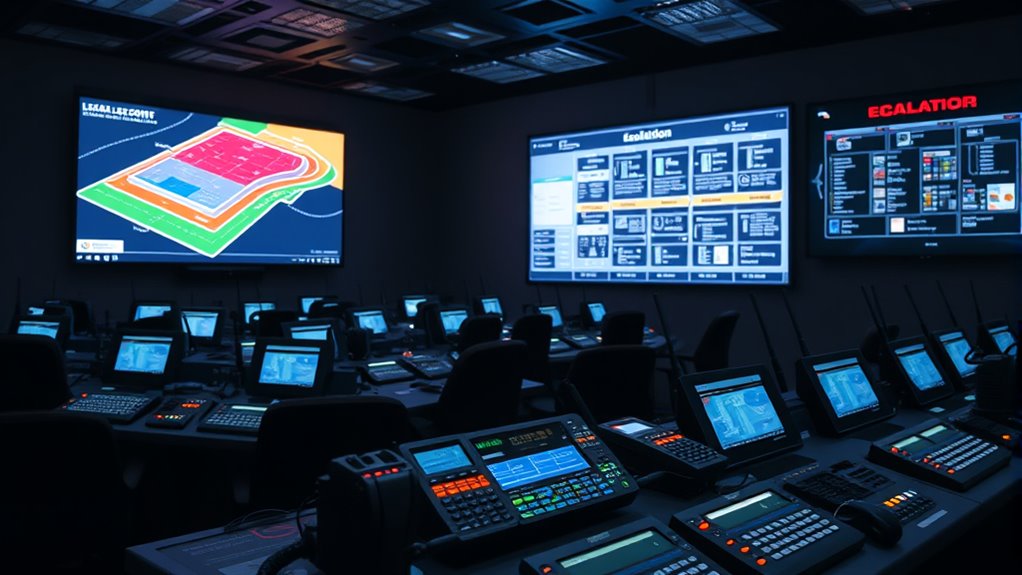
A well-organized security command structure is essential for guaranteeing effective coordination and response during emergencies. When an incident occurs, your ability to manage it efficiently depends heavily on clear incident management procedures and well-defined communication protocols. You need a system where every team member understands their role, knows who to report to, and can relay information swiftly and accurately. This structure helps prevent chaos and ensures that resources are deployed where they’re needed most.
In practice, incident management relies on a chain of command that keeps everyone on the same page. As soon as an incident is identified, you follow established protocols, which typically involve activating a command post and assigning specific roles—such as incident commander, security officer, and communication liaison. These roles are critical because they define who makes decisions and who implements them. Clear incident management ensures that responses are coordinated and that efforts aren’t duplicated or overlooked. It also allows for quick assessment of the situation, enabling you to escalate or de-escalate responses as necessary.
Communication protocols are the backbone of this structure. Without reliable channels, even the best plans can fall apart. You must guarantee that radios and other communication devices are functioning properly, and that everyone knows which channels to use for different types of information. For example, there should be designated radios for emergency alerts, routine updates, and escalation notices. When a situation develops, swift and precise communication minimizes confusion and prevents misinformation from spreading. Regular drills help reinforce these protocols, so everyone knows how to communicate under pressure.
Zones also play a crucial role in your security command structure. By dividing the area into zones, you can assign teams specific sectors to monitor and manage. This segmentation allows for more targeted incident management and helps streamline communication. When something happens in a particular zone, your team members there can quickly report details up the chain, enabling a faster response. It also minimizes the risk of overlooking incidents in less monitored areas, maintaining thorough coverage during critical moments.
As incidents escalate, your command structure must adapt. Clear escalation procedures ensure that higher-level authorities are brought in at the right moment, and that additional resources are mobilized without delay. This process relies heavily on your established communication protocols, which must facilitate rapid information flow to decision-makers. An effective security command structure that integrates zones, radios, incident management, and communication protocols ensures that you’ll respond swiftly, coordinate efficiently, and resolve incidents with minimal disruption. Additionally, understanding the importance of security zone info helps in designing an effective layout for incident containment and resource allocation. Ultimately, this organized approach helps you protect people, property, and assets during every emergency.

SAMCOM Two Way Radio with Shoulder Speaker Mic,5W High Power 2 Way Radios Long Range Walkie Talkie earpiece with mic for Adults Construction Site School Security(4 Pack)
Long distance radios with loud 2-Pin hand mic to provide stable transmission even in noisy surroundings like construction…
As an affiliate, we earn on qualifying purchases.
As an affiliate, we earn on qualifying purchases.
Frequently Asked Questions
How Are Security Zones Initially Established and Reviewed?
You establish security zones by assigning a clear Zone designation based on risk levels and operational needs. Initially, you review these zones through regular review procedures, which include evaluating threat levels, operational changes, and incident reports. This process helps you guarantee each zone remains appropriate and effective. You continually update zone designations as needed, maintaining ideal security coverage and ensuring your response protocols are aligned with current conditions.
What Training Is Required for Radio Protocol Compliance?
Did you know that 85% of security incidents could be avoided with proper radio protocol? To guarantee protocol consistency, you need thorough training on radio etiquette, including clear communication, proper use of codes, and active listening. This training helps you respond quickly and accurately during emergencies. By mastering these skills, you maintain effective communication, reduce misunderstandings, and ensure safety and coordination across all security zones.
How Is Escalation Severity Determined During Incidents?
During incidents, you determine escalation severity through a thorough severity assessment. You evaluate factors like the threat level, potential impact, and response time needed. Your goal is to identify if the situation requires immediate escalation to higher command or specialized teams. By carefully analyzing these elements, you guarantee appropriate incident escalation, enabling swift and effective responses that mitigate risks and maintain security protocol compliance.
Are There Any Digital Tools Supporting Command Structure Management?
Did you know over 75% of security teams use digital tools to streamline command management? Digital mapping and software integration are key in managing zones, radios, and escalation. These tools allow you to visualize incident areas, coordinate responses efficiently, and guarantee clear communication. By integrating software, you gain real-time updates, better situational awareness, and faster decision-making, making your command structure more effective during critical incidents.
How Is Inter-Agency Communication Coordinated Within the System?
You coordinate inter-agency communication by following established communication protocols that guarantee clear, timely exchanges. During incidents, you activate mutual aid channels and designated radios for each agency, maintaining constant updates. You facilitate inter-agency coordination through pre-planned procedures, ensuring everyone understands their roles. Regular training and drills reinforce these protocols, allowing seamless communication during emergencies. This approach helps prevent misunderstandings and promotes effective collaboration across all involved agencies.

PGST Home Security Systems for House, Wireless Home Security Alarm System, Door/Window Sensor Motion Sensors with App Alert, WiFi+GSM 4G Home Alarm System No Subscription(103-F)
【WIFI 4G GSM AlARM SYSTEM】Wherever you are, you can change the security mode and manage your devices on…
As an affiliate, we earn on qualifying purchases.
As an affiliate, we earn on qualifying purchases.
Conclusion
By understanding the security command structure, including zones, radios, and escalation protocols, you can respond swiftly and confidently in any situation. Picture yourself managing a breach in a restricted zone, coordinating with team members via radios, and escalating the issue when necessary. This clear hierarchy guarantees everyone knows their role, keeps incidents contained, and maintains safety. Mastering these elements puts you in control, ready to handle emergencies effectively and protect what matters most.

10 Powerful Strategies For Conflict De-Escalation: How To Achieve Conflict Resolution Through Effective Communication
As an affiliate, we earn on qualifying purchases.
As an affiliate, we earn on qualifying purchases.

Accident & Incident Report Book: Workplace Injury & Safety Log for Employees. Track Accidents, Employee Injuries, & Near Misses with This Easy-to-Use … Offices, Factories, and Construction Sites.
As an affiliate, we earn on qualifying purchases.
As an affiliate, we earn on qualifying purchases.