
TL;DR

Get movie nights delivered free with Prime
- Fast, free delivery on millions of items
- Prime Video, Amazon Music and more included
- Member-only deals all year
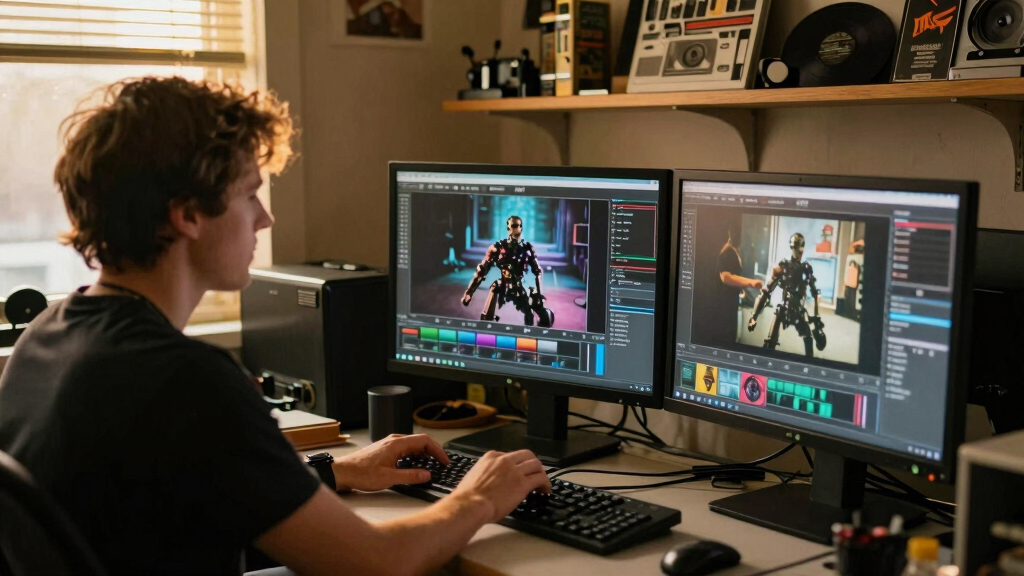
An oral history from 2017 reveals how ‘Terminator 2’ pioneered visual effects and robotics technology. The article details confirmed innovations, their impact, and ongoing questions about the film’s legacy.
The technological innovations behind ‘Terminator 2: Judgment Day’ were groundbreaking for their time, according to a 2017 oral history featuring key creators. The film’s use of advanced visual effects and robotics set new standards in filmmaking, making it a landmark in cinematic history.
The oral history, published in 2017, includes interviews with director James Cameron, special effects supervisor Stan Winston, and other key figures involved in the film’s production. It confirms that the film’s innovative use of CGI, particularly the T-1000’s liquid metal effects, was a pioneering achievement. The T-800’s endoskeleton was created with practical robotics, blending physical effects with digital technology. These innovations required significant technical development, including new software and hardware, which pushed the boundaries of what was possible in 1991. The creators also discuss the challenges faced during production, such as creating realistic liquid metal movements and integrating practical effects seamlessly with CGI.Impact of ‘Terminator 2’s’ Technological Breakthroughs
The innovations detailed in the oral history demonstrate how ‘Terminator 2’ transformed visual effects in cinema, influencing countless films that followed. Its successful integration of CGI and practical effects validated digital technology as a tool for blockbuster filmmaking. This shift has had lasting effects on the industry, making digital effects a standard component in modern movies. Additionally, the film’s robotics and animatronics techniques advanced the field of practical effects, contributing to the development of more realistic creature and character effects in subsequent productions. Understanding these breakthroughs highlights the film’s role in shaping the future of visual storytelling and special effects technology.Popular right now

Hisense 40-Inch Class QD4SR Series Hi-QLED FHD Smart Roku TV (2026 Model)

TCL 43-Inch 4K UHD Smart LED Roku TV (43S435, 2021 Model)

Dyson V15 Detect Cordless Vacuum
As an affiliate, we earn on qualifying purchases.
The Evolution of Visual Effects Leading to ‘Terminator 2’
Prior to ‘Terminator 2,’ visual effects primarily relied on practical techniques like puppetry, miniatures, and compositing. The film’s success was partly due to its ambitious attempt to create a convincing liquid metal T-1000, which required new software and hardware innovations. Stan Winston’s team also developed realistic robotics for the T-800 endoskeleton, building on earlier effects work but pushing further. The film’s release in 1991 marked a turning point, as CGI was still in its infancy, and ‘Terminator 2’ demonstrated its potential for blockbuster cinema. The film’s technological achievements set new industry standards and inspired subsequent innovations in digital effects.“We wanted to create effects that felt real, that could move and react like liquid metal. It was a huge technical challenge, but it paid off.”
— James Cameron
Unresolved Questions About ‘Terminator 2’s’ Technical Legacy
While the oral history confirms many technological achievements, it is not yet clear how much of the original software and hardware innovations directly influenced later CGI developments. Details about the specific software tools created for the liquid metal effects remain proprietary or undocumented. Additionally, some technical challenges faced during production are still not fully detailed, and the long-term impact on effect industry standards continues to evolve with new technologies.Future Research on ‘Terminator 2’s’ Impact on Visual Effects
Further analysis of archival materials and interviews could clarify the precise technological innovations and their influence. Industry experts may explore how ‘Terminator 2’’s effects techniques have been adapted or improved in subsequent films. Ongoing technological advancements in CGI and robotics suggest that the film’s legacy will continue to be studied and celebrated in the effects community.Key Questions
What specific effects techniques did ‘Terminator 2’ pioneer?
The film pioneered the use of computer-generated imagery (CGI) for the liquid metal T-1000, and integrated practical robotics for the T-800 endoskeleton, setting new standards in visual effects.
How did the effects team develop the liquid metal character?
According to the oral history, the team used pioneering software and hardware to simulate realistic liquid metal movements, with significant technical challenges overcome through innovative solutions.
Did ‘Terminator 2’ influence later CGI films?
Yes, the film’s successful blending of CGI and practical effects demonstrated the potential of digital effects in mainstream cinema, influencing many subsequent blockbuster productions.
Are the effects technology used in ‘Terminator 2’ still relevant today?
While technology has advanced, the principles established in ‘Terminator 2’ remain foundational, and its effects techniques are still studied and built upon in modern visual effects work.
Source: hn