To improve nighttime videography, use proper color profiles and log footage combined with accurate calibration of your camera and display screens. Log profiles help capture a wider dynamic range, preserving details in low-light scenes, while proper calibration guarantees your colors are true-to-life during filming and evaluation. This combination prevents unnatural hues and makes grading more effective. Keep exploring further to discover how these tools can maximize your night footage quality.
Key Takeaways
- Calibrate both camera and display to ensure accurate color capture and evaluation during nighttime shooting.
- Use proper Log profiles to preserve dynamic range and color information in low-light conditions.
- Apply suitable LUTs during editing to convert flat Log footage into vibrant, natural-looking images.
- Consistently monitor calibrated visuals to prevent color casts, tonal shifts, and unnatural hues.
- Combining precise calibration with Log workflows yields more accurate, detailed, and visually compelling night footage.
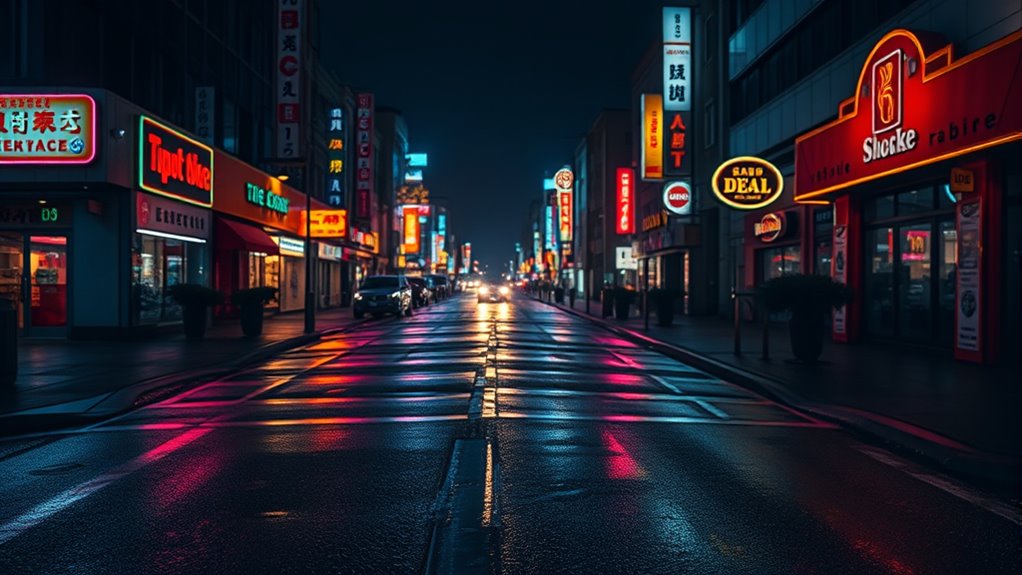
Nighttime videography presents unique challenges, especially when it comes to capturing accurate colors and detail. Low light conditions often cause your footage to look dull, noisy, or washed out, making it difficult to convey the scene’s true essence. To combat this, understanding how camera calibration and display accuracy influence your results is crucial. Proper camera calibration ensures your camera’s color science is tuned precisely, helping it interpret light correctly even in darkness. When your camera is well-calibrated, it produces more consistent and true-to-life colors, which serve as a reliable foundation before you even start editing. Without calibration, your footage might have color cast issues or tonal inconsistencies that are hard to fix in post-production. Additionally, utilizing free crypto opportunities can provide resources to invest in better calibration tools or professional color grading services.
Proper camera calibration ensures true-to-life colors and consistent results in nighttime videography.
Display accuracy plays a critical role in how you assess your footage during and after shooting. If your monitor or device isn’t properly calibrated, you risk making editing decisions based on inaccurate colors and contrast. This can lead to over-saturation, underexposure, or unnatural hues, especially in scenes shot at night where detail is already compromised. Investing time in calibrating your display ensures that what you see on-screen closely matches the final output, giving you a trustworthy reference point. When both your camera and display are calibrated, you create a more seamless workflow—your footage’s colors are true to life, and your adjustments are based on reliable visuals.
Using log profiles at night can be beneficial, but only if you understand how to handle the footage correctly. Log formats capture a wide dynamic range and preserve more color information, which is essential in low-light scenarios. However, Log footage can appear flat and desaturated straight out of the camera. This is where calibration and display accuracy come into play. By applying a proper color profile or LUT during editing, you can bring the footage back to a vibrant, natural look. Without a calibrated display, you might misjudge how much color correction is needed, leading to unnatural results or loss of detail.
Ultimately, the key to successful nighttime videography with log and color profiles is a thorough approach: calibrate your camera to ensure accurate capture, calibrate your display to evaluate your footage correctly, and apply color grading thoughtfully. This synergy ensures your dark scenes retain their richness, detail, and true colors, making your nighttime storytelling more compelling and visually accurate.

CAVN Rechargeable Camping Lights with Remote & Detachable Tripod Max Height 6.0 ft, Portable Work Light with 3 LED Lamp Heads, Camping Essentials Gear Emergency Flashlight with Hook, Orange
Remote Control & Versatile Lighting Modes---This rechargeable camping lights is a must-have for outdoor adventures, featuring five distinct...
As an affiliate, we earn on qualifying purchases.
Frequently Asked Questions
How Do I Choose the Best Color Profile for Night Shooting?
To choose the best color profile for night shooting, consider your sensor sensitivity and the look you want. Use a profile comparison to see which enhances low-light details without introducing noise. Opt for profiles with higher contrast and dynamic range, like log profiles, to capture more information. Test different profiles in your camera’s settings, and pick one that balances color accuracy and flexibility for post-processing.
Can Log Footage Be Effectively Color Graded for Nighttime Scenes?
Yes, log footage can be effectively color graded for nighttime scenes. You’ll want to maximize its dynamic range, allowing you to lift shadows and control highlights without losing detail. Use color grading to enhance contrast and color balance, bringing out mood and atmosphere. With careful adjustments, log footage becomes a powerful tool for nighttime scenes, giving you flexibility and high-quality results that match your creative vision.
What Equipment Is Necessary for Capturing High-Quality Night Logs?
To capture high-quality night logs, you need a camera with strong sensor capabilities that perform well in low light. Use a fast lens with a wide aperture to gather more light, improving image clarity. Additionally, consider equipment like tripods to stabilize shots and external lights or ND filters to manage exposure. Combining these tools guarantees you get detailed, well-exposed footage even in challenging nighttime conditions.
How Does Ambient Light Affect Color Profile Selection at Night?
Ambient light is like a painter’s brushstroke, shaping your color profile choices at night. When light pollution clouds the sky, you’ll want to select profiles optimized for low-light conditions, guaranteeing accurate color reproduction. Screen calibration becomes essential to counteract the effects of ambient light, helping you see true colors despite the glow. Adjusting your settings ensures your night logs remain reliable, even under the most starless skies.
Are There Specific Settings for Optimizing Low-Light Log Recording?
To optimize low-light log recording, you should increase your camera’s sensor sensitivity (ISO) and open the lens aperture wider. Adjust the ISO to boost light capture without introducing too much noise, and set your aperture to the lowest f-stop to maximize light entry. Use a tripod to keep your shots stable, and consider manual focus to ensure sharpness in dim conditions. These settings help you capture better night footage with minimal noise.

ABORON Camping Cot for Adult 28" Extra Wide, Heavy-Duty 1200D Oxford Cot for Sleeping, Portable Folding Camp Bed with Mat & Carry Bag
Cot for Sleeping with Detachable Soft Pad: The included soft mat adds comfort for better sleep; remove it...
As an affiliate, we earn on qualifying purchases.
Conclusion
Understanding how color profiles and log formats work at night can dramatically improve your footage. Did you know that shooters using log footage report up to 30% more flexibility in post-production? By mastering these tools, you’re not just capturing more accurate colors—you’re revealing your camera’s full potential. So, don’t overlook the importance of proper profiles and log settings after sunset. It’s the secret to stunning nighttime footage that truly stands out.

Lighting EVER 1000LM LED Camping Lantern Rechargeable, 4400mAh Power Bank, Camping Essential with 4 Light Modes, IP44 Waterproof Lantern Flashlight for Hurricane Emergency, Hiking, USB Cable Included
Convenient and Portable: There is one hook on the top and one hook at the base of this...
As an affiliate, we earn on qualifying purchases.

LED Camping Lantern Rechargeable, Consciot Camping Lights, 1000LM, 4 Light Modes, 4400mAh Power Bank, IPX4 Waterproof, Dimmable Tent Lights for Emergency, Power Outages, USB C Cable Included, 2 Pack
Ultra Bright : The led lantern emits up to 1000-Lumens of light and covers 360 degrees full-beam angle...
As an affiliate, we earn on qualifying purchases.