
TL;DR
Building an AI workstation used to be cheaper, but recent component shortages and price spikes make prebuilt systems competitive or even cheaper in some cases. The choice now depends on your need for speed, customization, and support, rather than just cost alone.
If you thought building your own AI workstation was always the cheaper route, think again. The landscape has shifted dramatically in 2026, especially with the rise of prebuilt AI workstations. Component shortages and rising prices mean prebuilt systems now offer prices and performance that can match or beat DIY options, making building vs buying decisions more nuanced. But beyond cost, your choice depends on speed, customization, and how much support you need. This article breaks down what matters most, so you can pick the right path for your AI projects.
Whether you’re a hobbyist, a small startup, or a big enterprise, understanding these tradeoffs can save you time and headaches — or money, if you knew where to look. Let’s explore the real costs and benefits of building versus buying your AI workstation today.
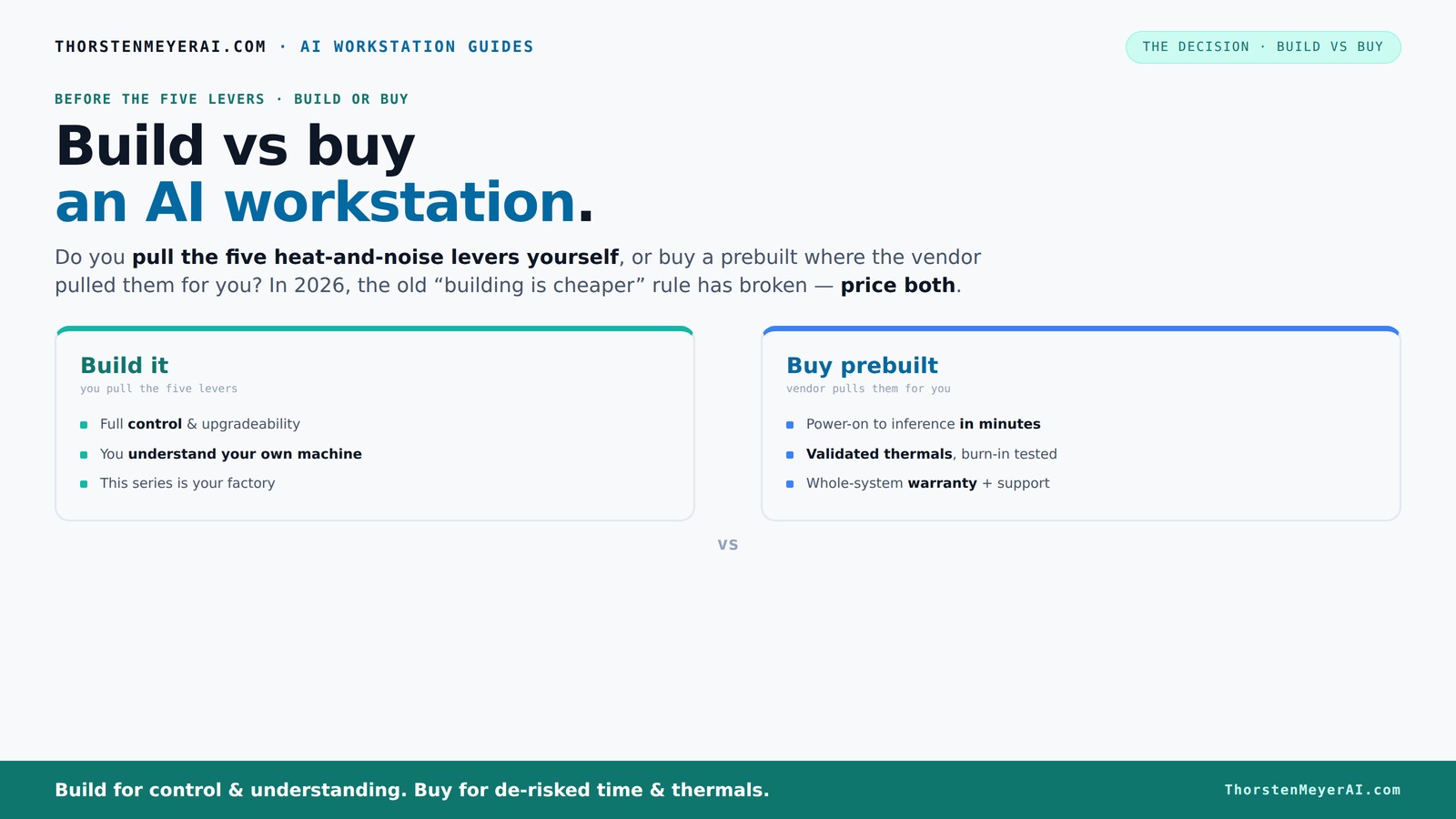
Build vs buy
an AI workstation.
The real question behind this whole series: do you pull the five heat-and-noise levers yourself, or buy a prebuilt where the vendor pulled them for you? And in 2026, the old “building is cheaper” rule has broken. Match your situation in Part 3.
Key Takeaways
- Component shortages in 2026 make prebuilt workstations often as affordable as, or cheaper than, DIY builds.
- Prebuilt vendors validate thermals and support, reducing risk and setup time for demanding AI workloads.
- Building offers unmatched customization and learning, but requires time, expertise, and troubleshooting skills.
- Consider your workload: training large models favors validated, high-end prebuilt systems; inference can be more flexible.
- Long-term upgradeability and support are easier with prebuilt systems, but DIY allows tailored hardware and future tweaks.

HELLOLAND Ocean of Stars AI Gaming PC Desktop - RTX 5070 12GB - AMD Ryzen 7 9700X- 16GB DDR5 RAM- 1TB PCIe +2TB SATA SSD- 850W PSU- WiFi + BT- Windows 11 -RGB Lights with Software Control - White
- Powerful Ryzen 7 Processor: 8 cores, 16 threads, up to 5.5GHz
- High-Performance RTX 5070 GPU: 12GB VRAM, 4K-ready, ray tracing
- Fast DDR5 RAM: 16GB for multitasking and heavy workloads
As an affiliate, we earn on qualifying purchases.
As an affiliate, we earn on qualifying purchases.
Why the old rule — build cheaper — no longer holds in 2026
Building your own AI workstation used to be a straightforward way to save money. However, in 2026, this advantage has largely evaporated. The main reason is the global component shortages, especially of high-demand GPUs, fast RAM, and power supplies. For more insights, see our homepage about AI tools and workflows. These shortages have driven up component prices significantly. When supply is tight, the cost of individual parts can skyrocket, and sourcing everything at a reasonable price becomes a challenge. As a result, the total cost of a DIY build now often rivals or exceeds that of prebuilt systems.
Moreover, bulk purchasing by established vendors like Lambda and BIZON allows them to negotiate better prices and secure components more reliably. They also have the advantage of supply chain leverage, enabling them to offer systems at competitive prices despite rising component costs. This shift means that the traditional wisdom — that building your own system is always cheaper — no longer applies in the current market, and understanding the build vs buy tradeoff is more important than ever. Instead, the real value lies in understanding the tradeoffs: time, support, and customization.
So, before you start sourcing parts, it’s critical to compare actual costs carefully. In many cases, a prebuilt system can deliver similar or better performance at a comparable or lower price, with the added benefit of warranty and support. The landscape has fundamentally changed, and being aware of these dynamics can help you make smarter decisions.

AI Systems Performance Engineering: Optimizing Model Training and Inference Workloads with GPUs, CUDA, and PyTorch
As an affiliate, we earn on qualifying purchases.
As an affiliate, we earn on qualifying purchases.
The five levers: who pulls them — you or the vendor?
Managing thermal performance in a high-powered AI workstation is not just about choosing the right hardware but also about fine-tuning how that hardware operates under load. The five critical levers—undervolting the GPU, matching the cooler, optimizing airflow, tuning fans, and proper placement—are essential to balancing performance, noise, and thermal stability. How you handle these can significantly impact your system’s longevity and efficiency.
Buy a prebuilt: the vendor takes on these tasks for you. They extensively test and tune thermal solutions, often incorporating advanced cooling methods like water-cooling or custom airflow designs. This results in a system that is factory-optimized, delivering maximum performance with minimal noise and thermal throttling. For example, Lambda’s systems are engineered to operate 30% cooler and quieter than typical DIY setups, validated through rigorous testing. This proactive thermal management ensures your AI workloads run smoothly without unexpected slowdowns or hardware failures, saving you time and reducing stress.
Build it yourself: you assume the responsibility. You select your cooling solutions, undervolt your GPU using software, and manually tune fans and airflow. While this offers the advantage of customization—such as choosing ultra-quiet fans or custom water loops—it also requires a certain level of expertise and patience. The process involves trial and error, and the risk of thermal issues or noise problems increases if not done carefully. However, this approach provides deep control over your system’s behavior, which can be valuable if your workloads have specific cooling or noise requirements.
The key tradeoff is control versus convenience, which is why many turn to prebuilt solutions for reliability. Prebuilts handle the thermal management for you, ensuring reliability and performance consistency, while DIY gives you the flexibility to customize but demands more effort and technical skill. Your choice depends on whether you prefer to spend time fine-tuning or want a ready-to-run system that just works.

MINISFORUM MS-S1 Max Mini Workstation AMD Ryzen AI Max+ 395(16C/32T) 64GB LPDDR5 2TB SSD Mini PC, HDMI+2X USB4+2X USB4 V2 Video Output, 2x10G RJ45 Port, WiFi7, BT5.4, Radeon 8060S Graphics Computer
- Processor: AMD Ryzen AI Max+ 395 with 16C/32T
- Performance: Up to 126 TOPS CPU, 50 TOPS NPU
- Graphics: AMD Radeon 8060S RDNA 3.5 architecture
As an affiliate, we earn on qualifying purchases.
As an affiliate, we earn on qualifying purchases.
Defining Your Needs: Assessing Performance, Budget, and Expertise
Before deciding whether to build or buy, it’s essential to clearly define your specific needs. Are you working on large-scale AI training that demands maximum GPU power and extensive support? Or are you running inference tasks where flexibility and cost-effectiveness are more important? Your workload type influences which option makes the most sense.
Additionally, consider your budget. While prebuilt systems might seem more expensive upfront, the hidden costs of building—such as time investment, troubleshooting, and potential hardware failures—can add up. Conversely, DIY offers customization but requires technical expertise and patience. Evaluate your own skills and resources honestly to determine if you’re better suited for hands-on assembly or a turnkey solution.
Finally, think about future scalability. Do you anticipate needing to upgrade components frequently or expand your system? Prebuilt systems often have limited upgrade paths, especially compact models, whereas DIY builds can be tailored for future tweaks and expansions. Balancing these factors helps ensure your choice aligns with your long-term goals and capabilities. For more guidance, visit Funigy’s entertainment and tech ideas.
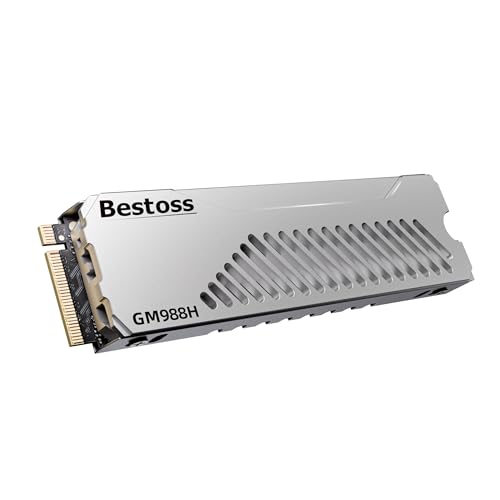
Bestoss 1TB PCIe Gen4 NVMe M.2 2280 SSD with Heatsink,PS5 Storage,7350MB/s
- Explosive Speed: 7350MB/s read speed for fast loading
- Compatibility: Supports PS5 and real-time 3D rendering
- Stable Performance: HMB + SLC cache for reliable operation
As an affiliate, we earn on qualifying purchases.
As an affiliate, we earn on qualifying purchases.
Frequently Asked Questions
Is it cheaper to build or buy a prebuilt AI workstation?
In 2026, component prices and shortages have closed the gap, making prebuilt systems often as affordable or even cheaper than DIY. Always compare specific configurations before deciding.Which option is better for AI model training versus inference?
Training large models benefits from validated, high-end prebuilt systems with robust cooling and support. For inference or small experiments, building your own can be more cost-effective and flexible.How many GPUs do I need for my workload?
It depends on your project. Large-scale training might need 4-8 GPUs, while inference can often run well on a single high-end GPU. Consider your VRAM needs and scalability.What specs matter most: GPU VRAM, system RAM, CPU, storage, PSU, or cooling?
GPU VRAM and cooling are critical for performance and thermal stability in AI workloads. CPU and RAM matter for data handling, but the GPU’s memory often sets the limit.Can I upgrade a prebuilt workstation later?
Upgrade options vary by system. Many prebuilts allow adding or replacing RAM and GPUs, but some compact models limit upgrades. Check vendor policies if future expansion matters.Conclusion
Choosing between building and buying your AI workstation in 2026 isn’t just about saving money — it’s about the right fit for your speed, control, and support needs. The days of automatically saving a buck by DIY are fading, replaced by smarter decisions based on your project’s demands.
Remember, your ideal setup is the one that gets your AI work done without surprises. Whether you build or buy, focus on what matters most: performance, reliability, and peace of mind. Your next AI breakthrough starts with the right machine — make it count.