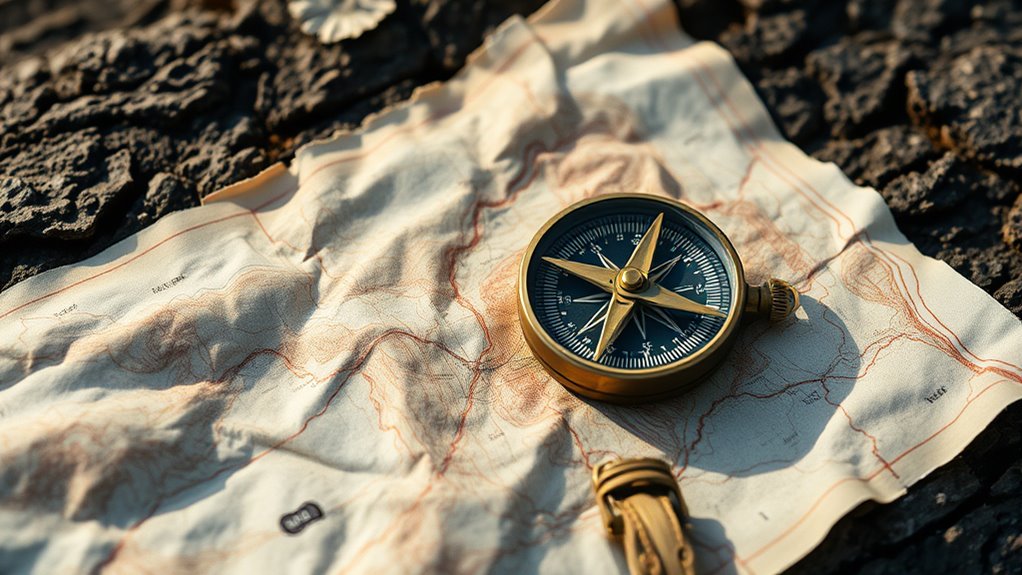

When orienting without a signal, rely on natural landmarks like mountain peaks or distinctive trees to create mental maps and confirm your location. Use the sun and stars to find direction—note that the sun rises east and sets west, while Polaris points north at night. A compass and map help you align your surroundings and verify your position. Knowing these basics and practicing them can make you confident—you’ll discover more techniques if you keep exploring.
Key Takeaways
- Use natural landmarks like mountain peaks or distinctive trees to confirm your location on a map.
- Orient your map with a compass to align it with the landscape or celestial cues for accurate navigation.
- Identify celestial objects, such as Polaris or stars, to determine true north and maintain direction at night.
- Recognize that weather and environmental conditions may obscure landmarks and celestial cues, affecting navigation.
- Practice navigation skills regularly to improve confidence and reliability in signal-free environments.
Navigation Without Signal
When your GPS signal drops in remote areas or during emergencies, knowing how to navigate without digital assistance becomes essential. In such situations, relying on natural landmarks and celestial navigation can be your best tools. Natural landmarks, like prominent rock formations, distinctive trees, or mountain peaks, serve as visual cues that help you determine your location and direction. By paying close attention to the landscape around you, you can create mental maps that guide you toward safety or your intended destination. Remember, landmarks that stand out are easier to recognize and remember, making them reliable references even in challenging conditions.
In emergencies, natural landmarks help you navigate when GPS signals fail.
Celestial navigation offers another indispensable method when visual cues are limited. By understanding how to read the night sky, you can determine your position and direction without a GPS. The key is knowing the position of the sun during the day and the stars at night. For daytime navigation, the sun rises in the east and sets in the west, so tracking its position can help you maintain your course. At night, familiar constellations like the Big Dipper or Orion can act as celestial signposts. The North Star, Polaris, is especially useful for finding north in the Northern Hemisphere. If you can identify Polaris, you instantly know which way is north, and from there, you can orient yourself and plan your route accordingly.
Using a map and compass effectively requires understanding how to interpret natural features and celestial cues. To start, orient your map with the compass so that it aligns with the landscape or sky. Then, identify natural landmarks visible from your current position and match them to your map. If you’re at a known point, like a river bend or a mountain peak, you can use these features to confirm your location. When navigating at night, locate Polaris to establish your north-south line, then use your compass to determine your heading. Keep in mind that natural landmarks can change with weather conditions or seasons, so cross-reference multiple cues whenever possible. Practicing these skills before you find yourself in a critical situation is vital. Spend time learning to recognize key landmarks in your local area and practicing celestial navigation techniques on clear nights. Additionally, understanding basic navigational tools such as a compass and map can greatly improve your ability to stay on course. With patience and attention to detail, you’ll develop confidence in your abilities to navigate reliably without relying on digital signals. This knowledge not only enhances your safety but also deepens your connection to the natural world, making your outdoor adventures more enriching and self-reliant.

Proster IP65 Compass Hiking Survival – Lensatic Sighting Compass for Camping Navigation, Compass with Clinometer & Carry Bag for Camping Hunting Hiking Geology Activities
Sighting Compass for Hiking Survival: 330grams professional metal compass with allows you to read datas directly, and the…
As an affiliate, we earn on qualifying purchases.
As an affiliate, we earn on qualifying purchases.
Frequently Asked Questions
How Do I Calibrate a Magnetic Compass in Different Terrains?
You calibrate a magnetic compass by first avoiding areas with magnetic interference, like near metal objects or electronics. In different terrains, perform a figure-eight motion to resolve local magnetic anomalies, and keep the compass level. Be aware that terrain considerations, such as mountains or valleys, can affect readings; recalibrate periodically to guarantee accuracy. Always check your compass against a known direction before steering in unfamiliar terrain.
Can I Use a Map and Compass Without Prior Navigation Experience?
Yes, you can use a map and compass without prior navigation experience. Start with basic orientation by identifying your surroundings and matching them to map symbols. Practice reading the map, understanding key features, and using the compass to find directions. Take it slow, double-check your bearings, and stay aware of your environment. With some patience, you’ll improve your skills and navigate confidently even without prior experience.
What Are Common Mistakes to Avoid When Navigating With a Compass?
When orienting with a compass, avoid common mistakes like improper alignment and magnetic interference, which can steer you off course like a ship caught in a storm. Always guarantee your compass is level and away from metal objects and electronics, as these cause magnetic interference. Double-check your bearing and keep it steady to prevent misdirection. Misreading the compass or not adjusting for declination also leads to errors, so stay attentive.
How Does Magnetic Declination Affect Compass Readings?
Magnetic declination, or magnetic variation, affects your compass readings by showing the difference between magnetic north and true north. If you don’t account for it, your directions could be off. Compass deviation caused by nearby metal objects can also skew readings. Always check local magnetic variation and adjust your compass accordingly, ensuring accurate navigation. Ignoring these factors might lead you off course, especially in unfamiliar terrain.
What Are Alternative Tools if My Compass or Map Fails?
If your compass or map fails, you can use celestial navigation by observing the sun, stars, or moon to determine direction. Trail markers like cairns, blazes, or stamped signs also help you stay on course. Combining celestial navigation with trail markers allows you to verify your route, especially in remote areas. Practice these skills beforehand to guarantee you can navigate confidently when electronic tools aren’t available.

Great Smoky Mountains National Park Day Hikes Map (National Geographic Topographic Map Guide, 1702)
As an affiliate, we earn on qualifying purchases.
As an affiliate, we earn on qualifying purchases.
Conclusion
Without signals, navigation becomes your compass’s true test—like sailing through fog with only the stars to guide you. By mastering map and compass skills, you’re charting your own course, no matter how uncertain the terrain. Remember, the wilderness isn’t against you; it’s an open book waiting for your careful reading. Trust your tools, sharpen your skills, and you’ll find your way home, even when technology can’t lead the way.

Celestial Navigation: A Complete Home Study Course, Second Edition
As an affiliate, we earn on qualifying purchases.
As an affiliate, we earn on qualifying purchases.

Compasses,Hiking Compass for Survival with ,Waterproof Durable and Pocket-SizedTactical Survival Compass with Lanyard,Climbing Biking Exploring Geology, Outdoor Activities
TAKING BEARINGS EASILY – Build with an optical eyepiece for sighting bearings easily, with azimuth 360-degree and reversed…
As an affiliate, we earn on qualifying purchases.
As an affiliate, we earn on qualifying purchases.