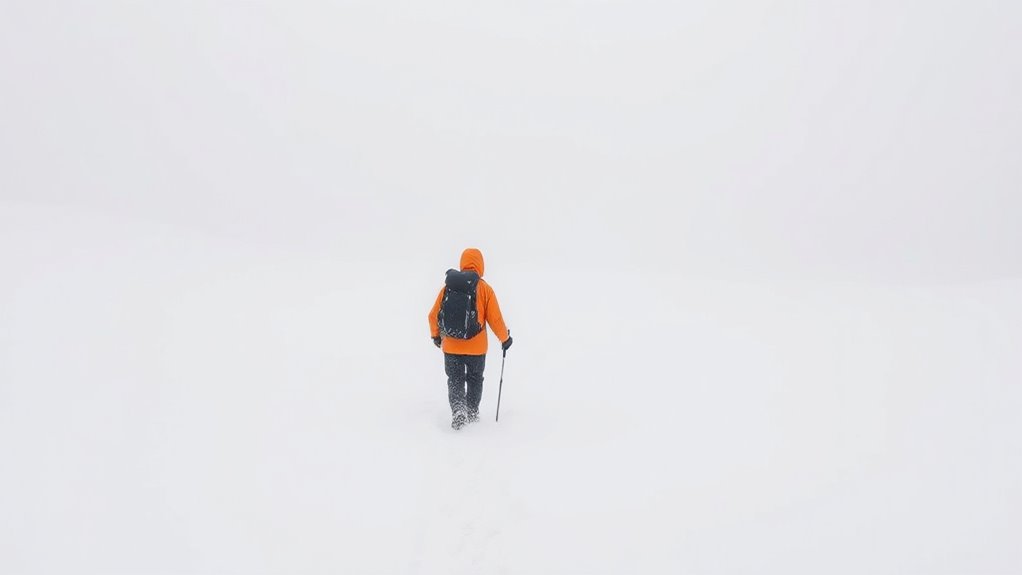

In whiteout conditions, staying oriented relies on your navigation tools like a compass or GPS since visual cues are unreliable. Protect your maps from moisture and wind, and memorize key landmarks beforehand to help guide you. Follow known routes or trail markers discreetly with reflective tape or waypoints. Move steadily, avoid sudden turns, and stay alert to environmental cues like wind or sound. If you keep these strategies in mind, you’ll better navigate through low visibility environments.
Key Takeaways
- Rely on a compass or GPS to maintain accurate orientation when visual cues are obscured.
- Use pre-memorized landmarks and known routes to navigate safely through snow-covered terrain.
- Mark your trail with discreet, reflective indicators to help retrace your path if needed.
- Move deliberately at a steady pace, avoiding sudden turns to prevent disorientation.
- Stay alert to environmental cues like wind, sound, and temperature changes to supplement navigation efforts.

When visibility drops to nearly zero during a whiteout, wayfinding becomes incredibly challenging, forcing you to rely on instinct and careful planning. The snow-covered landscape blends seamlessly into the sky, creating a phenomenon known as snow camouflage. This effect makes it difficult to distinguish between the ground and the horizon, so your surroundings appear as an endless, featureless expanse. Atmospheric conditions play a significant role here, as blowing snow, high winds, and fluctuating temperatures can intensify the whiteout, reducing visibility to mere inches. These conditions can be unpredictable, so it’s crucial to understand how they influence your environment and to adapt your navigation techniques accordingly.
Whiteouts blend snow and sky, making terrain indistinguishable and visibility nearly zero, requiring careful planning and reliable navigation tools.
In a whiteout, familiar landmarks vanish under a blanket of snow, and the terrain’s subtle contours are obscured. With snow camouflage in effect, even prominent features like trees, rocks, or trail markers become indistinguishable, forcing you to depend on other cues. You might focus on the feel of the wind or the sound of the environment, but these are unreliable in isolation. Instead, you need to plan ahead, using tools like a compass or GPS device to maintain your sense of direction. If you’re carrying a map, keep it protected from moisture and wind, and try to memorize key landmarks before conditions worsen. When wayfinding in atmospheric conditions where snow camouflage is prevalent, it’s vital to trust your tools and your sense of orientation, rather than visual cues alone.
Your posture and movement also matter. Move deliberately, avoiding sudden changes in direction that can lead you astray. Maintaining a steady pace helps conserve energy and keeps your bearings consistent. If possible, follow a known route or trail before the whiteout hits, so you have a mental map to rely on. Marking your path with small, discreet indicators—like a piece of reflective tape or a GPS waypoint—can prevent you from unintentionally wandering off course. Recognize that atmospheric conditions may change rapidly, so stay alert for shifts in wind or snow patterns that could signal a change in weather or terrain.
In such extreme conditions, your safety depends on preparation and awareness. Understand how snow camouflage and atmospheric conditions impact visibility, and use every available resource to stay oriented. Trust your navigation tools, move cautiously, and keep a mental picture of your surroundings. With careful planning and a calm approach, you can navigate through a whiteout and reach safety, despite the challenges posed by the snow-covered landscape and its ever-changing atmospheric conditions.

Garmin 010-02256-00 eTrex 22x, Rugged Handheld GPS Navigator, Black/Navy
Explore confidently with the reliable handheld GPS
As an affiliate, we earn on qualifying purchases.
As an affiliate, we earn on qualifying purchases.
Frequently Asked Questions
How Can I Prevent Panic During Whiteout Conditions?
To prevent panic during whiteout conditions, focus on mental conditioning and stress management techniques beforehand. Stay calm by trusting your training, take slow, deep breaths, and remind yourself that you can handle the situation. Keep your movements deliberate and avoid rushing. Visualize your navigation plan and stick to it. Maintaining a positive mindset and practicing these strategies reduces panic and helps you stay composed until you reach safety.
What Are the Best Clothing Choices for Whiteout Navigation?
To navigate whiteout conditions effectively, you should wear thermal layers to stay warm and maintain energy, plus waterproof gear to stay dry and prevent hypothermia. Opt for bright-colored clothing to increase visibility and help others find you. Layering ensures flexibility, while waterproof pieces defend against snow and moisture. With proper clothing, you’ll stay comfortable, focused, and better equipped to stay oriented in low visibility situations.
How Do Animals Navigate in Whiteout Environments?
Animals adapt astonishingly in whiteout environments by leveraging their keen senses. You can observe that many rely on animal homing instincts, using familiar scents, sounds, or landmarks to find their way. Their sensory adaptation helps them detect subtle environmental cues, like magnetic fields or vibrations, guiding them through the whiteout’s whiteness. This remarkable ability guarantees they navigate safely, even when visual references vanish, showcasing nature’s incredible resilience and resourcefulness.
Are There Specific Mental Exercises to Improve Whiteout Orientation?
You can improve whiteout orientation by practicing mental visualization and enhancing your spatial awareness. Regularly imagine traversing unfamiliar environments, focusing on landmarks and your surroundings. Engage in exercises like mentally mapping routes or recalling detailed scenes to sharpen your spatial awareness. These mental practices help you stay oriented during low visibility, making it easier to maintain direction and confidence in whiteout conditions.
What Are Common Mistakes to Avoid While Navigating in Low Visibility?
Imagine you’re sailing through fog, avoiding false stars. Don’t misjudge distances or rely solely on visual cues, or you might drift off course. Stay calm and use your compass and instruments, just like a captain trusts their navigation tools. Avoid rushing or making assumptions based on limited sight. Always double-check your bearings, stay methodical, and remember that in whiteouts, patience and proper technique keep you safe and on track.

Coghlan's Carabiner Compass with Liquid-Filled Design, Luminous Directional Markers, Built-in Carabiner – Compact, Lightweight (1.2 x 2.7 x 0.4 in, 0.6 oz) for Hiking and Camping Navigation
Liquid-filled compass: Ensures reliable navigation with smooth and accurate directional readings, making it a must-have tool for hiking…
As an affiliate, we earn on qualifying purchases.
As an affiliate, we earn on qualifying purchases.
Conclusion
So, next time you find yourself in a snowy hush, trust your instincts and keep your senses sharp. Embrace the quiet, let your experience be your guide, and remember that even in the softest veil of white, a steady mind and careful steps can lead you safely through. With patience and calm, you’ll navigate the gentle obscurity, emerging on the other side with confidence, ready to face whatever adventures lie ahead.

Rocky Mountain National Park – 2021 Topographic Hiking Map
Waterproof, tear-resistant, 1:50,000 scale with a compact 4"x7" folded size for your pocket
As an affiliate, we earn on qualifying purchases.
As an affiliate, we earn on qualifying purchases.

Amylove Trail Markers Reflective Trail Marker Pack Bright Trail Marking Reflectors for Hunting Hiking Driveway Camping Walking Backpacking Outdoors, Blue Green Red and Yellow (80 Pcs)
Large Amount for You to Use: you will receive 80 pieces of trail markers in 4 colors, 20…
As an affiliate, we earn on qualifying purchases.
As an affiliate, we earn on qualifying purchases.